You’ve probably seen the Venn diagram: one circle for SEO, one for AI, a nice overlap in the middle where the conference talks happen. I used to draw it that way too. Well, the truth is that SEO has been swallowed by AI, and everything you do in search now sits inside that bigger bubble. When Ross Hudgens of Siege Media came on my show, he agreed, and then spent the hour showing what that means for how you sell, staff and measure SEO. If you run an agency or consult on your own, here’s what I took from it.
You can’t sell SEO as a count of deliverables anymore
If your proposal says four blog posts, two backlinks and three optimized pages a month, your client can type four prompts and get the blog posts in four minutes. Then they ask the obvious question: why do I need an SEO?
For years you could win that argument by talking about backlinks and anchor text distribution until the client’s eyes glazed over and they signed the budget. That doesn’t work when they can ask an AI tool the same question. What still works is strategy, and the reach to carry it into other departments: email, PPC, PR. If you’re sitting back delivering X blog posts and X optimized pages, your SEO model is outdated.
Ross got there from the agency side. Siege moved from content marketing agency to organic growth agency to full-service GEO agency, and when I asked if that was cosmetic, he said “foundational.” His take on the job now:
“It’s more of an account management function than it ever has been.”
His account managers own which services each client gets and which prompts Siege tracks. That’s the lever worth copying: decide who owns the call, then build the tool stack around them.
The signals you used to get for free are now the whole game
Reviews, brand mentions, community, comparison content. You always benefited from them indirectly. Ross put it well: great reviews on a brand-plus-reviews search probably kept someone from bouncing back to Google, which may have helped your rankings. Now LLMs read those signals directly.
Mordy Oberstein was preaching brand long before most of us listened. It’s the same idea I wrote about in authority is what others say about you, and Ross has data behind it. Siege’s correlation study across client transactional pages found that sites with versus articles were the most likely to have AI search traffic. His other finding is sharper. A client ranking on page one for “best X” still missed the AI Overview, and Ross thinks it’s because they called themselves best overall. Nobody else can vote for you as “best for small business” if you already claimed everything.
Borrowing from Matt Brooks, here’s how you should think about it: Claude, ChatGPT and Perplexity have appointed themselves your off-site customer service reps. You can let them wing it, or you can train them. Ross’s version is “CRO is GEO” — put the case studies, data and reviews on your home, about and product pages so the model doesn’t have to go looking. If your about page is five headshots and a mission statement, go fix it this week.
The bots have wallets now
“Write for humans, not bots” was good advice when bots only indexed you. Now some of them are shopping. I covered this in robots with wallets, and Ross’s answer was practical: build long-tail use case pages that go a layer deeper than you used to. Take the words customers use in your reviews, match them to keyword data, and build pages that “educate that robot buyer.”
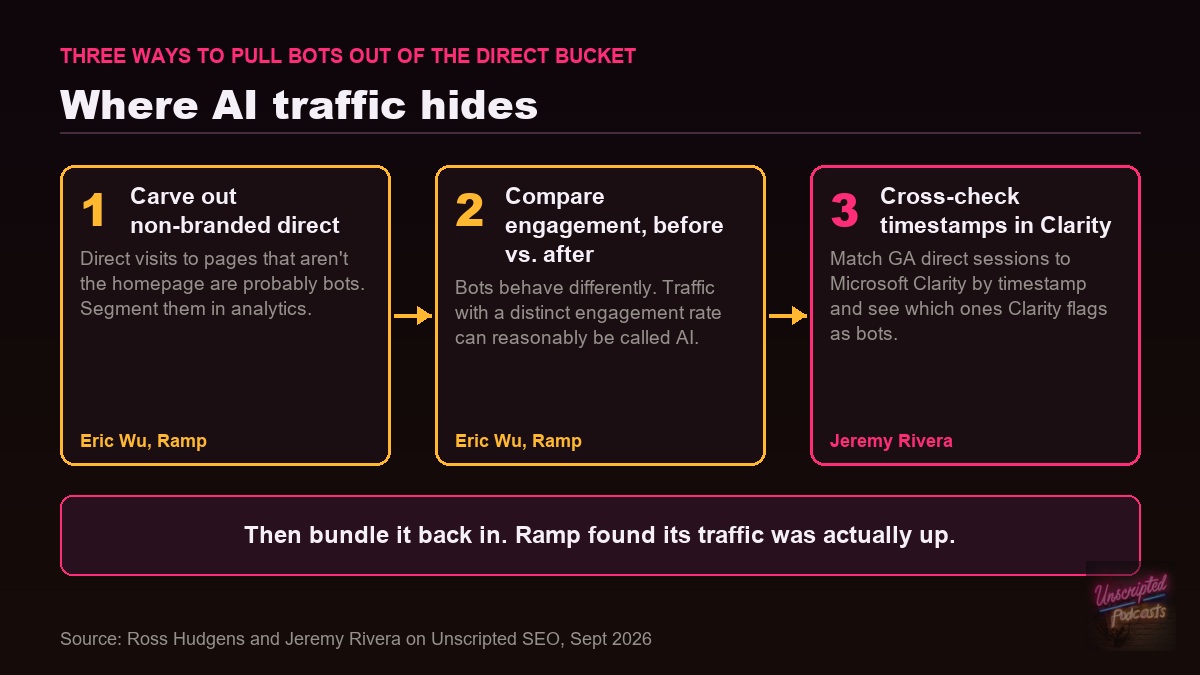
You also need to see them. I connected Claude Code to Google Analytics, Search Console and Microsoft Clarity while chasing dark clicks, and found visits GA called direct that Clarity flagged as bots, matched by timestamp. Ross shared how Eric Wu at Ramp handles it: treat direct traffic to non-branded, non-home-page URLs as probably bots, and carve it out. Neither method is perfect. Both beat pretending your direct bucket is all humans.
Get in the room before the launch, not after
Here’s the story I told Ross that still makes me want to scream into a pillow. I spent months on retainer optimizing a site for a very large company. At launch, the PR team and the CEO decided not to disclose the domain. NBC and the Wall Street Journal covered it. None of the coverage linked to the site. The brand still won because no competing entity shared the name, but every backlink it has today is one I scraped together outside that PR push.
Ross gave me the other side, from Siege’s VP of PR. If you want a publisher covering you for ten years, asking them to add your link can cost you more than the link is worth. He’s a former link builder, and it changed his mind.
Both stories say the same thing to you: the SEO has to be in the room when those calls get made. The same goes for PPC. Lisa Raehsler walked me through AI Max, which sends ad traffic to pages Google picks from your site. As I understand it, it becomes the default by February 2027. That makes your organic page the PPC landing page, and makes the PPC team your new best friend.
AI slop is a gift to good SEOs
The kids in my homeschool co-op spotted an AI-generated music video in seconds. My wife drove past an AI billboard and decided on the spot she wasn’t going. People catch the uncanny valley fast, and Ross thinks AI tropes are already backfiring in tight tech circles. He pointed to Darren Shaw’s post about the “eyebrow,” a design trope that was best practice until every AI deck started using it.
Meanwhile, one of my agency partners had a client build 34 pages over a weekend and ask to put them all on the site. You can’t just slap those up. As Brett Schklar told me, AI didn’t come for your job, it came for your tasks. The flood of small-business AI adoption hasn’t hit yet. When it does, Ross called it “pretty bullish for SEOs,” because there’s going to be a lot of bad work to clean up. The skill that’s left, as he put it, “will become taste.”
So ask yourself a few things before your next proposal goes out. Which of your deliverables could a client prompt in an afternoon? Who on your client’s team decides what the PR release links to, and have you ever met them? Does your own about page say what you’re best for, or that you’re best at everything? If you want more of Ross’s answers, his book Generative Engine Optimization: The Definitive Guide to AI SEO is out from Wiley on October 12, and he’s easy to find on LinkedIn. I call the whole thing search everywhere optimization. Go do some of it.