I first used AI tools back in 2015, long before anyone called them generative. So when Dr. Gleb Tsipursky told me on Unscripted Small Business that, according to the Pew Research he cites, only 9% of people are more excited than anxious about AI tools, I knew which camp I’m in. I told him so: “I’m very much in that nine percent pushing for adoption for it.”
Gleb’s point, and the reason he wrote The Psychology of AI Adoption at Work: From Resistance to Results, is that the 9% are usually the ones signing the checks. If you own a business and you love AI, you’re the least reliable judge of how your team feels about it.
You can watch the full episode or listen on Castos.
Being excited about AI is a blind spot when you’re the owner
Gleb is a behavioral scientist, CEO of Disaster Avoidance Experts, and runs an eight-person consulting firm himself. He called the problem an empathy gap: the owner’s gut says this is great, and the team’s gut says something else entirely.
“But when you show it to your employees, they’re not thinking this is an awesome thing that will take my business forward. That’s an ownership mindset. That’s a mindset for the business owner.”
He’s been on the wrong side of this himself. When I asked how eating his own dog food went, he admitted he was “doing too much of the demoing of cool AI use cases” until he watched his employees’ faces. His earlier book, ChatGPT for Leaders and Content Creators, came out around January 2023 and resonated with owners and solopreneurs. His own staff heard something else: “this is going to replace me.”
What helped him was not trusting his own read:
“because I don’t trust my intuitions nearly as much, because I know my intuitions will lead me astray.”
That one stuck with me. I’ve been in digital marketing long enough to watch plenty of tools get oversold, and I still assume everyone sees what I see in a new one.
The paycheck mindset isn’t a flaw you can coach out
Toward the end I asked Gleb something I’ve wondered about. As a solopreneur, I’m wired to constantly innovate and execute. A lot of people aren’t, and that’s fine. They like predictability, they like systems they know, they’re there to do good work and get a paycheck. I wanted to know whether that maps to Myers-Briggs or anything like it.
He said no, it’s a different thing:
“what you’re talking about is ownership mindset. You own your work, you get direct business benefits from doing so.”
The people resisting AI are on the other side of that line. “They are there for the paycheck, right?” And if you believe a tool is training your replacement, Gleb says, not using it well is the logical move. You comply, you press the button, you send out polished output without the right data, and when your boss complains you say you did what you were told.
“It’s rational, like it’s not dumb.”
From the employee’s chair, it’s a reasonable response to an owner who keeps showing off how much work the new tool can do.
Handing fifty people guitars
The analogy I came up with during the interview: rolling out AI is “like handing fifty people guitars and saying, Go for it.” A few have a natural feel for it. Most aren’t good on the first couple of strums and get hesitant.
Gleb’s version is more specific. AI isn’t a CRM, where you can write one SOP and check everyone follows it. Each person has to shape it around their own workflow:
“It’s kind of like hiring an executive assistant for yourself.”
You can’t stand over someone’s shoulder and check if they’re using their executive assistant correctly. So the motivation has to come from them, and fear kills it. That lines up with what Matthew Fornaro told me about running a lean firm: AI replaced his overhead, not his judgment. The judgment part is what your team needs to believe you want from them.
What I’d do as an owner with a team
Gleb’s book splits resistance into three profiles: AI alarmists, pragmatic resistors and reluctant adopters. Here’s the short version of his playbook, in the order I’d run it if you own a small business:
- Put growth in writing. Tell your team you’re using AI to grow, not to cut jobs. Gleb cites a Stanford study finding that more AI-forward companies grew top-line revenue over 9% faster than peers and grew headcount 6% faster.
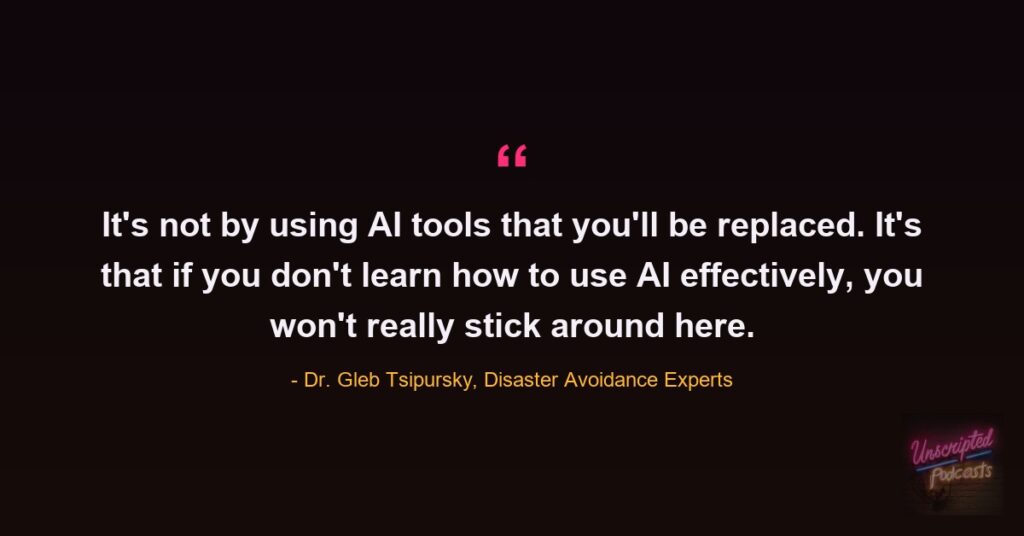
- Flip the script for the alarmists. The people who stay are the ones who learn it. “It’s not by using AI tools that you’ll be replaced,” as Gleb put it.
- Ask what people hate doing. Survey the tasks your team wants off their plate and what blocks the work they’re proud of. Build prompts for those first. He calls it “you go slow to go fast.”
- Show your own use. Talk about how you use AI for emails, sales outreach and performance reviews, so nobody feels they have to hide it.
- Reward sharing. A Slack or Teams channel for AI use cases, and a $25 Starbucks card each month for the best one.
None of these cost much. They mostly cost the owner some humility, and if you’re scaling a team, that’s the same lesson Alan Lazaros taught me about not being the bottleneck.
Stop demoing, start asking
If I had to pick one thing from this conversation, it’s this: the next time you build something cool with AI, don’t show it to the team first. Ask them what they’d want it to do. It’s artificial intelligence, not artificial wisdom, and the wisdom part is on you: knowing the person across the table has a different stake than you do.
Gleb’s book is The Psychology of AI Adoption at Work from Georgetown University Press, and you can connect with him on LinkedIn. For the full episode recap, read Dr. Gleb Tsipursky on the psychology of AI adoption on Unscripted Small Business, and for the marketing-team angle, why marketing teams quietly resist AI tools on SEO Arcade.