You know the sentence. A referral calls from Canada, or a client wants to launch in Germany, and you hear yourself say it: “I’ve done this before.” I’ve said a version of it too. I’m a single-country guy, and if most of your client work also lives inside one market, you know how easy that sentence is to believe. So when Laura Smith, Head of Client Strategy at ICS-digital, told me on Unscripted SEO what the biggest international pitfall is, it landed a little close to home.
“I think the biggest pitfall is thinking, I’ve done this before, so I’ll just do it the way I’ve always done it, and not digging into the market, or even just being open that you don’t know.”
Her agency works in over 100 languages. She still says “I don’t actually know” to clients. If she can, you can.
“I don’t know” is part of the deliverable
Here’s the part you should steal. When ICS hasn’t run a campaign in a given market, Laura tells the client they think it’s possible, and then asks for time to go away and look into it so they feel confident. That’s the whole move. You aren’t admitting weakness. You’re buying the research time you were going to need anyway.
Her proof is a German campaign. She was all in on Twitter because that’s what was carrying the UK version. People who knew the market told her Germans didn’t use Twitter the same way. Then the kicker: “The words are literally too long.” No amount of confidence fixes a character limit.
Laura isn’t fluent in other languages, and she says so. She goes to native speakers. You can do the same thing without an international agency behind you. Ask somebody who lives there before you write the plan.
Your US digital PR playbook won’t cross the Atlantic
This one works in both directions. Laura’s example was UK campaigns heading into the US. In the UK, breaking a data story down by city can get regional pickup. In the US, she said, you can’t just break the campaign down by state and expect state and local media to find it interesting. “It’s a completely different media landscape to what we have in the UK.”
Flip it around and you’ve got every American SEO who assumes a London journalist wants a 50-state ranking. If your PR plan has only been tested in one media market, you don’t have a playbook yet. You have a hypothesis.
I ignored digital PR for years, and you probably did too
I asked Laura if she feels a little na-na-na-boo-boo now that SEOs are finally paying attention to digital PR. I admitted on the show that I’ve ignored it or been siloed out of it. Maybe you’ve found out after the fact that a press release went out with your client’s name on it. She was more generous than you or I would’ve been.
She started in traditional PR, doing B2B, press office and restaurant launches. “I didn’t know what a link was until 2017,” she said, when a head of SEO had to explain it to her. The link-hungry SEOs were always digital PR’s champions. What’s changed, in her view, is “the link to brand”: brand entity, third-party citations and brand mentions all feed AI search now.
If you want the long version of why brand and SEO belong in the same meeting, I worked through it with Mordy Oberstein in lessons on integrating brand and SEO. Laura’s version is shorter. Go talk to your PR people.
An AI answer might only name three brands
The piece of Laura’s work you should read first is the white paper she authored for ICS, The Human-Machine Memory Gap. It’s about what it means to be remembered by people, and why being visible in AI isn’t enough.
“You need to understand why a human is going to choose your brand, which is especially important when an AI might only recommend three brands, compared to previously having the whole of the Google search to look through.”
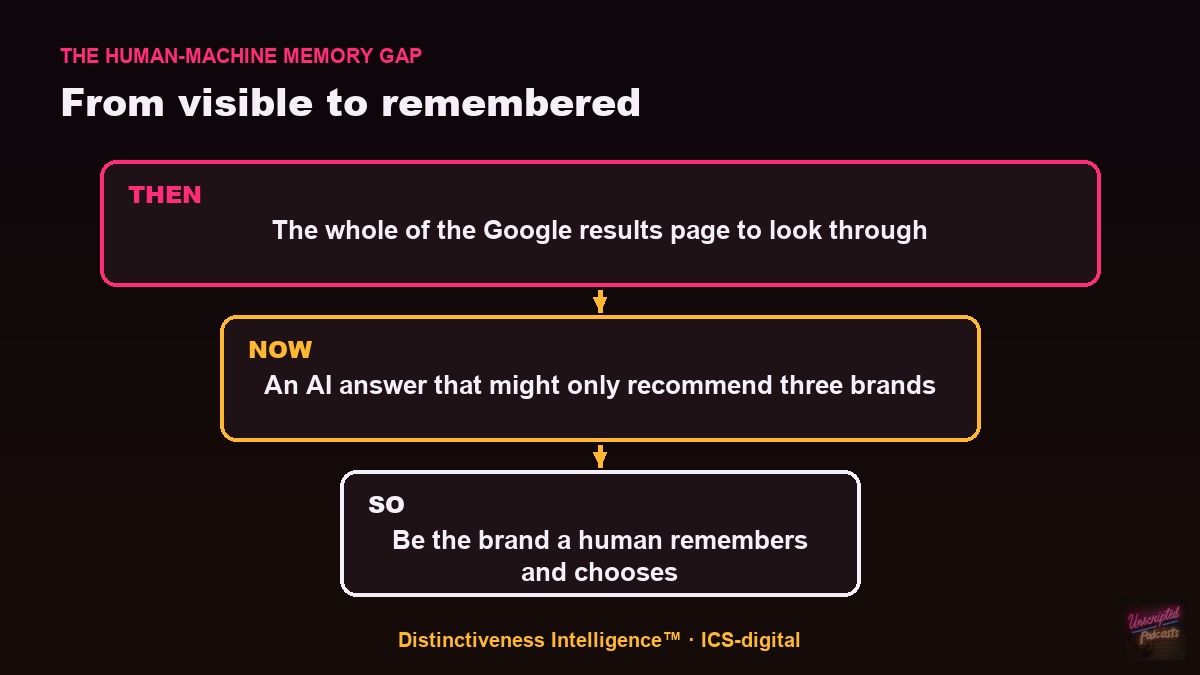
Her framework for it is called Distinctiveness Intelligence. She also wrote The New Shelf Space, which applies the same idea to retail: visibility is moving from search rankings to AI retrieval, and a customer can’t choose what isn’t on the shelf. I’ve been saying for a while that you should measure SEO by revenue, because traffic is a proxy. When three brands make the answer, a rankings report tells you even less.
Authenticity is a practice thing, which is annoying
I asked Laura how a brand stays authentic when it has to onboard lots of people across markets to one message. Her answer wasn’t about brand guidelines. It was about reps.
She started a TikTok this year to teach herself to listen to her own voice without cringing. She used to run her LinkedIn posts through AI. Now she just posts them, because “I think I needed the reps to get to that point.”
“It’s okay if you post something on LinkedIn and it gets no impressions and one like, it’s totally fine.”
You’ll feel that one the first time you hit record. I did at the end of the episode, when I said “like and subscribe” on a video for the first time. It felt awkward. Laura’s verdict: “I think you do have to, but it never stops feeling awkward.” So I said it.
So what’s your “I’ve done this before” right now? Which market, channel or media outlet are you planning around because it worked somewhere else? Who on your team could you ask before you find out the hard way? And when a client asks something you haven’t done, are you going to guess, or say you’ll go find out? Laura is on LinkedIn if you want to see how she’d answer. Go find out.