I didn’t get into SEO the honorable way. In my twenties I was a support rep at a web hosting company, and I built a feature that let customers trade reciprocal links in bulk. It worked a little too well, and it was part of the wave that pushed Google to devalue reciprocal links across the web. Twenty years later, most of the job is still helping people undo well-meaning mistakes like that one.
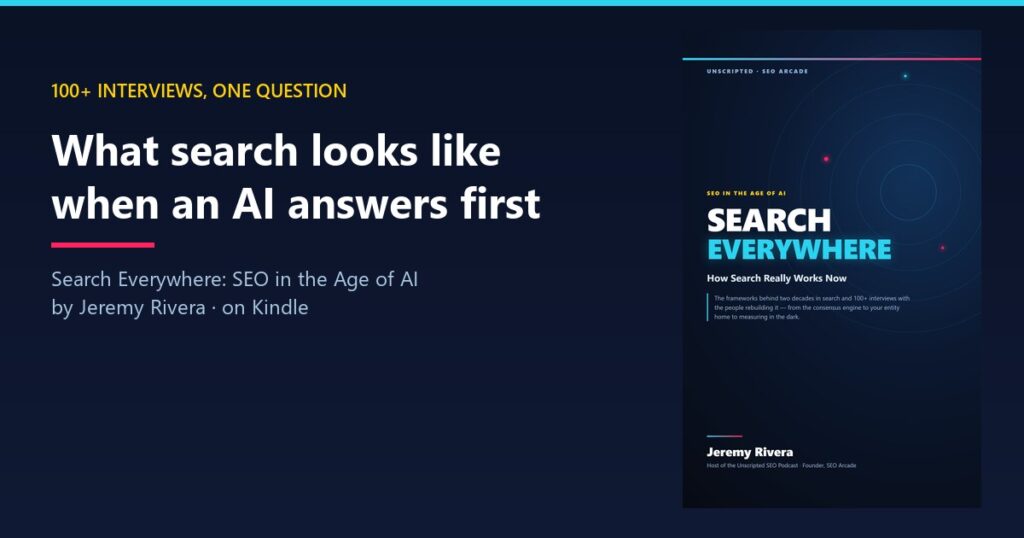
Lately that work runs through interviews: more than a hundred long-form conversations on the Unscripted podcasts, and almost every one circles back to the same question: how does search actually work now that an AI sits between your business and your customer, and what should you do about it? The answer became Search Everywhere: SEO in the Age of AI. Here’s the short version, aimed at you if you run a business or a marketing team and you’re trying to figure out what changed.
The AI recommends whoever the rest of the web vouches for
Traditional SEO was engineered findability: the right keywords, clean technical work, enough links to win. When somebody asks ChatGPT who the best option is, it doesn’t read your homepage and take your word for it. It synthesizes what everyone else says about you — editorial mentions, podcast appearances, reviews, forum threads, citations. In the book I call that the consensus engine.
You can hear it from both ends of the market. Malte Landwehr of Peec AI walked me through how consensus across the web can override what your own pricing page says, and I wrote up what I took away from interviewing Malte. Matt Goren of RunOctopus explained why AI search tends to recommend the expert instead of the biggest brand, which is why ChatGPT never recommends Starbucks for the questions a small business can actually win.
The practical upshot for you: SEO and PR are turning into one job. If you want an AI to recommend you, you need other people talking about you. The same case runs through authority is what other people say about you. AI made it more literal.
If the machine can’t resolve who you are, you don’t show up
Google, and now the LLMs, want to resolve your brand as a thing, an entity in a knowledge graph, not a string of words. One client’s brand name read like an ordinary search phrase, so search simply wouldn’t surface the brand. Their instinct was to rebrand. The real problem was that they had no entity home.
Your About page is your brand’s address in the knowledge graph. The fix is two moves:
- A real, unambiguous About page that says plainly what you are and what you do.
- Third-party authority pointing at it: interviews, mentions and links from sites the machines already trust.
This is also where I reversed one of my own positions. From 2010 to 2020 I dismissed branded search and chased non-branded queries. I was wrong. Branded search is the clearest signal you can send that an entity exists and is wanted. If you want to see how far an entity home plus earned mentions can carry a small brand, read how Ethan Felizzari-Castillo got a knowledge panel without a publicist.
The fundamentals got more expensive to skip
Here’s the part that surprised the people panicking about AI: the old work still matters, because an LLM is partly a wrapper around a search. It fans your question out across engines and filters what comes back. If you can’t be crawled, indexed and ranked, you’ve lost the AI answer before the model reads a word.
Matt Bailey was resubmitting pages to AltaVista before Google existed, and his lesson is the one I’d put in your pocket: SEO dies every two years, and the evergreen skills keep paying. The one fundamental most people ignore is Bing. ChatGPT pulls from the Bing index, so the Bing playbook I actually use now reaches a slice of AI search too.
The bigger version of this idea is search everywhere optimization: keep the letters in SEO, and change the E from engine to everywhere. The full argument is on SEO Arcade in keep the letters, change what the E means.
You’re measuring in the dark, so triangulate
GA4 is Google’s greatest punishment for the SEO industry. Search Console hides query data for a large share of your clicks — I call those dark clicks — and AI assistants have only just started showing up as their own channel in GA4. If you’re waiting for a clean report that proves AI search is working, you’ll wait forever.
What you can do is triangulate. Line up a rank tracker, GA4’s timestamped organic clicks and Search Console’s partial impressions, and assign each click a probable query with a confidence score. It isn’t perfect. It’s a lot better than reporting on the sliver of queries Google chooses to show you, and it’s the kind of measurement you should expect from anyone you hire.
Search when an AI answers first: what to do on Monday
The through-line of all those interviews is that you’re no longer a lone technician tuning a page. You’re the orchestrator of everything a machine might read about you. If you want a short list, start here:
- Make the machines’ job easy: clean, readable pages and an About page that says exactly what you are.
- Do real things in the real world and make sure they get written about, because that’s what the consensus engine reads.
- Fix what’s blocking conversions before you chase more traffic.
- Give every visitor a second option, like a guide or a newsletter, so you own the audience when the AI surface moves on.
If you want to hear the practitioners make these arguments in their own words, start with the Unscripted SEO episodes behind each chapter. If you want the whole framework in one sitting, Search Everywhere is on Kindle now and free on Kindle Unlimited. It’s my second book; you can find both on my author page.
So here’s the question to sit with. When somebody types your category into ChatGPT tonight, who is the rest of the web vouching for? Does your About page tell the machine who you are, or does it make the machine guess? And if the answer worries you, that’s the work I do for clients in AI search.