- 1 ChatGPT sends you to the local coffee shop, not Starbucks
- 2 AI is your customer now, so give it a reason to recommend you
- 3 Write down the questions your installation manager answers every day
- 4 Reviews and mentions are part of your SEO now
- 5 Fifty searches a month is still a job worth winning
- 6 What to do about AI search for your small business this quarter
I’ve been doing SEO for twenty years, and I call 2010 to 2020 the golden age. You edited some meta titles, wrote a few blog posts, grabbed a few backlinks, and you were pretty much on your way. That age is long past. So when Matt Goren of RunOctopus told me on Unscripted SEO that ChatGPT never recommends Starbucks, I heard the best news a small business owner has gotten in years. Here’s why, and what I’d do about it.
🎧 Listen to this episode
📺 Watch the interview
You can hear the whole conversation on the Unscripted SEO Interview Podcast. Here’s what stuck with me.
ChatGPT sends you to the local coffee shop, not Starbucks
Matt’s test is easy to run yourself. Pick a city, or even a town, and ask ChatGPT for the best coffee shop nearby. “And Starbucks is never going to be recommended. It’s always going to be a actual local business.” He says it holds for pizza and for air conditioning too: “Domino’s is not going to be recommended if you go for pizza in Encino, California, whatever.”
That’s Matt’s observation from his own prompting, not a controlled study, and I’d run it in your own market before you bet a budget on it. But it matches what I’m seeing. For twenty years the biggest brand with the biggest link budget had the advantage in Google. In AI answers, you get a shot at the recommendation if you’re the business that actually knows the answer.
AI is your customer now, so give it a reason to recommend you
Matt explains it with a bad knee. You ask a friend if he knows a knee doctor. He’s never been to one, but he heard about somebody. Now that recommendation just got weaker. Ask someone else, and they went to a knee doctor who didn’t help. You’re not going to that doctor. AI recommends the same way people do, so your website has to make the case that you’re the expert. In Matt’s words, the goal is to show you’re “Tom Hanks of acting, you are the champ.”
That rules out the shortcut most small businesses reach for.
“Really just going to [ChatGPT] or Claude and getting an article and putting it up is just not going to cut it.”
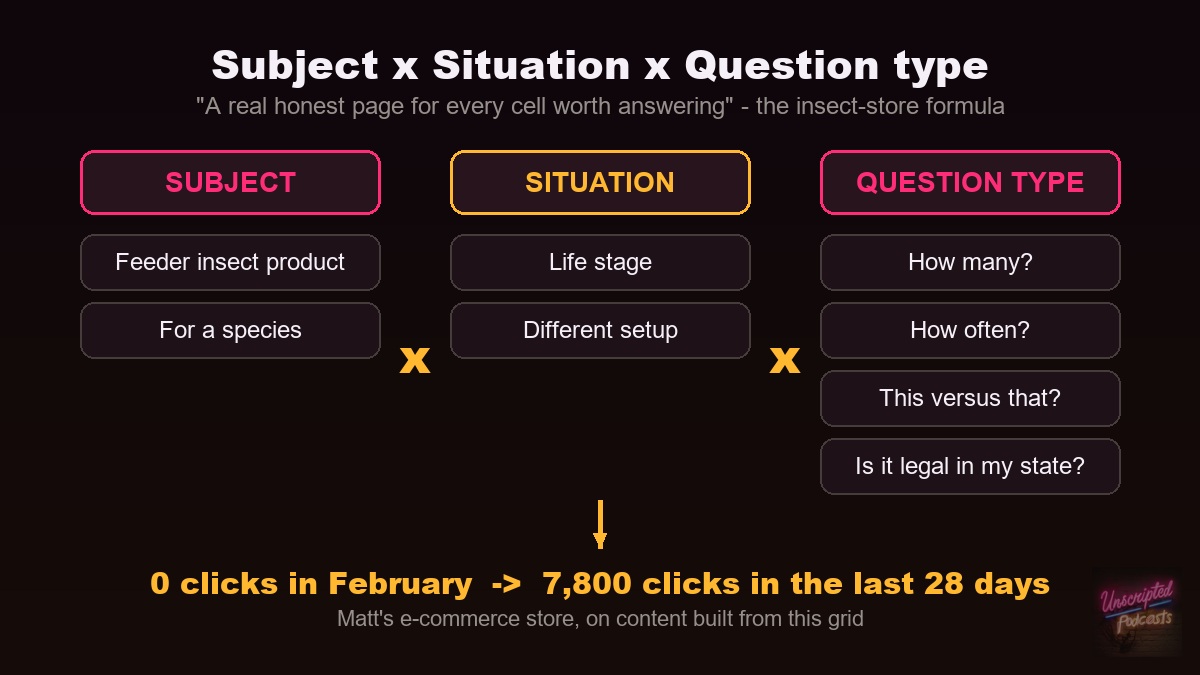
Matt doesn’t think 500, 900 or even 1,000-word articles are enough anymore. He wants encyclopedia-level content, and he built it for his own store, All Angles Creatures, which sold feeder insects to reptile owners. The formula is “the subject, the situation, and the question type, and then a real honest page for every cell worth answering.” He told me the site went from zero clicks in February to 7,800 in the last 28 days.
Write down the questions your installation manager answers every day
You don’t need a tool to start. Matt’s advice is to “start out with just ten questions that you think people would be going to [ChatGPT] and asking” where you’d want to be the answer, then find the variations.
This is where I start with my own clients. I interview the salesperson. I interview the installation manager. What problems come up constantly? What makes customers happy, and what frustrates them? One client I just started working with does holistic lice removal, and my first question was “what are the questions you have to answer every single time they come in?” Those are the pages you’re missing.
When Matt asked me for a business to riff on, I gave him a concrete wall installer in Pensacola, Florida, think Permacast’s precast concrete walls. In about two seconds he had ten pages: walls after a hurricane, how long to wait after a storm, cost in Pensacola, what changes by season, and who to hire for a big project. If your answer to “who’s your customer?” is “everybody,” as I put it on the show: “no bro, you gotta break it down.” Who it’s for, who it’s not for, and what they’re asking.
Reviews and mentions are part of your SEO now
Here’s the one that surprised me most. A new client compared six SaaS products that were roughly equal on backlinks and on Google rankings. Two of them were far more popular in LLM answers, and those two were rated between four and a half and almost five on G2 and similar review sites. The rest sat around three. LLMs also seem to have a good memory for negative reviews, and because the model wants to look fair, it will go find a negative to include in its answer.
Daniel Hebert, the founder of Oleno, described this to me as a decision layer that now sits between your customer and the search results. I see it as a second bite at the apple. You still have to show up in Google, but you can also influence the sources the AI uses to decide.
Matt pointed to Ahrefs’ study of 75,000 brands, which by his read found brand mentions tracked AI visibility about three times more strongly than backlinks. And Ben Wills’ OppAlerts research found links from topically matching pages correlated with AI visibility. Matt’s own summary of what counts: “a mention in the right place by someone with nothing to gain.” For a small business, that’s your reviews, the industry directories your customers read and the people talking about you on Reddit.
Fifty searches a month is still a job worth winning
Google hides a lot of the long questions people ask. In my study of dark clicks in Google Search Console, 64% of clicks on the average site came with no query attached. If you look at a keyword tool, see zero, and move on, you’re walking past real customers.
“Let’s say it’s fifty times a month but it shows zero, it’s like, well we shouldn’t work on it. No, you should.”
Matt’s point is that a concrete wall job is probably worth several thousand dollars, and not many people search for it. Win a few of those fifty searches a month and you’ve paid for the page many times over.
What to do about AI search for your small business this quarter
Here’s where I’d start, based on Matt’s answers and my own client work:
- Run the Starbucks test in your market. Ask ChatGPT and Claude the questions your customers ask, and see who gets recommended.
- Write your ten questions. Get them from your salesperson and the person who does the work, not from a keyword tool.
- Answer each one like the expert. One page per real question, with the local details only you know.
- Go get the reviews. A happy customer’s review is a mention from someone with nothing to gain.
Matt put the timing better than I can: “If you’re putting a pillar in the ground right now and your flag on the on the territory in the real estate, it’s gonna pay off for the next several years.”
For the full episode recap, read Matt Goren of RunOctopus on AI search recommendations on Unscripted SEO. For the agency version, read Matt Goren’s question map method on SEO Arcade. Matt’s at runoctopus.com and on LinkedIn. If you want to see where your own site stands, RunOctopus has a free website scan, and his free book Who the AI Picks goes deep on how the recommendations work.