In 2014 I was very happy in my little box. You run the business, I’ll work on these pages, you’ll get traffic and pay me, and we’re both happy. I admitted as much to Erika Braeger, Director of Strategy at Ten Speed, on her second visit to Unscripted SEO (her first episode is worth your time too). That deal doesn’t fly anymore, and the way Erika works with clients shows you why.
Machines want the same story everywhere
Erika has been telling clients that how you show up across the web has to line up.
LLMs are looking for that confirmation that you’re spoken about in the same way outside of your site that you’re spoken about, that you speak about yourself on your site. — Erika Braeger
That’s a bigger job than on-page SEO. Your reputation management, PR, how the site works and how you treat return customers all become part of what a model reads about you. For a long time SEOs treated Google like an endless ocean where you could always catch more fish, no matter how badly you treated the customers you already had. You can’t count on that now. If you run a SaaS, more of your content should help existing customers than fish for keywords to pull new ones in.
Proof beats promises in the middle of the funnel
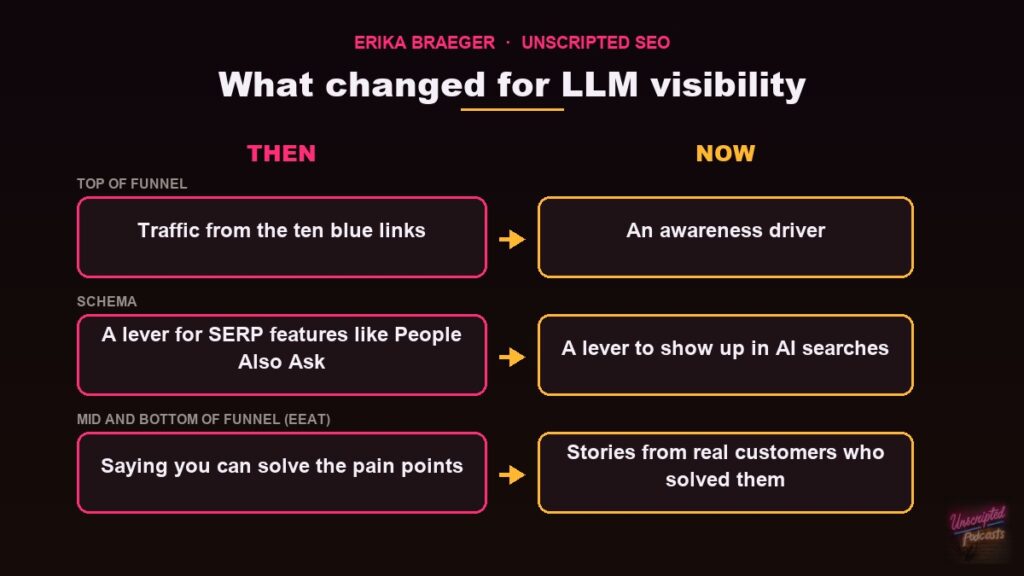
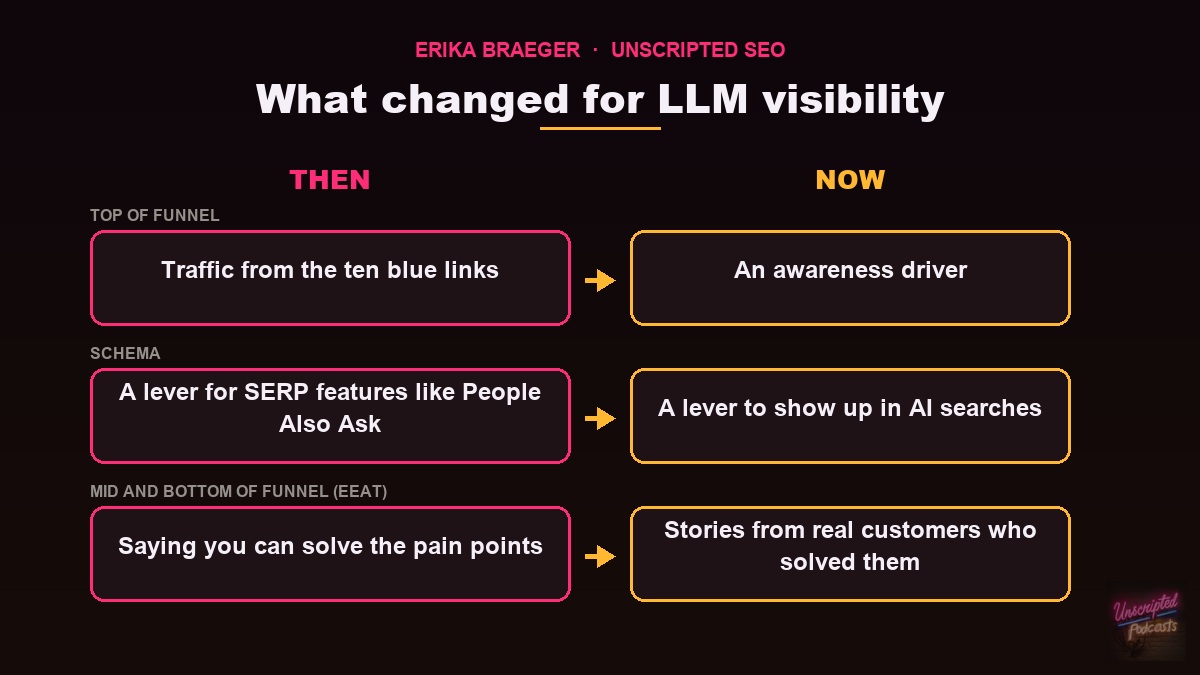
Erika puts a much heavier emphasis on EEAT and schema for LLM visibility. At the top of the funnel, content is now an awareness driver. In the middle and at the bottom, she wants proof.
So it’s not enough to say that we can solve these pain points. We need to show stories from real customers, real users that have solved these pain points and what success looked like for them. — Erika Braeger
That’s the part I see clients skip. They’ll write the page that says they solve the problem and never publish the customer who actually got it solved. Erika’s line on it is simple.
You need to tell a consistent story and you need that first-party data to back it up. — Erika Braeger
Schema does the same job in code. Review schema, she says, connects your site to places like G2 and Trustpilot where people have spoken well of you. If you sell into a considered B2B purchase, Ten Speed’s research on what AI cites for B2B evaluation-stage prompts is worth reading.
Big wins first, then take them to every team
My enterprise clients rarely have the SEO in the driver’s seat. You push PRs, you file tickets, you wait. So I asked Erika how she gets SEO argued, budgeted and implemented.
Because of the time it takes to do implementation and get buy-in for it on the enterprise side, I try to stick with the global items first, the big ticket items, because that’s what’s going to move the needle. — Erika Braeger
Then, when a fix moves the needle, she takes the win to every team it touches and shows how the next technical change will help them too. That’s the consulting move I wish I’d learned earlier. A win nobody hears about doesn’t buy you the next ticket.
A dashboard that isn’t waiting on a product manager
Google Analytics and Search Console have had APIs for a long time. Until I got into Claude Code, I never thought to make pulling them a default. Now I can build a dashboard that triangulates Clarity, GA and GSC in a browser tab without waiting on anyone’s production cycle. I asked Erika whether that changes what SEO SaaS is for.
She sees it lowering the barriers to entry and the learning curve. She remembers learning Data Studio, Looker Studio and complicated formulas to stitch separate systems together. Now she pulls it in through Claude’s API, and Gemini in Google Sheets handles the formulas. She also feeds chunks of a Screaming Frog crawl to Claude as a second set of eyes and has it build graphs for clients.
Her worry matches mine. She learned SEO on Stack Overflow, forums and Slack communities, not Claude and ChatGPT. I worry about the paid junior positions where people used to learn SEO on the company dime, and Erika’s seeing it too. She doesn’t think it’s unique to SEO.
Where I’d start: sample more than one page
Erika’s one takeaway is a page speed check, done properly.
Don’t sample only a singular page because not every page is going to tell the same story. — Erika Braeger
Check four or five pages and you’ll see which fixes are global. If you asked me to look at your site tomorrow, I’d start there too, and then ask you a few questions. Does your site say the same thing about you that G2, Trustpilot and your customers say? Is there a real customer story behind every claim on your bottom-of-funnel pages? And who on your team hears about it when an SEO fix works?
Read Ten Speed’s take on common technical SEO issues, connect with Erika on LinkedIn, and find the full conversation on Unscripted SEO. If you want a second set of eyes on your own site, here’s how I work.