Do you have to choose between being honest with a client and getting paid? I’ve carried a version of that question for most of my consulting career. On Unscripted Small Business I finally asked it out loud, to someone who has run a sales floor of 450 people with a 1.6 billion target. Neil Thubron didn’t take the bait. He asked me why I thought the two were connected at all.
Neil is an executive coach and sales trainer, the creator of the Whiteboard Value Selling methodology and the founder of XNRG. He writes about selling and leadership on his blog. You can watch the full episode.
The conflict I thought I had
Here’s how I put it to him. I called it an existential conflict: in marketing you know what’s going to work when you say it, and that sits against the need for honesty and heartfelt sentiment. I’ve met salespeople who are so obviously motivated by money that you’d guess they would sell their own mother.
Neil’s first answer was a question.
“So why would the two be disconnected? Why would just because your focus is on helping someone mean you don’t make money?”
Then he agreed with the part I had right. Salespeople are driven by money. They’re paid commission. And he wants it that way.
“I don’t want someone working for me who’s not motivated by money because that means you’re going to get out of bed early, you’re going to work, do the hard yards, you’re going to stay in the evening to write the proposal you need to write”
Motivation isn’t the problem. Selling what they don’t need is.
The line Neil draws is between wanting the sale and pushing a sale the customer doesn’t need. “I’m a firm believer that you can’t sell something to someone that they don’t need or don’t want,” he said. You might get away with it once, “but you’re not going to get a repeat customer out of that.” In B2B, the reputation from that gets around fast.
SEO has the same trap. It’s easy to sell a scope the business doesn’t need yet, because the bigger scope pays more this month. If you’re independent and wrestling with that, the scoping questions in what goes in the contract when you go independent are where I’d start.
Intent is the thing to train
When I asked Neil for the one thing salespeople should take from his training, he said it isn’t only about sales. It’s anyone who engages with customers.
“So the intention you have of when you’re sitting in front of someone is absolutely critical to how successful you’re gonna be in that relationship and that conversation.”
If you’re sitting there trying to sell them something, he said, “it’s all about you, not about them.” And he wasn’t selling it as a soft skill. His closing argument was about efficiency: helping someone the right way “is the best way of being successful in selling and also have a higher close rate as well.” A higher close rate means less of your week spent on deals that die.
Sell the outcome, then do the work
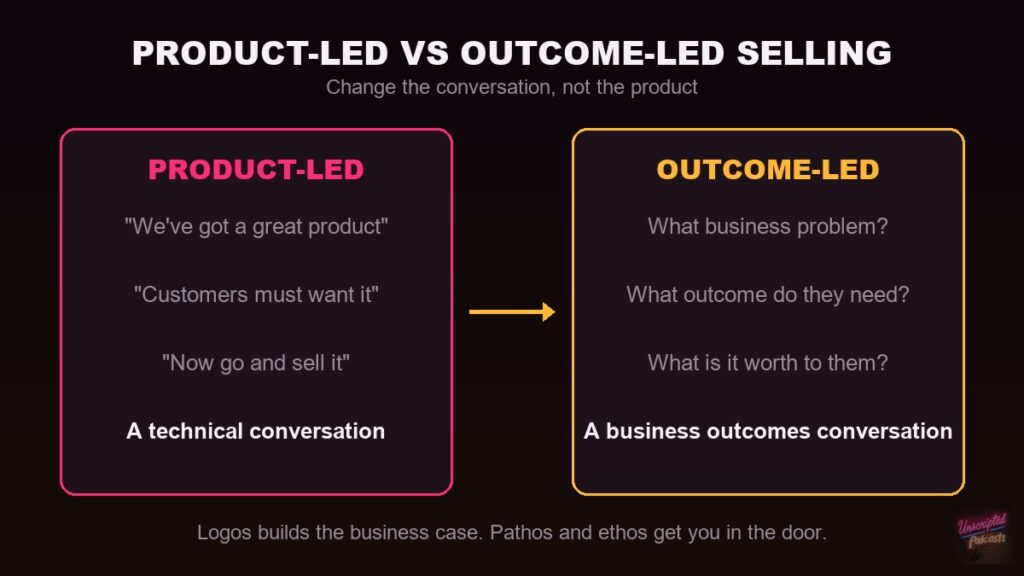
Intent only gets you so far if the conversation is about the wrong thing. Neil’s other fix is changing what you talk about. A lot of companies come to him with everything product led. He moves them to what business problem and what business outcome the product helps the customer reach.
“It’s transforming the conversation from a technical sales conversation to a business outcomes conversation.”
For an SEO consultant, the technical sales conversation is rankings, crawl budgets and audits. The business outcome is leads that close. Alex Radetic made the same point from the agency side when he told me a five percent close-rate lift beats twenty percent more leads. If you can’t say what the work does for the owner’s revenue, you’re having the technical conversation.
Where I’d start if you sell a service
Here’s how I’d apply Neil’s advice to any service sale:
- Before the call, write down what you’re there to help with. One sentence. If it’s about your quota, rewrite it.
- Ask what business outcome they need before you mention a deliverable.
- Say no to the scope they don’t need yet, out loud, and tell them when they will need it.
- Know what’s unique about your offer. Neil’s point: there are competitors, “but there are uniques that I have that other people don’t.”
Neil also has a free ebook on his Whiteboard Value Selling method, and the full interview is on the Unscripted Small Business recap.
If you hire people who want the money and train them to want the customer’s outcome, you don’t have a conflict to manage. You have a sales team.