In 2015 I could hand you an SEO projection with a straight face. Here are the keywords, here’s their volume, here’s the click-through rate, here’s the revenue when we get this many leads at this conversion rate, plus or minus ten. I don’t feel that way now. On Unscripted Small Business I told Rich M. Smith it feels like an eye has been gouged out, an ear is clogged, and we got hit in the snout by Claude. Then I asked him the question I actually wanted answered: “We’re just a bit punch drunk, or do we need to rethink how we communicate those metrics?”
Rich has been chief marketing officer of seven companies over 25 years, including AIG Bank during the 2008 financial crisis. He now runs Rich M. Smith Growth Studio. He is writing up our conversation on his own blog. You can watch the full episode.
Your CEO can’t do anything with organic traffic up 15%
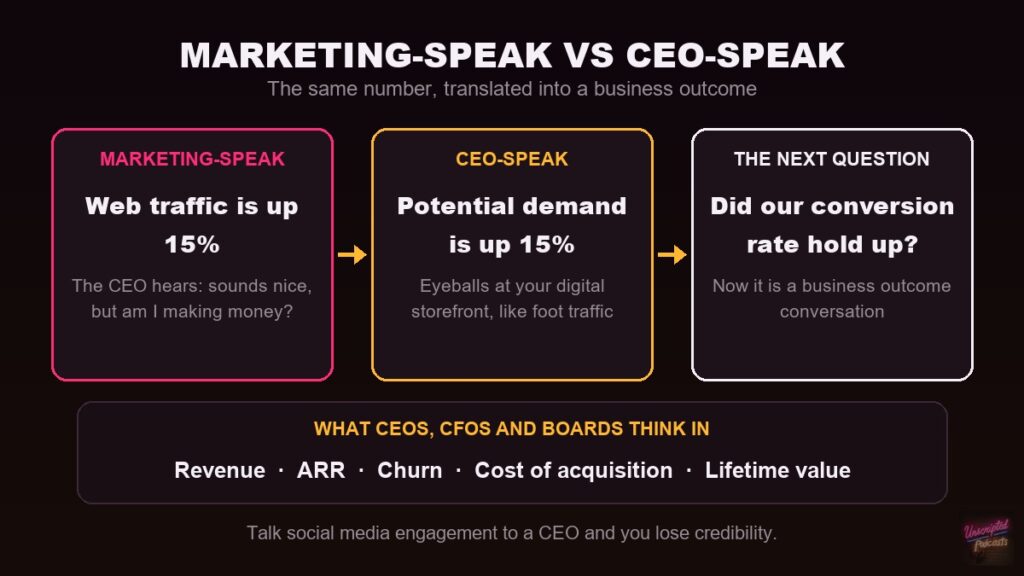
Rich’s answer started before my question did. He says the skill that made him effective as a CMO is “having the ability to translate marketing speak into CEO speak.” He used SEO as the example, which stung a little. You walk in and say organic traffic is up, and the CEO is thinking “that sounds kind of nice, but I don’t really know if I’m making any money.”
“CEOs think in different terms. They think in terms of business outcomes, you know, revenue generation, ARR, churn rates, right, cost of acquisition.”
Bring up social media engagement, he said, and “their eyes are gonna roll back into the back of their head and you’re gonna lose credibility with them.” If you’ve ever put an engagement chart in front of an owner, you’ve seen it.
Report potential demand, then ask what converted
Rich’s translation is simple enough to steal. Web traffic is people walking into your digital storefront, the same as foot traffic in a physical store. So you don’t report traffic. You report demand:
“We’ve increased potential demand by fifteen percent this month over last month.”
The CEO’s next question is whether the conversion rate on that demand held up, and now you’re in a business outcome conversation. Here’s how I’d apply that to an SEO report. These translations are mine, built on his rule:
- Organic sessions become potential demand from search, with the conversion rate next to it.
- Rankings become the share of buyers searching for the service who can find you, on the pages that sell it.
- Leads become revenue, which means you need the close rate. Alex Radetic made that case when he told me a five percent close-rate lift beats twenty percent more leads.
CFOs love organic because it looks free
This is the part of the episode every SEO should hear. Rich said it plainly: “CFOs love organic traffic. Let me just tell you. They love it.” On a report by inbound channel, “organic looks amazing because it appears to be free.” We both know it isn’t. And he asked the question every SEO should be able to answer: what happens to SEO traffic when you cut paid marketing? It goes down.
So his attribution models gave “some credit to paid for the organic that’s being generated.” Display gets the same treatment. On its own metrics it looks terrible, but people see a display ad, don’t click it, and type your URL straight in. If your report credits all of that to organic, you’re taking credit for someone else’s budget, and the first time paid gets cut you’ll own the drop too. Gert Mellak pushed me on this from a different angle when he challenged my SEO ROI math on my own podcast.
Run a controlled test in one region
Rich didn’t claim attribution is solved. He said it keeps getting better as we gather more data, but there’s always an unknown factor. His way through is designing controlled tests. If you’re a national company, “you might pick a particular region of the country to change your mix and see what the impact is if you change your mix in that region.”
He was honest about the limit: a regional result isn’t statistically translatable to the rest of the country. It still shows you the relationships between channels, and over time those tests let him build models that approximate reality.
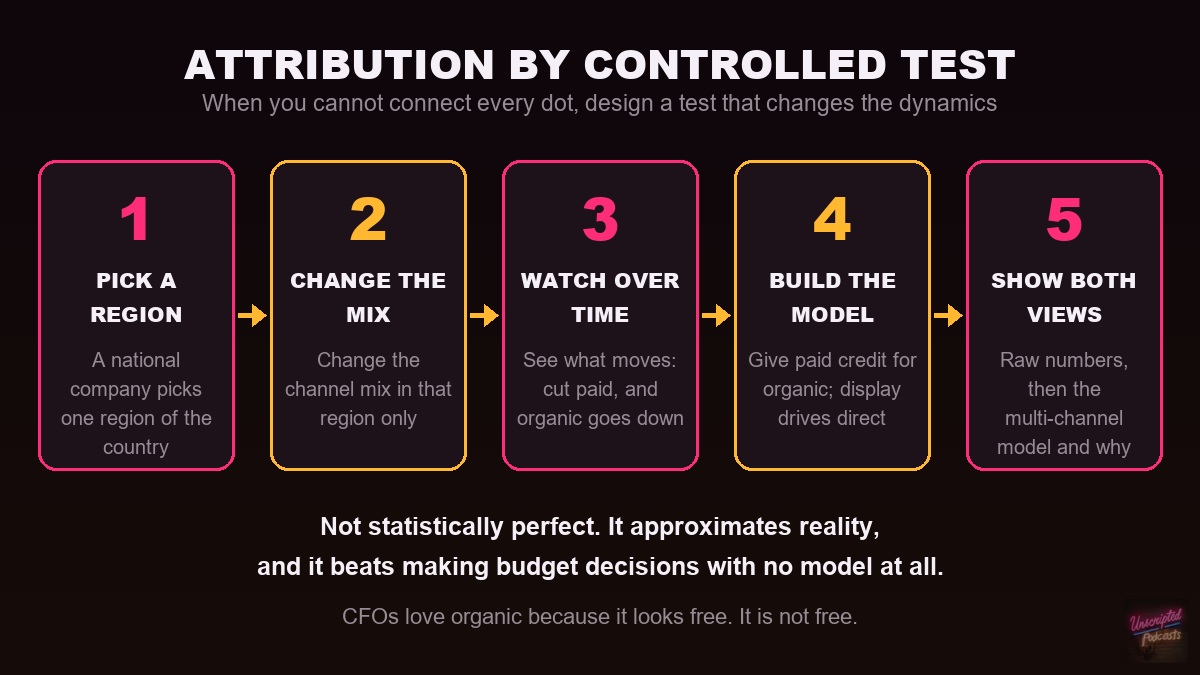
“Here’s why we’re using those assumptions, because we’ve tested them in certain markets and we understand that they’re assumptions and, you know, they’re not perfect, but they’re better than not having a tool like that to help us make those decisions.”
That’s the sentence I want in my reports. Not a promise, a tested assumption with the test named. If you run a local business across a few cities, the same idea scales down: change one thing in one market for a set period and leave the others alone.
Drop the metric that costs you credibility
Rich’s other point is that comprehension doesn’t happen unless the audience receives the message. That applies to the person reading your report as much as to a customer reading an ad. I already pulled one vanity number out of my reporting, and I explained why in the link metric I stopped reporting. I’d look at the rest of the report the same way: if a number doesn’t connect to demand, conversion or revenue, it goes in the appendix.
Rich also covered AIG Bank’s decision not to rebrand during the crisis, the ground beef example of framing without manipulation, and why AI search is outsourced sales. That’s all in the Unscripted Small Business recap. You can find Rich at richmsmith.com or on LinkedIn.
We’re not punch drunk. We were reporting in the wrong language.