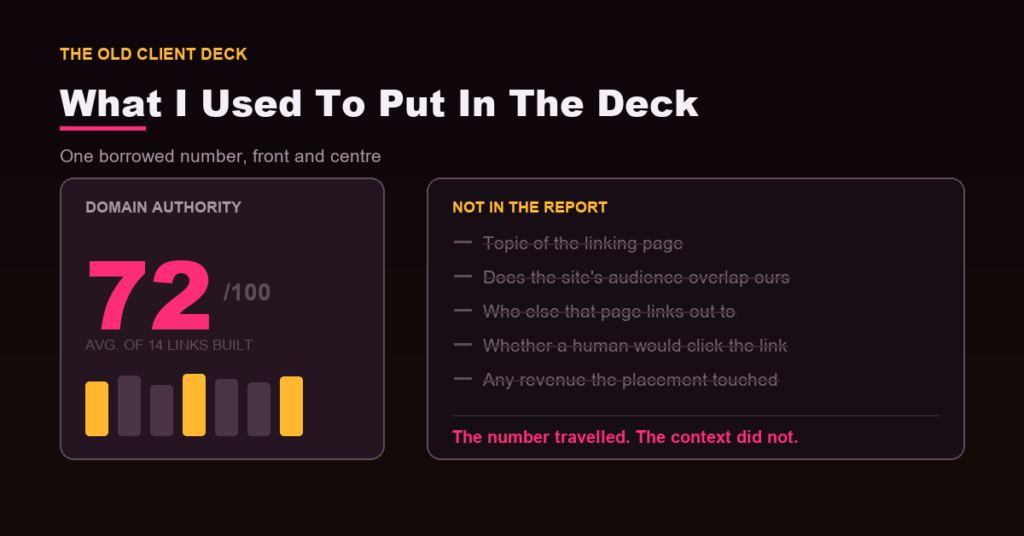
I deleted a slide from my link-building report template this summer. It had been in every deck I sent for the better part of a decade, and pulling it out felt like taking down a load-bearing wall. The slide held one number: the average Domain Authority of the links acquired that month.
Nobody asked me to remove it. No client complained about it. It came out because I finally could not defend it, and the person who made it indefensible was a guest on my own podcast.
What I Used To Put In The Deck
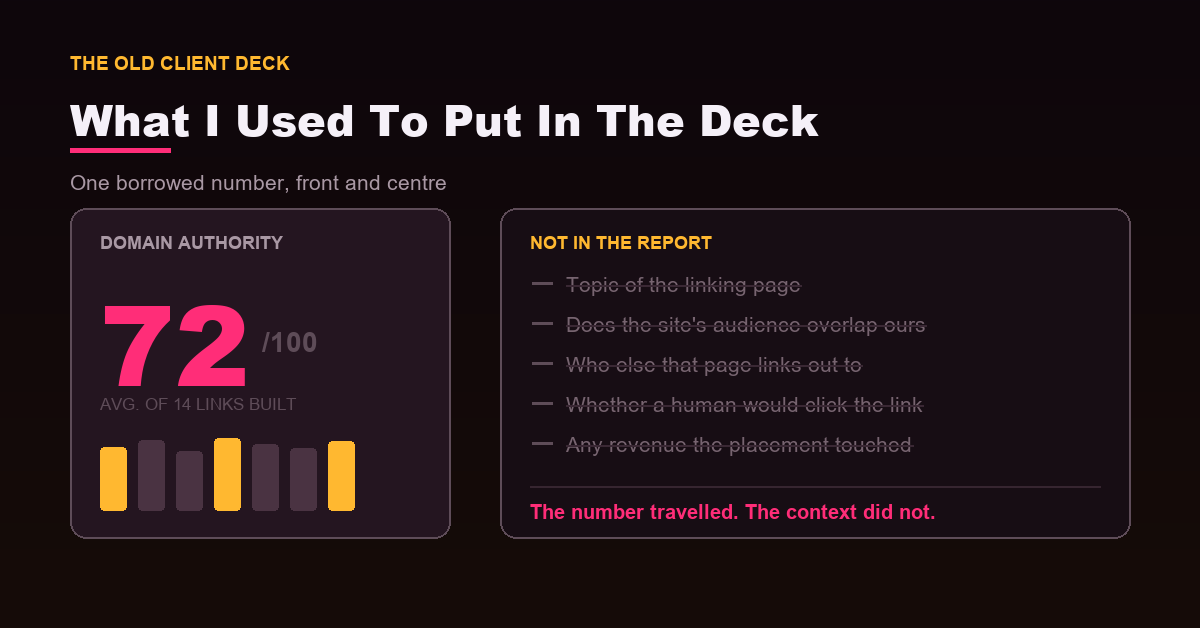
The old report was easy to assemble, which should have been my first warning. Pull the month’s placements into a spreadsheet, run them through a metrics tool, average the column, drop the number into a slide with a bar chart underneath. Fourteen links, average DA 72. Green arrow. Next slide.
It performed beautifully in the room. A number that goes up is the easiest story a marketer can tell, and DA had the additional charm of sounding official. Clients would nod at 72 the way they nod at a credit score. Nobody in that meeting, me included, ever asked the obvious follow-up: seventy-two out of what, calculated by whom, and correlated with which outcome?
Here is what that slide never contained. It did not say what any of those linking pages were actually about. It did not say whether the audience of the linking site had any overlap with my client’s buyers. It did not say who else those pages linked out to, which is often the single most revealing thing about a placement. It did not say whether a human being would ever have a reason to click the link. And it certainly did not say whether any of it touched revenue.
The number travelled from the tool to the deck without any of that context attached. I was reporting a proxy for a proxy and calling it measurement.
Benner’s Line That Broke The Habit
Bradley Benner runs Semantic Links, a white-label off-page service he launched in January 2022 after months of testing through 2021. He places links at a volume I do not, across a client base I do not have, which is exactly why I wanted him on the show. When I asked him how we should be thinking about the off-page side of the equation, he did not hedge.
It’s not some stupid third-party metric like DA or DR or trust flow or anything else that matters about whether a link is valuable or not. What matters is whether it’s relevant.
— Bradley Benner, Unscripted SEO
I want to be precise about what he is and is not saying, because it is easy to flatten this into “metrics are bad.” He is making an argument about order. He is fine with you looking at DA or DR or Trust Flow as a secondary check, once you have already established that a source is genuinely relevant to whatever it is going to link to. What he objects to is using the metric as the qualifier, because then you are sorting by the wrong column and disqualifying good placements while waving through bad ones.
His reasoning for why relevance is the qualifier is mechanical rather than philosophical. Our job, as he framed it, is no longer pushing metrics; it is creating associations between a brand, the products or services it provides, and the locations it serves, strengthening those associations, and forcing the models and algorithms to recognise them. A link from a high-authority page with no topical relationship to your client does not strengthen any association. It is a number with nothing behind it. I unpacked the full three-layer version of his argument in a longer piece on why relevance is the only link metric that survived, if you want the mechanics.
What broke the habit for me was realising my report was structurally incapable of showing the thing Bradley says is the only thing that matters. There was no relevance column. There was nowhere to put one.
The Three Signals I Report Instead
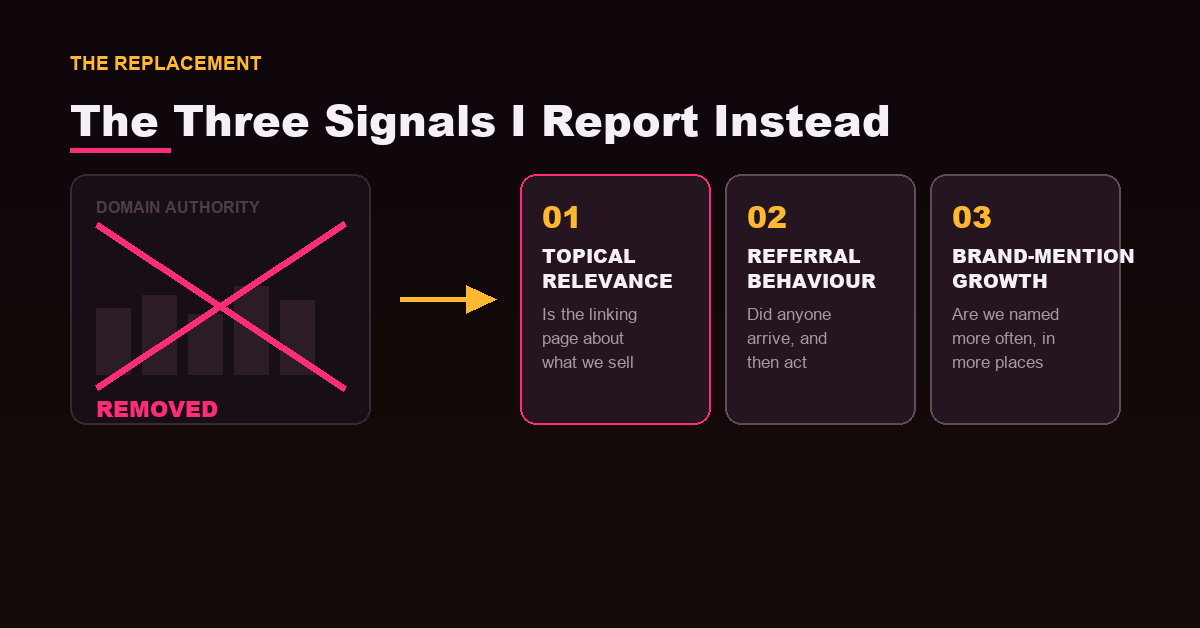
Topical relevance of the linking page. Not the domain, the page. For every placement I now write one plain sentence: what this page is about, and why someone reading it would plausibly want what my client sells. If I cannot write that sentence without straining, the placement was a mistake and the report says so. This is subjective and I have stopped apologising for that. A judgement I can explain beats a number I cannot.
Referral behaviour. Not raw referral traffic, which for most good links is a trickle and always has been. What I look at is whether anyone who arrived from the placement did anything afterwards. Two visitors who requested a quote is a better line item than four hundred who bounced. This is the same discipline I apply to organic reporting generally, and I have written before about why traffic is a proxy and revenue is the measure.
Brand-mention growth. How many places name the client this month that did not name them last month, linked or not. This one has become more useful, not less, as language models moved into the search stack, because an unlinked mention in relevant copy still teaches a model who a brand is and what it does. It also happens to be the metric that best reflects the way I actually generate links now, which is podcast-powered rather than cold-email-powered.
None of these three are as tidy as a single score out of a hundred. That is the point. They are harder to fake, harder to buy, and each of them survives contact with a client asking “so what?”
How Clients Reacted To Losing The Number
Better than I expected, and the reason is unflattering to my old report. Most clients were not attached to DA. They were attached to having something that told them whether the money was working. When I replaced one number with three sentences that actually answered that question, only one person pushed back, and their objection was fair: their previous agency had promised a DA threshold in writing, and they wanted to know whether I was quietly lowering the bar.
I told them the truth, which is that I was raising it. A DA floor is a filter you can satisfy with a placement nobody will ever read. A relevance standard is a filter that a lot of cheap link inventory cannot pass at all. Removing the number made the work more expensive to fake and easier to justify.
The one thing I would do differently is transitional. Do not delete the metric mid-engagement without warning. Run both for a month, put the old number and the new signals side by side, and let the client watch a high-DA placement with no topical fit sit next to a modest one that sent three qualified enquiries. They will draw the conclusion themselves, and it lands far harder than an email announcing a methodology change.
If you are rebuilding how you judge and report this work from the ground up, I keep the underlying principles collected on my search fundamentals hub. Start there, then go delete a slide.