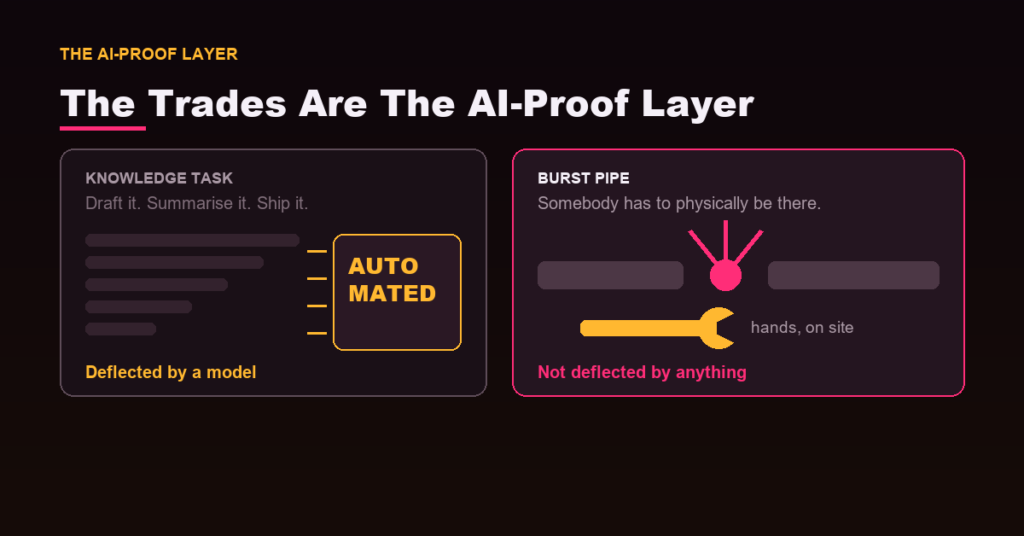
My water heater went out on a Sunday. I did what everyone does now and asked a model about it, got a genuinely competent explanation of thermocouples and sediment and anode rods, and then sat in a cold house until Monday morning because none of that information could physically drain a tank.
I thought about that gap for a while, because Benjamin Behrooz had put it to me almost exactly six weeks earlier on the podcast and I had nodded along without quite feeling it yet.
The Trades Are The AI-Proof Layer
Benjamin runs the Branding agency network out of Los Angeles and has been at this since 2007. When I asked him what the go-to play is for home services in the current season, he did not start with a channel. He started with a claim about where the money is going.
We know that AI can’t fix your roof, it can’t fix your door… So we know the future millionaires of this country are gonna be blue collar workers.
— Benjamin Behrooz, Unscripted SEO
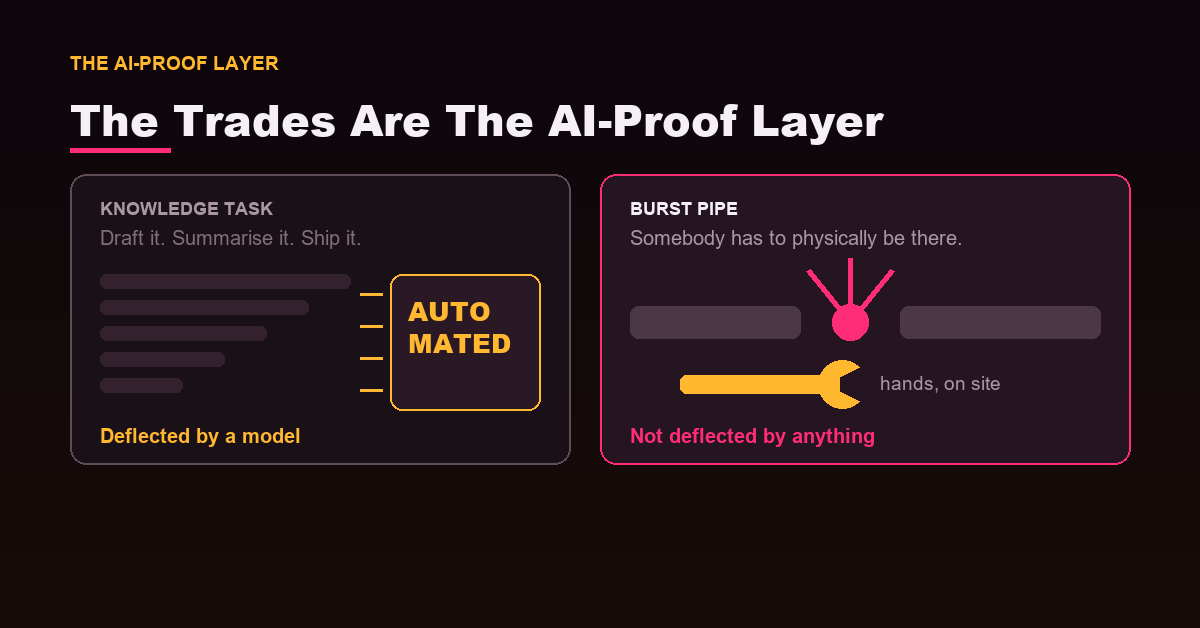
He listed the trades the way you would list load-bearing walls: roofing, doors, electrical, plumbing. Not a single one of them can be resolved by a better answer. The information layer around them has been commoditised almost completely — I now know more about my water heater than I ever wanted to — while the execution layer has not moved at all. Somebody with hands still has to show up.
That asymmetry is what makes the trades interesting to me as a consultant rather than just as a homeowner. Whole categories of knowledge work are having their output deflected by a model. The demand for a licensed plumber on a Sunday is exactly where it was.
I wrote up my first take on his argument shortly after we recorded, in the future millionaires are blue-collar. Six weeks of watching my own client mix has not softened it.
Why Local Service Demand Is Not Being Deflected
Here is the mechanism, as plainly as I can put it. AI eats the research step. It does not eat the job.
For an information business, those two things are the same thing, which is why publishers are in trouble. For a trade business they are completely separate. A homeowner researching “why is my water heater leaking from the bottom” was never going to buy anything at that moment anyway. That query was top-of-funnel, it was answered by a blog post before and it is answered by an AI summary now, and losing it costs a plumbing company approximately nothing.
The query that matters is the one made twenty minutes later, from a phone, in a hurry, with a puddle spreading. That intent cannot be summarised into satisfaction. It terminates in a truck arriving.
Benjamin’s read on the market was not that this makes it easy, though. His warning was the opposite: other people know this too, so it is a very inundated market. His answer is layered, largely physical touch points — a street team in branded shirts handing you something in person, print left on the door, then a geo-targeted social ad that catches you afterwards — on the theory that three to five brand exposures is what makes a person comfortable. He is blunt that phone-first prospecting is finished, because people have stopped picking up. It is a strategy built on being recognisable before the emergency, since nobody comparison-shops during one.
What Blue-Collar Clients Actually Need From SEO
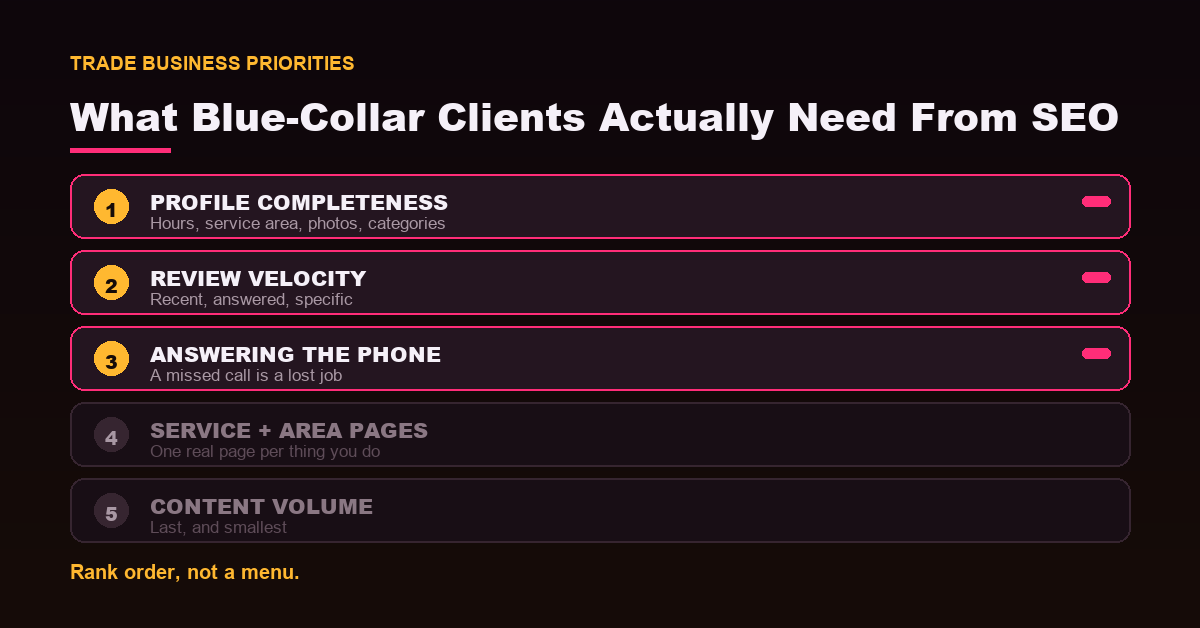
This is where I have changed how I scope engagements, and it is mostly a matter of what I refuse to sell first.
Profile completeness comes first. Hours that are correct, a service area that matches reality, real photographs, the right primary category. It is unglamorous and it is frequently the entire gap between a company and its competitor two miles away.
Review velocity second. Recent beats numerous. Answered beats unanswered. Specific beats generic. A steady trickle of detailed reviews from the last ninety days does more for a trade business than a content calendar ever will.
Answering the phone third, and I am serious that it belongs on an SEO priority list. Every optimisation upstream of a missed call is wasted. If a client cannot answer or return calls within the hour, I would rather fix that than rank them, because ranking them just increases the number of jobs they lose.
Then service and area pages. One genuine page per thing you actually do, in each place you actually do it. Not a spun grid of town names.
Content volume last, and smallest. The top-of-funnel article treadmill is the piece I most often remove from an inherited strategy. For a trades business it was always weak, and the AI answer layer has made it weaker.
That ordering is mine, not Benjamin’s — he was describing an outbound brand strategy rather than an SEO scope — but it follows directly from his logic. If the buying moment is physical and urgent, spend the budget as close to that moment as possible. I keep the broader version of this thinking on my small business and local hub.
Where I Am Pointing New Consulting Capacity
Toward the trades, deliberately, and toward the ones in my own backyard.
Part of that is the argument above: a client whose demand cannot be deflected by a model is a more durable client than one whose whole category is being summarised out of existence. Part of it is simpler. Trade owners are unusually good to work with, because the feedback loop is honest. There is no debate about whether the campaign is working. Either the crews are busy or they are not.
The other half of Benjamin’s argument that I have taken to heart is the in-real-life layer. He is out at local events putting a face on the brand, and I have found the same thing works for the SEO side of it — showing up where the contractors already are beats any cold outreach sequence I have ever run. That is most of why I invest in local work here in Cookeville rather than chasing accounts I would only ever meet on a call.
Benjamin’s closing advice was to go into the market on your customers’ terms — to lead with their pain points rather than your capabilities, because a business owner does not care that you have AI services. That applies to me pitching a roofer at least as much as it applies to the roofer pitching a homeowner. Nobody is buying search visibility. They are buying a full schedule.