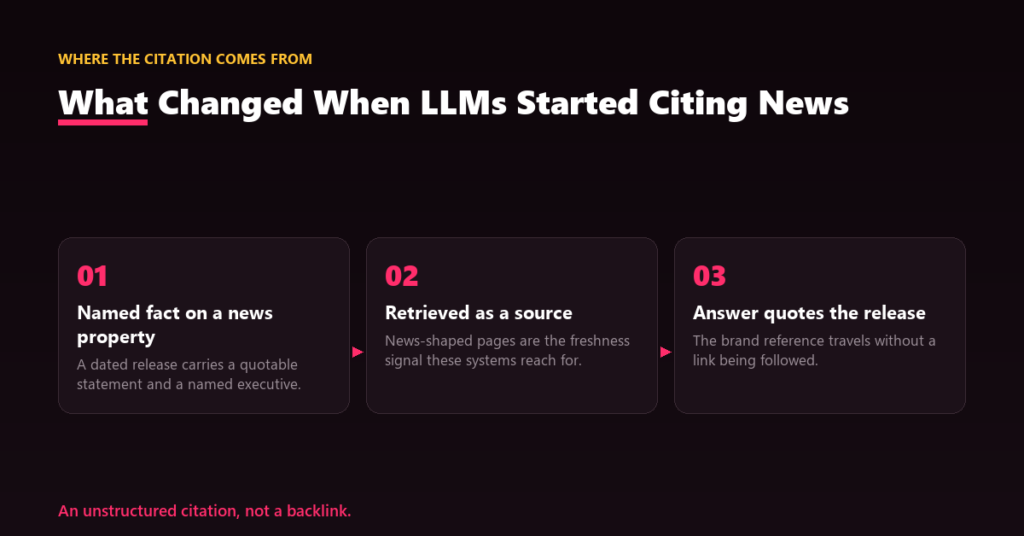
I have been telling clients that press releases were dead since roughly 2012. I said it in audits, I said it on calls, and I said it with the particular confidence of someone who had watched the tactic get destroyed in public. Then I interviewed Bradley Benner, and I have had to go back and qualify it.
This is the qualification. It is narrower than a reversal and more than a shrug, and it has almost nothing to do with the reason anyone bought press releases in the first place.
The Position I Held For Ten Years
The case against was straightforward and, for its time, correct. Wire distribution produced hundreds of syndicated copies of the same text, each carrying the same optimised anchors, on domains with no editorial relationship to the business. Google’s response was to discount the links and, eventually, to treat aggressive release-building as a link scheme.
What killed the tactic was not the format. It was the reason people were buying it. A press release purchased for anchor text is a paid link with a dateline, and search engines got good at spotting exactly that. So the advice hardened into a rule: do not buy releases for SEO. I gave that advice for a decade and I still think it was right about links.
What Changed When LLMs Started Citing News
Benner runs Semantic Links, an off-page fulfilment agency, and Semantic Mastery, his teaching business. He is not defending the old play. He is describing a different mechanism entirely — one where the value never touches a link at all.
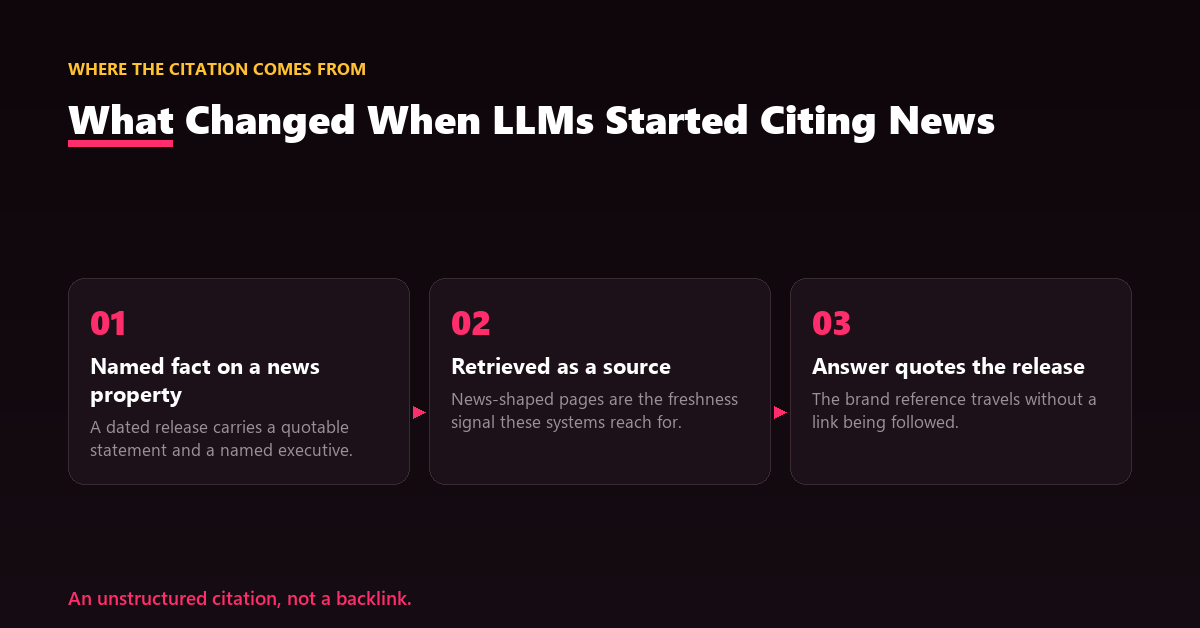
His starting point is that a brand mention with one corroborating data point is a citation, and citations do not have to be structured directory listings. In his framing, “press releases, branded assets, brand mentions on blog posts, things like that, those all can act as unstructured citations. And that’s what influences LLM or AI search visibility right now, more than anything.” Then the specific claim:
Press releases work really, really good for helping to improve AI search visibility because you get brand references on high authority media and news style like freshness factor type properties that the LLMs like to cite.
— Bradley Benner, Semantic Mastery / Semantic Links, Unscripted SEO
Read that carefully and you will see it is not a link argument. It is a corpus argument. The proposition is that certain properties are disproportionately represented in what these systems retrieve and quote, that news-shaped properties are among them, and that a release is the cheapest legitimate way to get a factual statement about your business onto one.
I find that plausible, and I want to be honest that plausible is where I have landed rather than proven. I have not run a controlled test. What moved me was that the mechanism no longer depends on a search engine choosing to pass authority through a syndicated copy — it depends only on a machine reading a page and finding your brand attached to a verifiable fact.
The Narrow Case Where Releases Now Work
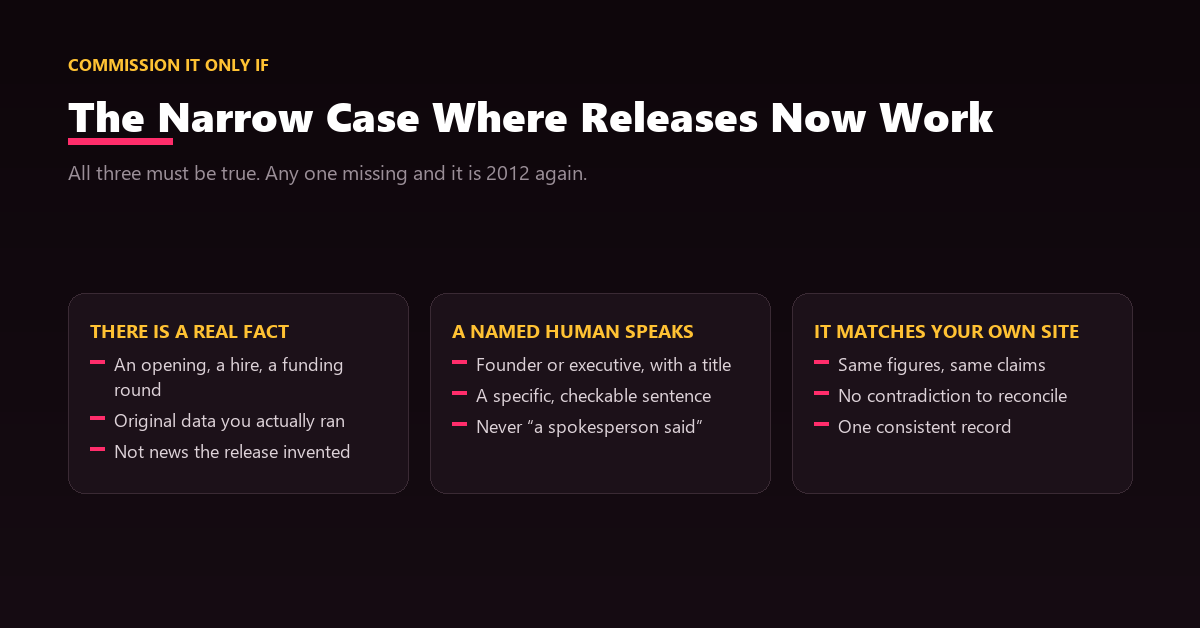
Here is where I have ended up, offered as my own practitioner judgement rather than as anything Benner prescribed. A release is worth commissioning when all three of the following are true, and is a waste of money when any one of them is not.
- There is a real fact. An opening, a hire, an acquisition, a funding round, a genuinely new product, a piece of original data. If the release has to invent its own news, the resulting sentence is not one you want a model repeating.
- A named human says something. Attribution is what makes a sentence quotable. “A spokesperson said” is unquotable filler; a named founder with a title is a source.
- The facts match your own site. If the release says one thing and your homepage implies another, you have created a discrepancy in the record about your own company rather than a citation.
The third point is the one I now spend the most time on, and it is not really about releases. It is the same discipline as everything else in AI search and GEO: decide what is true about the business, then make every surface say it consistently.
What I Still Will Not Recommend
I have not changed my mind about any of this: buying releases in volume, optimised anchor text in the boilerplate, monthly “drip” release packages sold as a link product, or releases written to contain a keyword rather than a fact. Every one of those is the 2012 tactic with a 2026 justification stapled to it, and the justification does not survive contact with the actual mechanism Benner describes.
Nor would I move budget out of the things that already work. If you are choosing between a release and a real conversation that produces something quotable — a podcast appearance, an interview, a piece of research — take the conversation. The reason I keep coming back to that is written up in podcasts, Reddit, and the new citation map.
What I will now say, which I would not have said last year, is this: if your business has genuine news and a person willing to be quoted saying something specific about it, putting that on a news property is no longer a waste. It is just not a link tactic, and you should stop measuring it like one. The rest of what I think holds up is on my search fundamentals hub.