Some interview lines are useful. A few are annoying, in the sense that they keep surfacing weeks later while you are doing something unrelated. Zak Ali, who leads SEO at Finder in the US, said one of those to me and I have not been able to put it down since.
Zak Ali’s Uncomfortable Sentence
We had been talking about whether the job of an SEO is turning into audience acquisition. His answer started with agreement and then went somewhere sharper:
The traffic you have today is as cheap as it’s going to be. It’s only going to get more expensive. So as much as you’re getting now, you want to keep it, retain it.
— Zak Ali, Finder US, Unscripted SEO
The reason that lands is that it is a statement about direction, not about a number. You do not have to accept any particular forecast to accept the shape of it. Every discovery surface that has ever existed has become more contested and more expensive as it matured, and nothing about the current one suggests it is the exception.
What follows from it is not a growth tactic. It is closer to a treasury decision. If today’s visitor is the cheapest visitor you will ever acquire, then every one you let leave anonymously is a purchase you will have to make again later at a worse price.
Ali’s own conclusion was a metric one — “I think retention should be a core KPI of every SEO” — and he framed the sequence as getting people in, conversion work, then retention. He described that as audience cultivation, and said it is the role of every SEO now.
Converting Visitors Into Something You Own
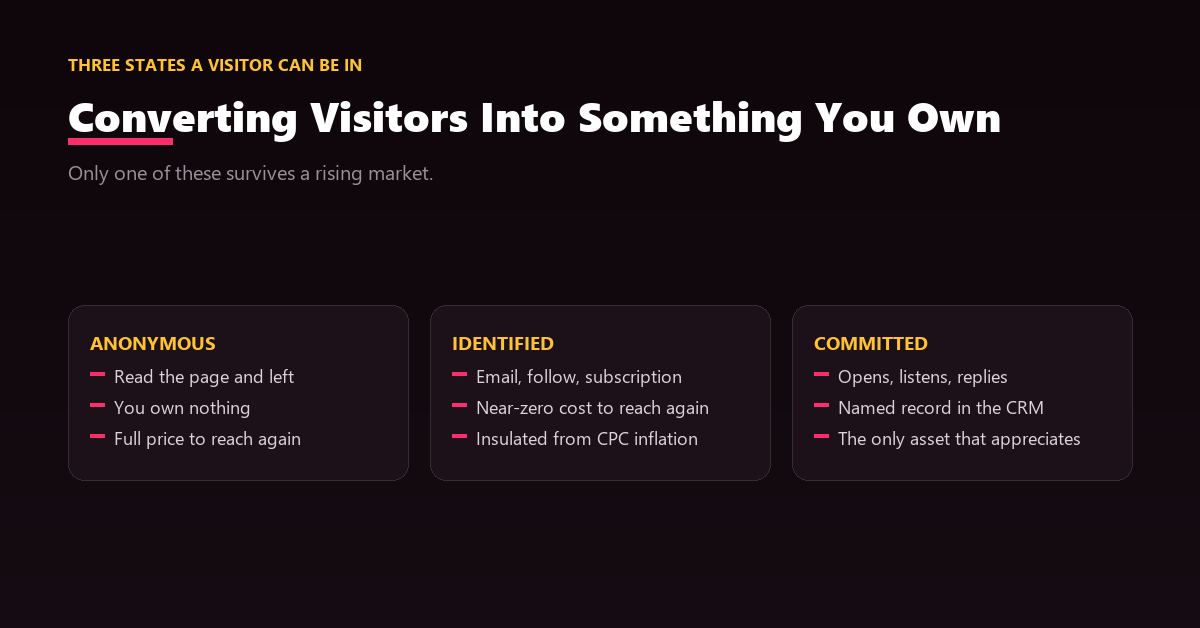
The practical translation, and this part is mine rather than his: there are only a few states a visitor can be in, and only one of them is durable.
- Anonymous. They read something and left. You own nothing. You will pay full price to reach them again, if you ever do.
- Identified. You have an email address, a follow, a subscription. The cost of reaching them again is roughly zero and does not rise with the market.
- Committed. They open, they listen, they reply. This is the only asset in the list that appreciates.
Most sites I audit are extremely good at producing state one and have no mechanism at all for state two. The content is fine. The traffic is real. And the entire month’s audience evaporates on schedule because nothing on the page asked them for anything except a purchase they were not ready to make.
The Three Assets I Build For Every Client Now
Practitioner guidance, from my own engagements rather than from the episode. When a client asks what to do about this, I stop scoping new content until three things exist.
- A reason to hand over an email that is not a newsletter. “Subscribe for updates” converts almost nobody. A specific, finite, useful artefact converts a lot of people — a checklist, a calculator, a template, the thing they were going to build in a spreadsheet anyway.
- Somewhere the same person can hear a voice. A podcast, a video series, a recurring live session. Text is efficient and forgettable; a voice is how a name becomes a person, which is what makes a later message get opened.
- A named record in the CRM. Not a marketing list — a record that ties the anonymous session to a human, so the next conversation starts where the last one ended.
None of that is novel. What is new is the sequencing argument. These used to be things you built once the traffic was working. Ali’s point is that they are the reason to have traffic at all, and that building them later means building them at a higher price.
It is the same argument I make about measurement on SEO ROI, arriving from the other direction: a channel you do not own is rented, and rent goes up.
What This Costs If You Wait A Year
I want to be careful here, because the honest answer is that nobody can price this precisely, and any specific multiplier I gave you would be invented. Ali did not put a number on it either — his claim was directional.
So take the directional version seriously and do the arithmetic on your own numbers rather than on mine. Whatever your organic sessions are this month, assume you capture none of them. That is your baseline. Now assume you capture two per cent into something you own. Over twelve months that is an audience you can reach for free, forever, that costs nothing further to maintain, and that you assembled at the cheapest acquisition price you will be offered.
Wait a year and you buy the same audience in a more expensive market, having thrown away twelve months of the cheap one. That is the whole argument, and it is why the sentence keeps coming back. The full conversation is written up in search everywhere optimization with Zak Ali, and the broader case sits in distribution is the last moat.