I have a bad habit in discovery calls. Someone asks about link building or AI search or whatever they read about last week, and I answer the question they asked instead of the one that matters. Tom Malesic has been running EZMarketing for thirty years and does not have that habit at all.
Thirty Years And One Non-Negotiable
His position, given without hedging when I asked where a business should start:
I look at it that the website is the center of all your marketing. If that piece sucks, it doesn’t really matter. Anything else you do is also terrible.
— Tom Malesic, EZMarketing, Unscripted SEO
His analogy was about first dates — turning up at the bar in the jeans you mowed the lawn in and wondering why nobody wants to talk to you. He is describing what he sees small businesses do: outsource the site to a high school kid, or build it themselves on a page builder, and end up with something that destroys trust before a single word is read. As he put it, as much as mum used to say don’t judge a book by its cover, marketing is the cover.
I have resisted this framing for years because it sounds like agency talk — the guy who sells websites says you need a better website. But I have now watched enough campaigns fail in the same place to concede the point. Traffic to a page that does not convince anybody is not a marketing result. It is a bill.
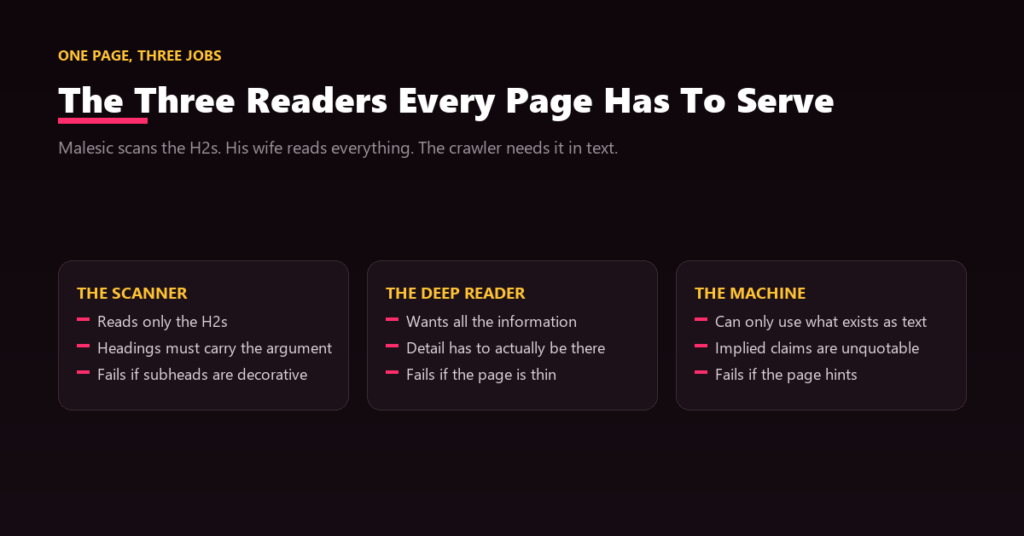
The Three Readers Every Page Has To Serve
The most useful specific thing Malesic said came out of a defence of long pages, and it is a better argument for page length than the word-count arguments I usually hear.
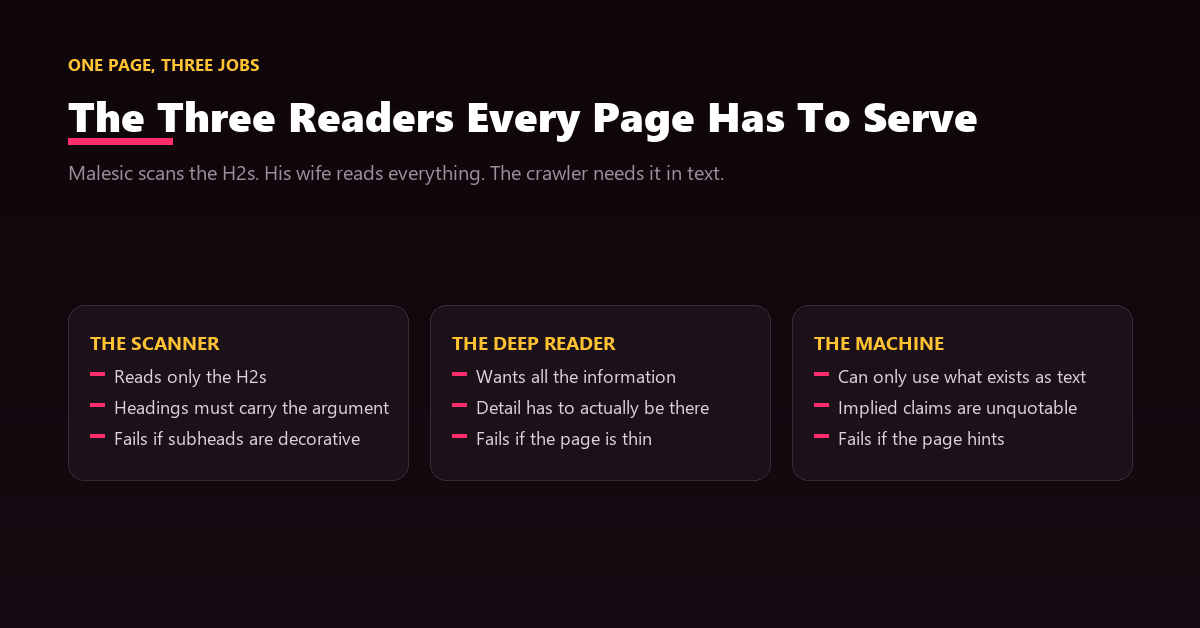
He described two human readers in his own household. He scans: “I’m going to scan it and look at the H twos.” His wife, who he describes as very detail oriented, reads everywhere on the page because she wants all the information. Two people, same page, completely different consumption patterns, and a page built for only one of them fails the other.
Then the third reader. His argument for length is that more content means more chances to be the one talking — in his words, “you have more chances, whether Google’s viewing is a long section or you got a copy in there that Google liked in any section.” He is candid that small business owners resist this and say nobody will read it all, and his answer is that they are right, and that this is not an argument against writing it.
So: the scanner, who needs the headings to carry the whole argument on their own; the deep reader, who needs the detail to actually be there; and the machine, which needs the claim to exist in text. One page, three jobs. That is a genuinely useful editing test, and I have started using it — read only the H2s and see whether the page still makes its case.
Why Long Pages Still Win With Google And ChatGPT
I want to be careful about how far I take Malesic’s point, because he made a claim about Google and I am about to extend it. His argument was about search. The extension to answer engines is mine, and it is a reasonable inference rather than something he asserted.
The inference is this: a machine that assembles an answer can only use claims that exist somewhere as text. If your page implies your service area rather than stating it, implies the price range rather than giving one, implies who you serve rather than naming them, there is nothing to lift. The thin page is not merely less persuasive to humans; it is unquotable.
Which is not a licence to pad. Length that comes from saying more true, specific things is what Malesic is describing. Length that comes from restating the same thing five ways is the thing everybody hates, and it fails all three readers at once. The distinction is whether a paragraph contains a fact somebody could act on.
The Audit I Run Before Taking Any Other Work
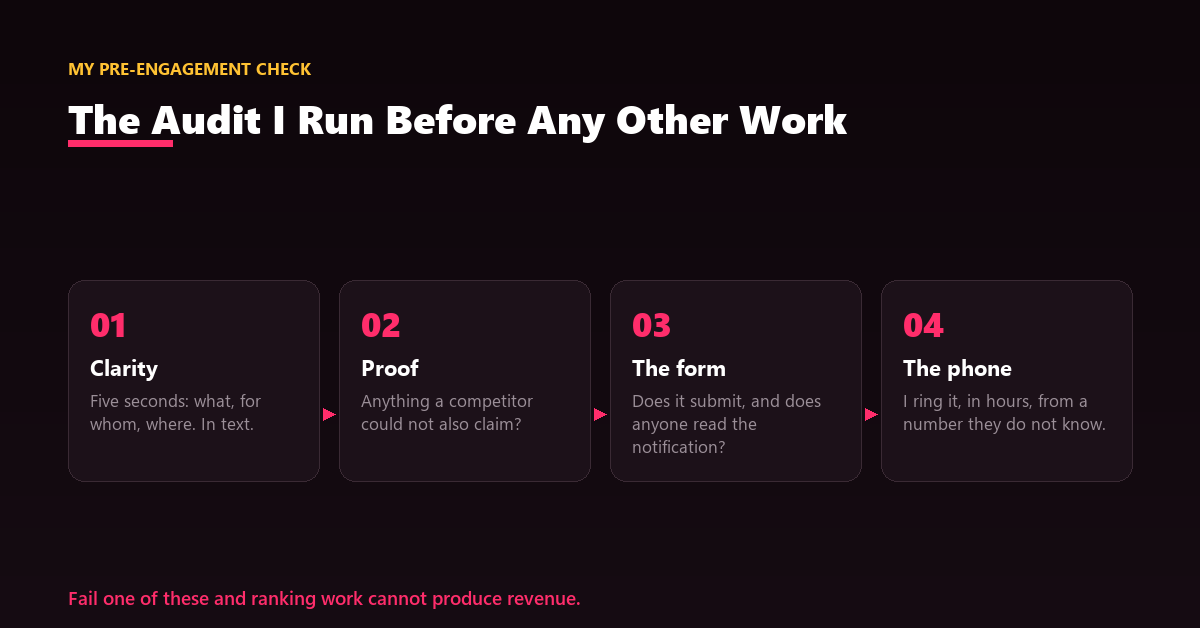
This checklist is mine, not his — my practitioner version of his non-negotiable. I run it before quoting on anything else, and I have talked myself out of retainers with it more than once.
- Clarity. Within five seconds, does the page say what the business does, for whom, and where? In text. Not in a hero image.
- Proof. Is there anything on the page a competitor could not also claim? Named people, real project photos, specific numbers, reviews with detail in them.
- Speed and structure. Does it load, does it resolve at crawlable URLs, does every service have its own page.
- The form. Does it submit, does the notification arrive, and does it arrive somewhere a human is actually looking.
- The phone. I ring it. During business hours, from a number they do not know. This single test has changed more scopes than any crawl I have ever run.
If items one, two, four or five fail, no amount of ranking work will produce revenue, and taking the retainer anyway is how you end up explaining a traffic increase to someone whose phone has not rung. Malesic’s version is blunter and it has the advantage of thirty years behind it: if the website sucks, everything else you do is also terrible.
The full conversation, including where I had to concede ground, is in what a 30-year agency owner made me admit about my own consultancy. If you want this run on your site, that is foundational consulting, and the underlying principles live on search fundamentals.