Most explanations of why AI systems cite one page and not another are hand-waving with a diagram attached. Drew Dorenfest gave me a mechanical one — a loop, with steps, that you can actually design a content brief around. It changed mine.
The Loop Nobody Draws On A Whiteboard
Dorenfest runs Client Magnet CRM and came into SEO from an unusual direction — years as a trailer editor in Hollywood, cutting promos for Netflix, Apple and Warner Brothers. He describes the mechanism through a tax-firm client he built content for in California and Nevada:
The key to getting cited is to cite your sources. Link to IRS.gov, link to the tax research that backs your claims. When crawlers come and cross-reference your information against those sources and verify them, they go: okay, this company is legitimate, has been around for ten years, has great reviews — I will treat this as an authoritative source.
— Drew Dorenfest, Client Magnet CRM, Unscripted SEO
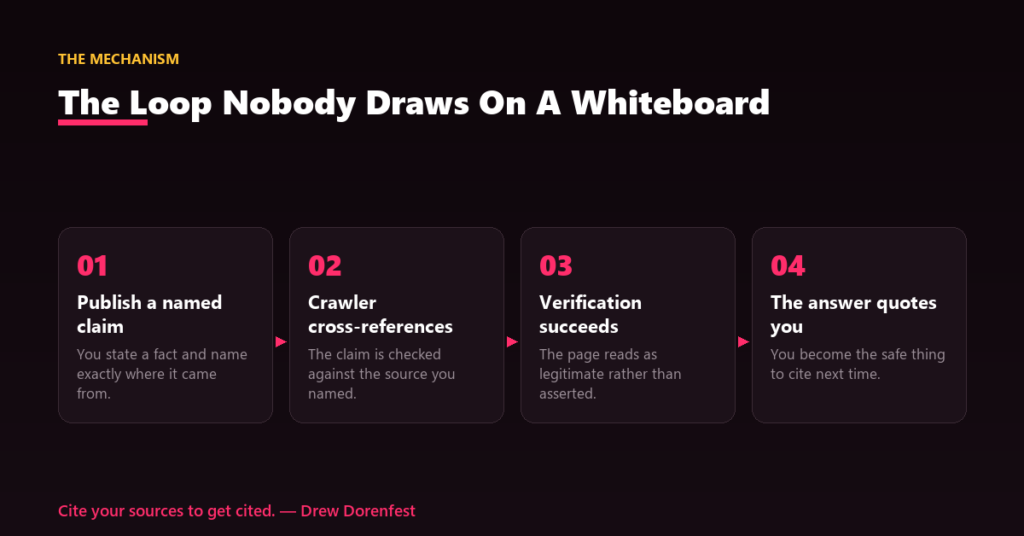
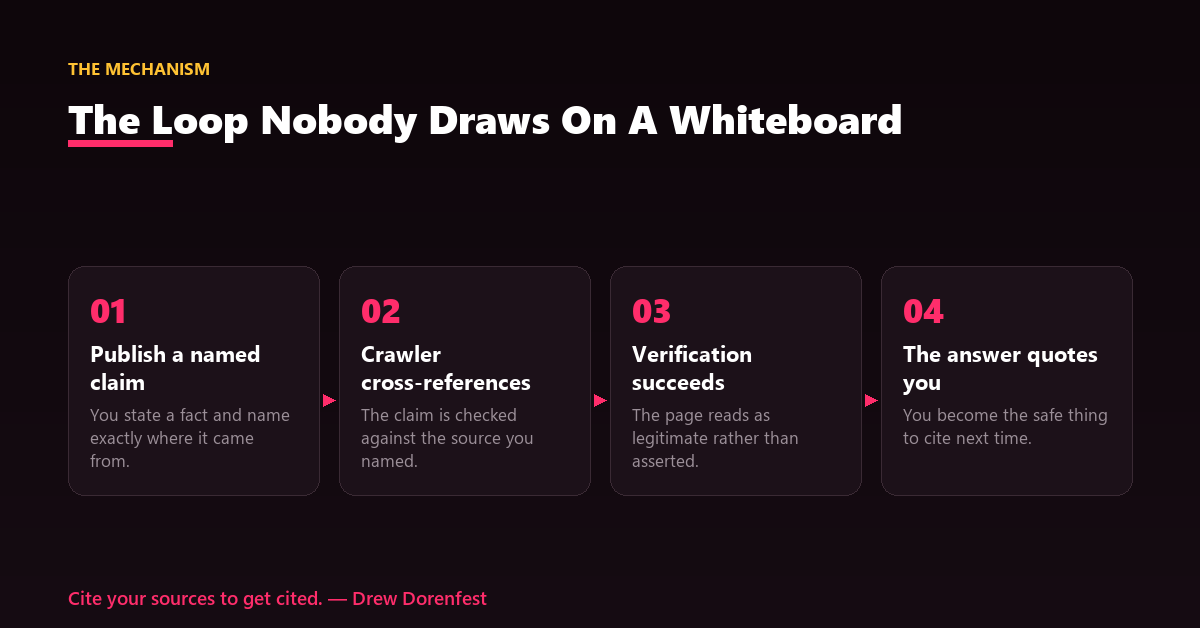
The loop is: you publish a claim and name where it came from; something crawls the page and can check the claim against the named source; the check succeeds; the page becomes a safe thing to quote. What makes it a loop rather than a checklist is that the outcome of the check is what determines whether you get quoted next time.
The results he reports for that client are specific — a student loan interest deduction post ranking above IRS.gov, HR Block and TurboTax within two weeks. His own explanation is not that citing sources did it alone: he attributes it to that combined with content depth at a level of specificity the national brands did not have, and adds that tax professionals reviewed every post for accuracy. Worth keeping the whole causal claim intact rather than reducing it to the tactic.
What I Changed In My Content Brief
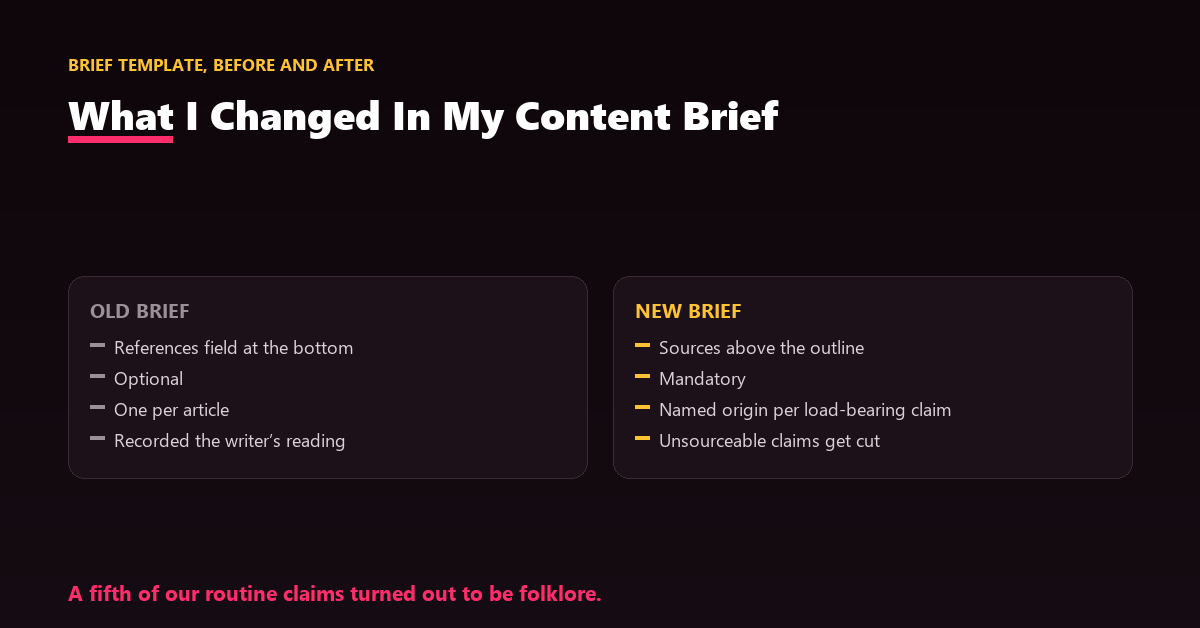
My brief template had a references field for years. It was optional, it lived at the bottom, and it was mostly used to record where the writer had done their reading. It was documentation, not structure.
What I changed, and this is my process rather than his prescription: sources moved above the outline and became a requirement per claim rather than per article. The brief now lists the two or three load-bearing assertions the piece exists to make, and each one has to arrive with a named, linkable origin before the outline is approved.
The immediate effect was uncomfortable and useful. About a fifth of the claims we had been routinely making could not be sourced at all. Not because they were false — because they were industry folklore that everyone repeats and nobody has traced. Those either became something we researched properly or came out of the brief.
Naming Sources Inside The Sentence
The second change was smaller and has had a bigger effect on how the pages read. A bare hyperlink on the word “study” tells a human reader almost nothing and tells a parser only that a link exists. Naming the source inside the sentence — the organisation, the year, what the figure actually is — puts the attribution in the text where it survives being extracted.
Practically: “according to the IRS’s 2025 guidance, the deduction phases out above X” rather than “the deduction phases out above X (source)”. Same link, same claim, but the first version remains a complete, checkable statement if it is lifted out of the page entirely. That is the whole design goal.
It also improves the human version, which I did not expect. Naming your sources in prose reads as confidence. Hiding them behind an anchor reads as hedging.
What Happened To Citation Rates After
Here is where I have to be honest rather than impressive. I do not have a clean before-and-after number to give you, and any figure I invented would be exactly the kind of unsourced claim this entire piece argues against.
What I can report is what I observe and how I now track it. I keep a fixed list of questions a prospective client would actually ask, run them monthly in the same wording, and record what gets named. It is crude, it is not a controlled test, and it is still the most informative report I produce. The pages that get named are consistently the ones that make specific, sourced, checkable claims rather than the ones that cover a topic comprehensively.
Dorenfest’s broader point is worth ending on, because it is the reason the loop matters at all. His view is that conversions are the only metric he cares about — that traffic is nice but a business owner cannot feel it, and can feel more sales, more emails, more calls. Getting cited is only useful insofar as it puts you in front of someone who then does something. Everything else is a scoreboard.
More on how I think about this in AI search and GEO, and the strategic version in the content library no competitor can copy. The underlying principles are on search fundamentals.