I get a version of the same enquiry most weeks. The site is not producing enough business, the owner wants to know what it would cost to fix the rankings, and somewhere in the first ten minutes it becomes clear that the rankings are not the constraint.
Two guests said this better than I have been saying it, from opposite sides of the transaction — one running the business, one measuring the businesses.
The Sentence Every Owner Should Read Twice
Cameron Tope runs Emerson Property Management in greater Houston, remotely, from San Diego. He was describing his own hiring sequence — a salesperson first, then a marketing person — and explained the order like this:
you’re gonna spend ten, twenty $20,000 a month on marketing, but you don’t have anybody answer the phone, and you get back to them two days later, you’re just lighting money on fire.
— Cameron Tope, Emerson Property Management, Unscripted Small Business
What makes that worth quoting is that it is an owner talking about his own budget, not a consultant selling a fix. Tope’s first hire was somebody whose sole job is answering the phone and closing leads, and only then did he hire marketing. He describes himself as “a big firm believer in making sure operations are in a good spot before turning on marketing,” and is candid that plenty of people go the other way.
He also described it from the buying side, which is the part that stuck with me. Shopping for movers, he says he called and filled in forms and got nothing back from most of them — and that the one that had its business in order called within minutes, took details and scheduled the next step. His conclusion: you can tell when somebody has actually designed a process to get you from lead to client.
Melendy’s Data Backs It Up
Jake Melendy of Ignitvio went and measured it. His study started as a personal irritation — his mother called five roofers for a quote and none replied within three days; two months later he called five law firms on a Sunday as a prospective client and none called back — and turned into repeated tests across competitive metros in roofing, HVAC, accounting and dental.
Every single time, over fifty percent would never get back to me. And of the ones that did, only two percent followed up more than once, which is insane to me.
— Jake Melendy, Ignitvio, Unscripted SEO
He sets that against the sales fundamental that makes it damning: “you need five touches generally to get a sale. The majority of sales happen after the fifth touch.” So it is not that the market is slightly slow. It is that most of it never starts the sequence that closes business at all.
And the line I now quote at owners who think their response time is acceptable: “Yeah, but your competitors are responding within ninety seconds, and they’re booking that same person. So where are we really at?”
One note on citing this accurately, because I have already seen it inflated. Melendy describes running these tests across those four verticals in competitive metros; he does not give a total number of businesses called. The two figures he does give — over fifty per cent, and two per cent — are his, and they are enough.
What I Now Check Before Quoting SEO Work
My own practice, and the reason a couple of proposals have got smaller rather than bigger. Before I scope anything, I run four checks that take under an hour combined.
- I ring the number on the site. During business hours, from a number they do not recognise, as a prospect. What happens next tells me more than any crawl.
- I submit the form. Then I ask the owner to show me where the notification landed and who reads that inbox. The number of times the answer is an unmonitored alias is not funny any more.
- I ask how quickly they aim to respond, then ask how they know. The gap between the intention and the measurement is usually the entire problem.
- I ask what happens on the second, third and fifth contact. Melendy’s two per cent finding lives here, and almost nobody has an answer.
If those fail, more traffic makes the leak bigger, and I say so before quoting. It has cost me work. It has also meant that the engagements I do take can actually produce the outcome the client is paying for, which is the only version of this job worth having.
The Cheapest Revenue Fix In Local Marketing
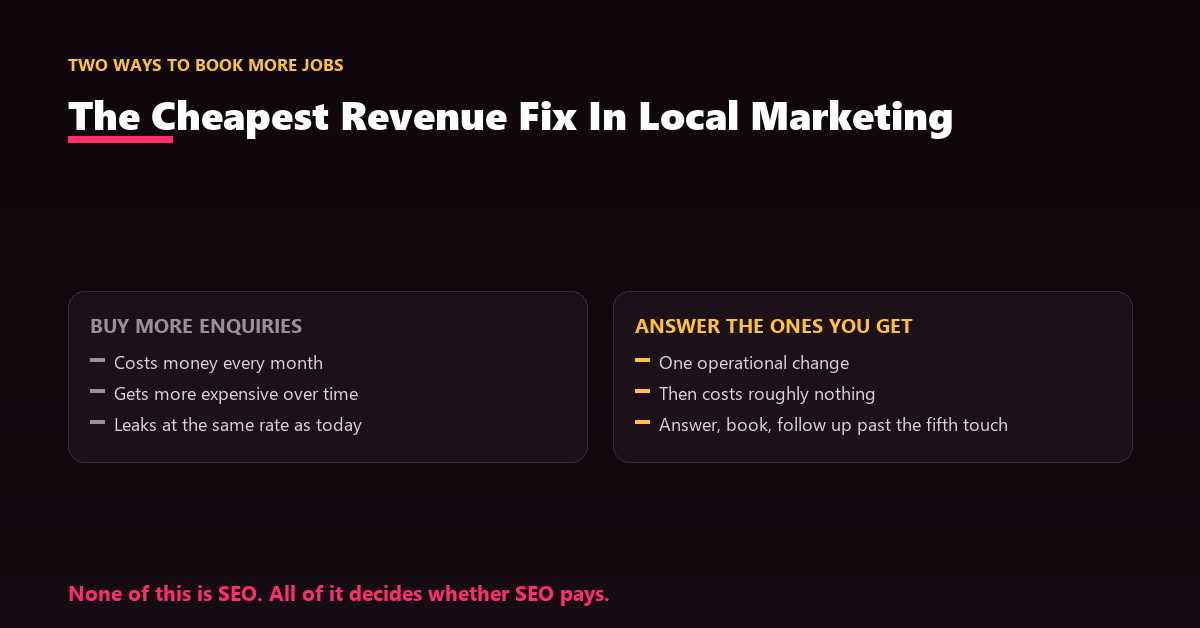
I am not going to invent a return figure, and neither guest gave one. But the shape of the comparison is not controversial: buying more enquiries costs money every month and gets more expensive; answering the enquiries you already receive is a one-off operational change that then costs roughly nothing.
Tope’s version of the fix was structural rather than technological, and it is the detail most people skip. He did not just assign the phone to someone — he made it their sole job, and he was explicit that the person needs slack in their day to be able to pick up. His analogy is a fire department: you do not want them running from fire to fire, you want them able to respond when the call comes. A receptionist booked solid all day cannot answer the phone, whatever the org chart says.
Melendy’s addition, from the vendor side, is worth knowing before you buy an answering service. His test question is whether they can actually schedule an appointment, and he says the ones he has called cannot — they take a message and forward it, which reintroduces exactly the delay you paid to remove. When he put that to a roofing client, he says the client went quiet for about forty-five seconds and then conceded the point.
So the practical order is: answer, book, then follow up more than once. None of that is SEO. All of it determines whether SEO pays. More on how I think about the wider picture in small business and local, on measurement in SEO ROI, and on the basics in SEO basics for small business.