I have built a reasonable number of links in Cookeville, and not one of them came from an outreach campaign. Every single one started as a conversation with a person, usually about something other than a website. For years I treated that as an embarrassing lack of process. Apurva Bose reframed it as the process.
Bose’s Framing And Why It Landed
Bose runs Overtake Digital and put it this way on Unscripted SEO:
local link building transcends mere online interactions; it’s fundamentally about establishing and nurturing real-world business relationships within the community.
— Apurva Bose, Overtake Digital, Unscripted SEO
What landed for me was the scope he puts around it. He is explicit that the relationships should not be limited to your own business niche — that it means charity events, community networking, being present across a broad spectrum of the local community rather than only among businesses in your sector.
That directly contradicts how I was taught to prospect. Relevance-first vetting, applied mechanically, tells you to ignore the amateur football club and the church hall renovation committee, because they are topically unrelated. Locally that filter is wrong, because the thing being built is not topical adjacency. It is standing.
He also says something practical that most agencies would rather not hear: because these organisations get so much email, a more direct approach — phone calls or personal visits — can be more effective. That is my whole experience, stated more politely than I would have stated it.
Three Cookeville Links That Started As Coffee
My own examples, offered as illustration rather than as anything Bose prescribed. All three are ordinary, which is the point.
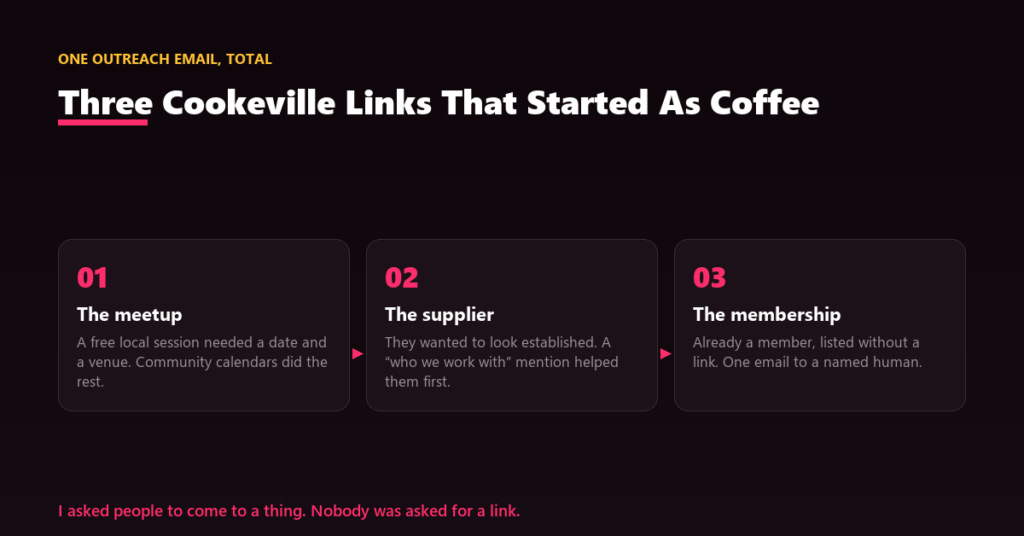
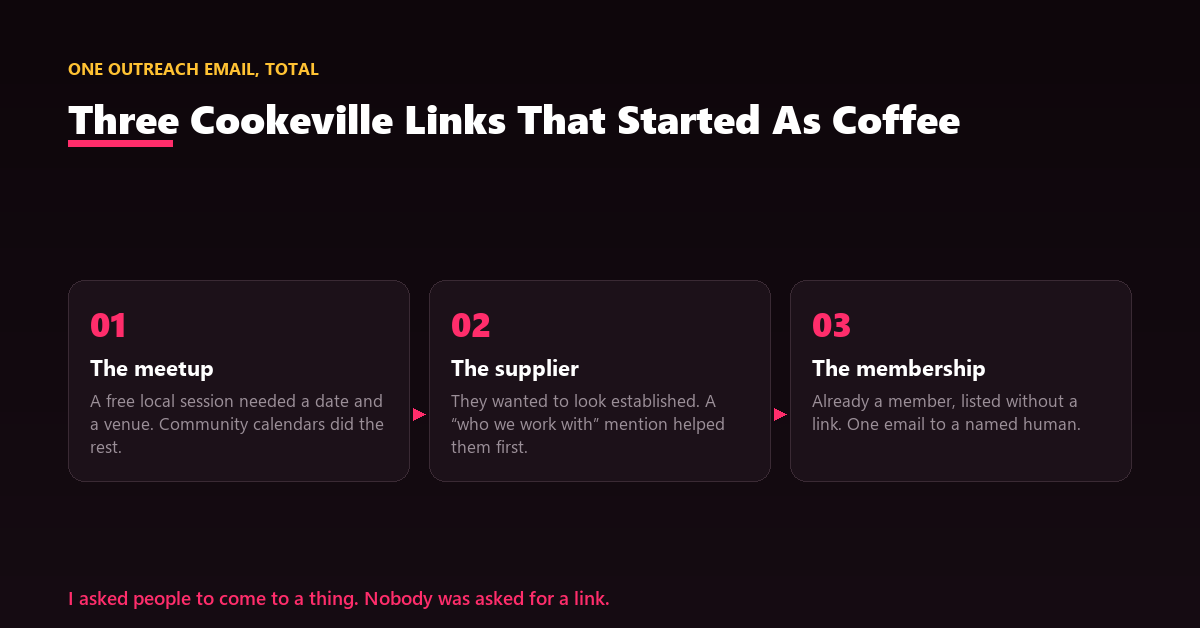
- The meetup that became a listing. I ran a free coffee-and-links session locally. It needed a venue, a date and somewhere to point people, so it went on community calendars — which are pages other people maintain and which linked back. I did not ask anyone for a link; I asked people to come to a thing.
- The supplier who needed a case study more than I did. A local business I had helped wanted to look established on their own site. Adding a “who we work with” mention helped them. It is the pattern Bose describes as joint partnerships between complementary businesses, and the initiative came from their side.
- The organisation I was already a member of. Listed, but with no link. One email to a named human fixed it in a day. Bose flags exactly this case — already a member but not listed, or listed without a link — and it is the highest-yield hour in local link building.
Total outreach emails sent across all three: one, and it went to someone who already knew my name.
The Ask That Does Not Feel Like An Ask
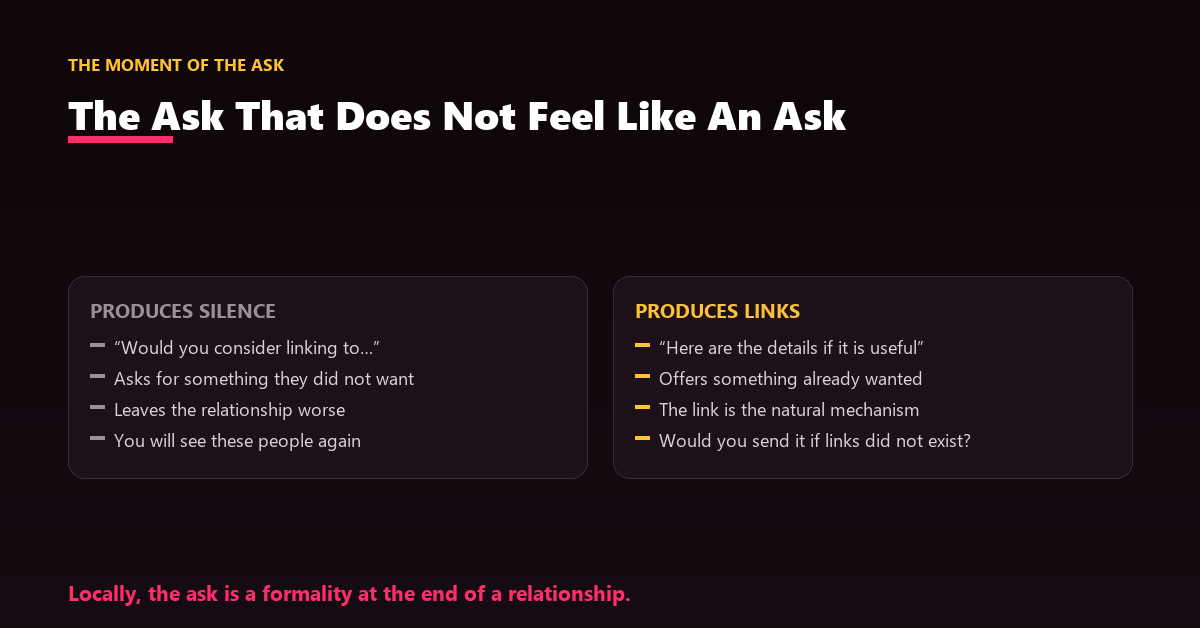
Bose stresses that this requires the business owner’s active participation to stay authentic, and consistent presence rather than a campaign. My addition is about the moment of the ask, which is where most people either flinch or overreach.
The version that works is not an ask at all. It is offering something the other party already wanted, where a link is the natural mechanism. “We are running X on the fourteenth, here are the details if it is useful for your newsletter” produces links. “Would you consider linking to our services page” produces silence and a slightly worse relationship than you had before.
The test I apply: would I still send this message if links did not exist? If the answer is no, the recipient will feel it, because locally you will see these people again.
Why This Does Not Scale And Should Not
Every agency that encounters this asks how to systematise it, and the honest answer is that the part that works is the part that cannot be systematised. You can systematise the record-keeping — who, when, what came of it — and you should. You cannot systematise being a person that other people in a town want to help.
That is a limitation, and it is also the moat. Bose’s related point is that in local SEO the emphasis should move toward shared audiences rather than link authority, and that there is a human element to it that is doing the actual work. A competitor with a bigger budget cannot buy nine years of showing up. They can outspend you on content in an afternoon.
So my advice to local businesses is deliberately unimpressive: pick a smaller number of organisations, actually turn up, and keep a record so you notice when four months have gone by without contact. The links arrive as a byproduct, which is the only reliable way I have seen them arrive.
The write-up of the meetup itself is in coffee and links, Cookeville. The local practice is on Cookeville SEO, and the broader category is small business and local.