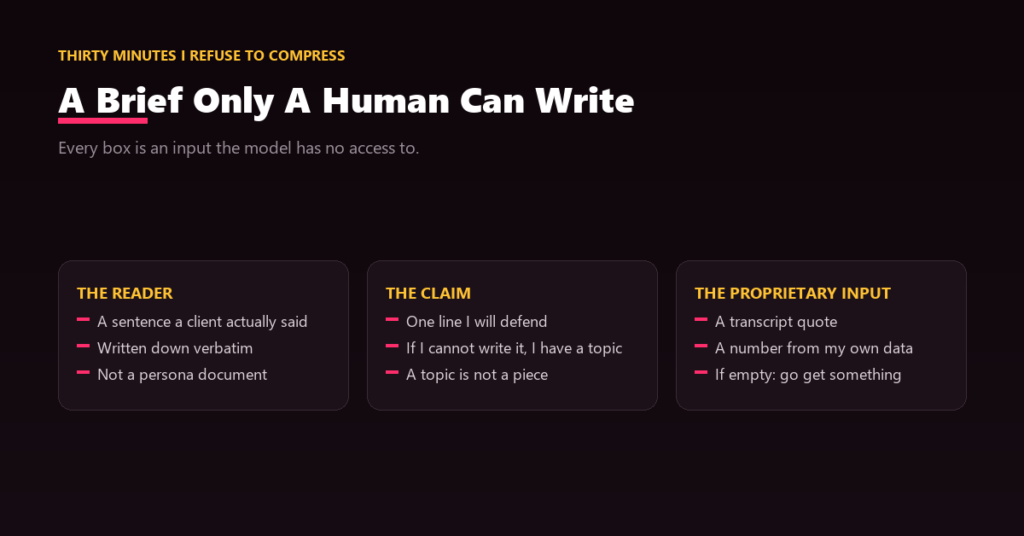
I spent about a year using these tools in the wrong place and could not work out why the output felt hollow. The workflow looked sensible: automate the tedious upfront work, keep the human on the writing, let the machine clean up afterwards. Nick Eubanks explained why that is precisely backwards, and rearranging it changed my output more than any prompt ever has.
A Lot Of Agencies Have It Exactly Backwards
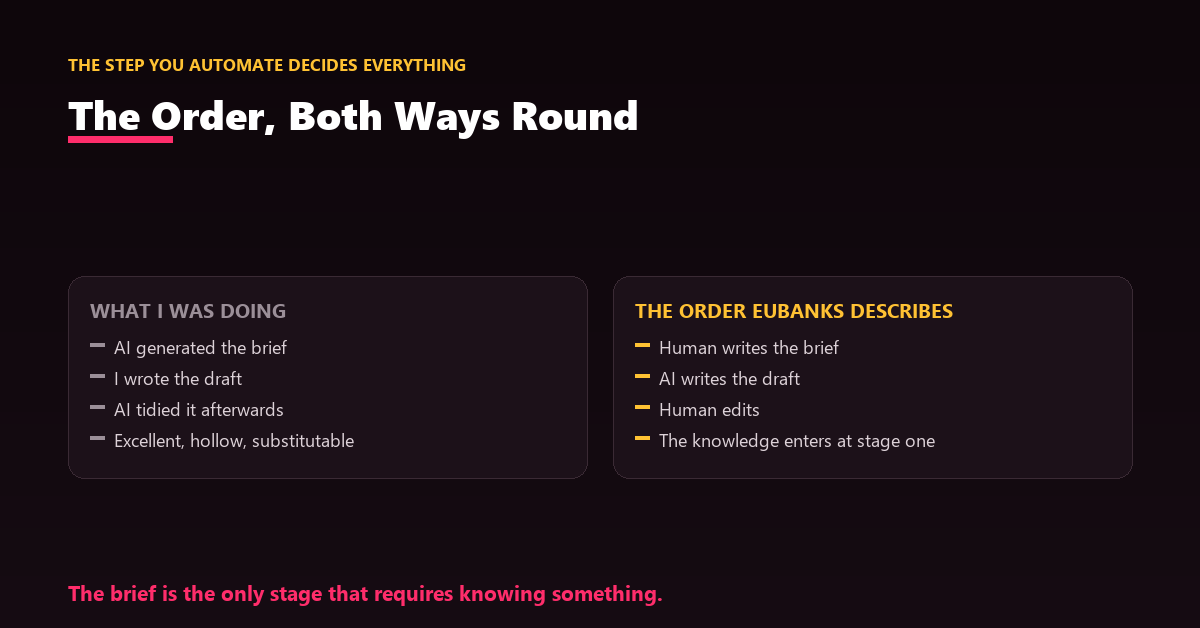
Eubanks is not an AI sceptic — he says building content workflows around these tools is not really optional any more. His objection is to which step gets automated. He describes the brief as the thing everyone reached for first, because it was painful and expensive: answer five questions in a form, generate the brief in five minutes, still charge for it.
I think it’s completely backwards. Where I think things are better… the best results that I’ve seen from a content perspective is where it’s humans actually doing the brief still and then it’s AI writing the draft and then it’s humans doing the editing.
— Nick Eubanks, Unscripted SEO
One precision note, since this quote is going to get flattened by everyone who repeats it: he says “a lot of people, a lot of agencies… or maybe even in-house teams” have it wrong. He does not say most. I am not going to upgrade his estimate for him, and the argument does not need it.
Why it is backwards, once you see it: the brief is the only stage that requires knowing something. It is where you decide what the company uniquely knows, who this is for, and what claim you are prepared to defend. Automate that and every later step is working on a synthesis of what was already public. The draft can be excellent and still contain nothing that was not already on the internet.
What Goes Into A Brief Only A Human Can Write
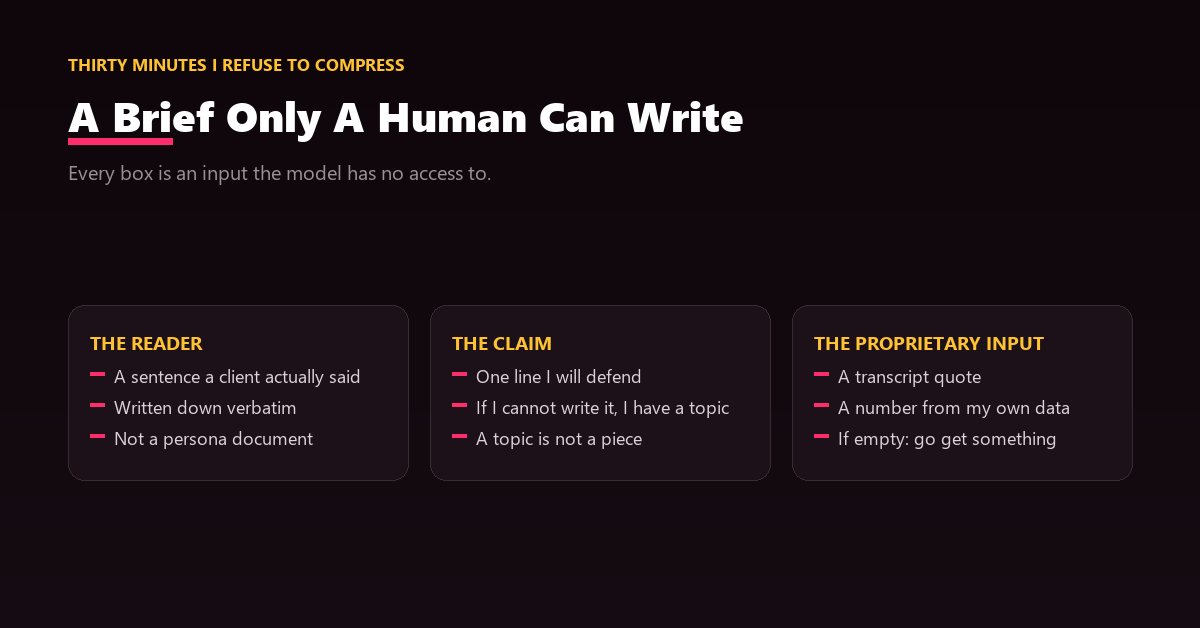
My template after taking this seriously. Everything here is an input the model has no access to, which is the test for whether it belongs in the brief.
- The specific reader problem. Not a persona. The sentence a real client actually said on a call, written down verbatim.
- The claim I am prepared to defend. One line. If I cannot write it, I do not yet have a piece — I have a topic, which is not the same thing.
- The proprietary input. The transcript quote, the number from my own data, the engagement I can describe with permission. If this box is empty, the piece is going to be substitutable and I should either go get something or not write it.
- What I am not going to say. Positions I have moved away from, claims I cannot support, the tempting overstatement I know I will drift toward.
- The structure the argument requires. Not the structure the SERP suggests. Those are frequently the same and when they are not, the SERP is describing what already exists.
That takes me thirty to forty minutes and it is the only part of the process I refuse to compress.
Where I Let The Model Do Real Work
Everything downstream of a good brief, honestly and without embarrassment: expanding the structure into prose, producing alternative phrasings when a paragraph will not sit right, reorganising an argument I have written badly, generating the boring connective tissue between sections I care about.
The constraint is that it is working from a document containing things it could not have known. Given a brief with a verbatim quote from an interview I conducted, a number from my own client data and a position I have committed to, the draft comes back containing those things. Given a brief generated from the top ten results, it comes back containing the top ten results.
That is the whole mechanism, and it is why the argument is about sequence rather than about the tool being good or bad.
The Edit Pass That Catches Everything
Eubanks’ third stage. My version has four checks and I run them in this order because each is cheaper than the one after it.
- Is the proprietary input actually present? If it was in the brief and is not in the draft, the draft is incomplete, however well it reads. This catches more problems than the other three combined.
- Is every quote verbatim? Back to the transcript, every time. A smoothed quote reads better and is a fabrication, and this is the failure I have personally had to correct most often.
- Is every claim mine to make? Sourced, or my own data, or cut. Confident sentences with no origin are the characteristic failure of a draft written from a synthesis.
- Does it still say the thing? Read the brief’s one-line claim, then read the piece. Drafts drift toward the agreeable middle and the edit is where you drag them back.
None of this is a purity position. I use these tools every day. The argument is only that they belong in the middle of the process, where the judgement has already been supplied and has not yet been checked. More on where this leads in the content library no competitor can copy and distribution is the last moat. Everything else is on the blog.