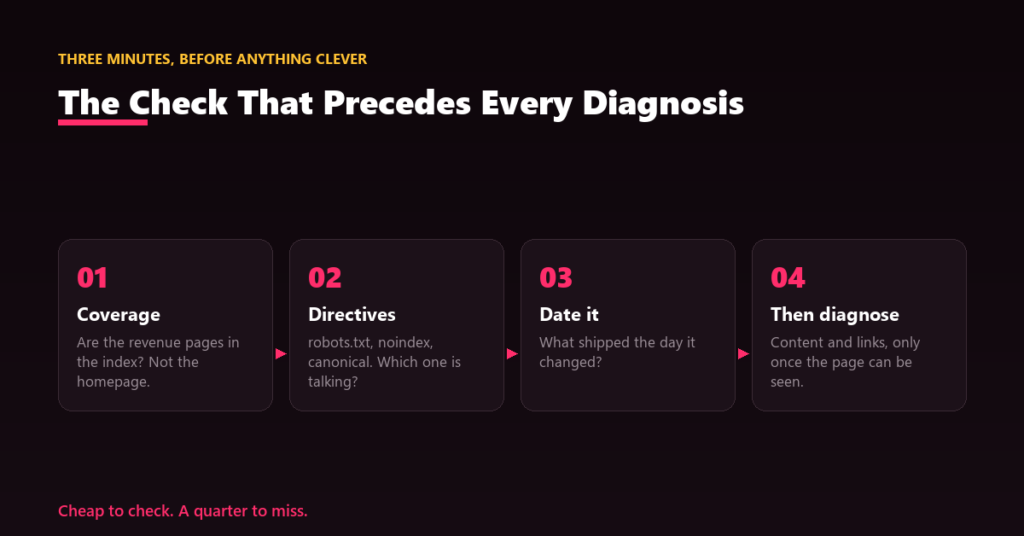
Three times in my career I have got onto a client call ready to explain a traffic decline with something clever, and been wrong in a way that was cheap to check and embarrassing to have missed. Matt Mellinger’s opener has since saved me from a fourth.
The Check That Precedes Every Diagnosis
Mellinger co-founded SEO Gets and runs a boutique local SEO agency. He was describing businesses that came to him after paying other providers — retainers between a few hundred and a few thousand a month — with fundamentals missing. No meta descriptions, no proper title tags, and in one case something worse:
There was a case that the site wasn’t even being indexed. They had a robots TXT. And I’m like, you’re paying an SEO company and your site isn’t even indexed.
— Matt Mellinger, SEO Gets / Local SEO Partners, Unscripted SEO
It is a heated subject for him, and he does not pretend otherwise — he describes a churn-and-burn segment of the industry that treats twelve months of retainer as the product regardless of outcome, and says his own father was on the receiving end of it. When he asked that provider for six months of Search Console data, he was told there was none. His response at the time: then how are you knowing what’s working?
I want to be fair about the scope of the claim: that is his account of what he has seen, not a survey of the industry. But the operational lesson does not depend on how common it is. The check costs three minutes and skipping it can cost a quarter.
Three Ways Pages Quietly Fall Out Of The Index
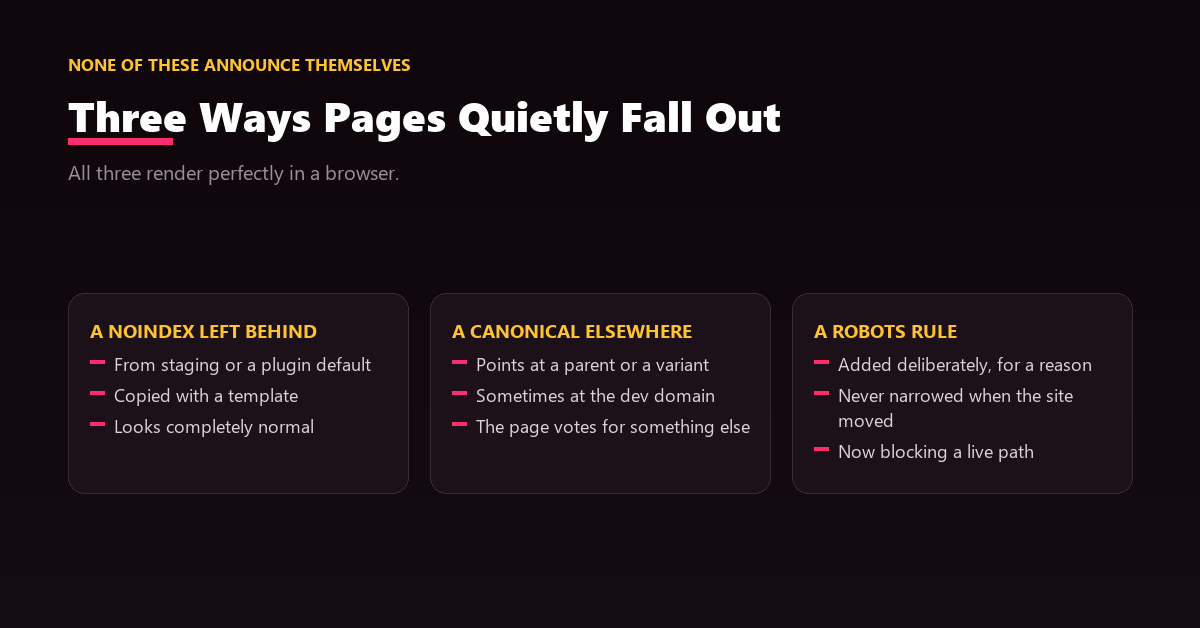
My own list, from the ones I have actually been caught by. None of these announce themselves and all three survive a superficial look at the site, because the page renders perfectly in a browser.
- A noindex left behind. Usually from a staging environment, a plugin default, or a template that was copied. The page looks completely normal to a human.
- A canonical pointing somewhere else. Often to a parent page, a parameterised variant, or, memorably, to the development domain. The page is fine; it is voting for something else.
- A robots rule blocking a path. Frequently added deliberately for a good reason and then not narrowed when the site structure changed underneath it.
The pattern is that all three are usually introduced by a legitimate change made by someone competent, which is why nobody suspects them. Ask what changed and when, and line the date up against the chart before theorising about anything else.
Reading Page-Level Data Like Mellinger Does
The other thing worth stealing from him is where he looks. Because he is building a Search Console tool, he has been examining the data for a case study, and his finding concerns the completeness of the query export.
His account: the share of clicks the exported queries account for varies enormously because of anonymised queries — he gives a range from roughly five per cent on a very small site up to around seventy per cent. But at page level, in his words, “it shows you 100 % of the clicks almost every time.” His conclusion is that if you want accuracy you need to go to the page level, which most people do not, because everyone works at the query level by habit.
He is transparent that this came out of a study still in progress, including one anomaly he triple-checked and could not explain. I am repeating it with the same caveat he gave it. What I have changed in my own practice is simply the order: page level first to see what actually moved, query level afterwards to guess why.
His broader framing is the one I now use with clients who want precision that does not exist. The only numbers he treats as exact are leads and revenue; everything else is directional and should be read for patterns and anomalies. Numbers tell a story, and a number without context means nothing.
What To Do In The First Hour After You Find It
If the check comes back bad, the first hour matters more than the following week.
- Confirm the mechanism before touching anything. Know whether it is robots, a noindex or a canonical. Removing the wrong one wastes the recovery window and muddies the evidence.
- Date it. Find when it was introduced and what else shipped that day. This is the difference between a fix and a recurrence.
- Fix, then verify at page level. Not that the tag has gone — that the specific URLs are being crawled and returning.
- Tell the client in writing, plainly, the same day. Including if it was your error. I have had to do this and it is a better conversation than the one where they find out later.
- Add it to the monthly checklist. Mellinger’s own onboarding answer ends on documented SOPs for precisely this reason: if you rely on remembering, you will eventually not remember.
If you want this run properly on a site, that is a technical SEO audit. The principles are on search fundamentals, and everything else is on the blog.