I have written a lot of long guides. Some of them rank, a few earn links, and none of them have ever been linked to the way a small useful tool gets linked to. Christopher Gimmer explained why in one sentence, and it has been quietly reorganising what I recommend ever since.
Why The Wall Of Text Does Not Get Linked
Gimmer bootstrapped Snappa and now runs GoodMetrics. His observation came out of a discussion about how much harder traditional link building has become — his framing is that everyone’s inbox is full of spam, so the outreach route has degraded. Then:
I think people are more willing and likely to link out to a really good tool that actually solves a problem versus yet another blog post with a wall of text.
— Christopher Gimmer, Snappa / GoodMetrics, Unscripted SEO
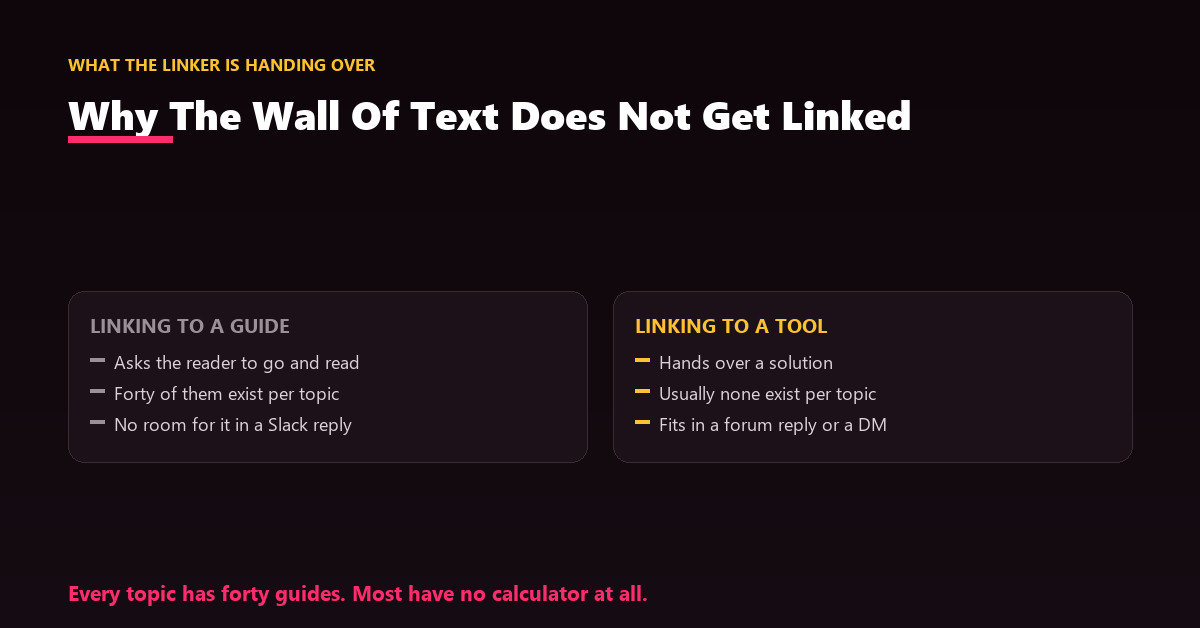
The mechanism, once you sit with it, is about what the linker gets. Linking to an article asks the reader to go and read something. Linking to a tool hands them a solution to the problem currently in front of them. The second is a more generous thing to do, so people do it more readily, and they do it in contexts where no article would fit — forum replies, Slack threads, answers to a colleague.
The other half is competition. Every topic has forty comprehensive guides. Most topics have no calculator at all.
Five Tools A One-Person Shop Could Ship
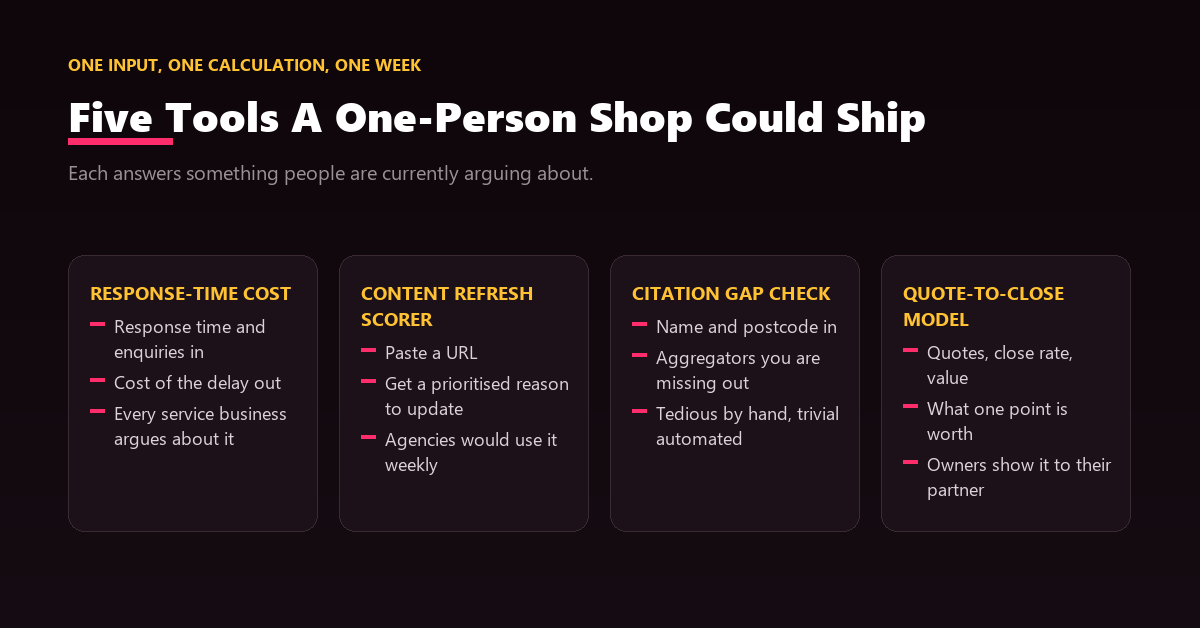
My own list, sized for a consultant rather than a product team. The constraint I use: one input, one calculation, one shareable result, shippable in a week.
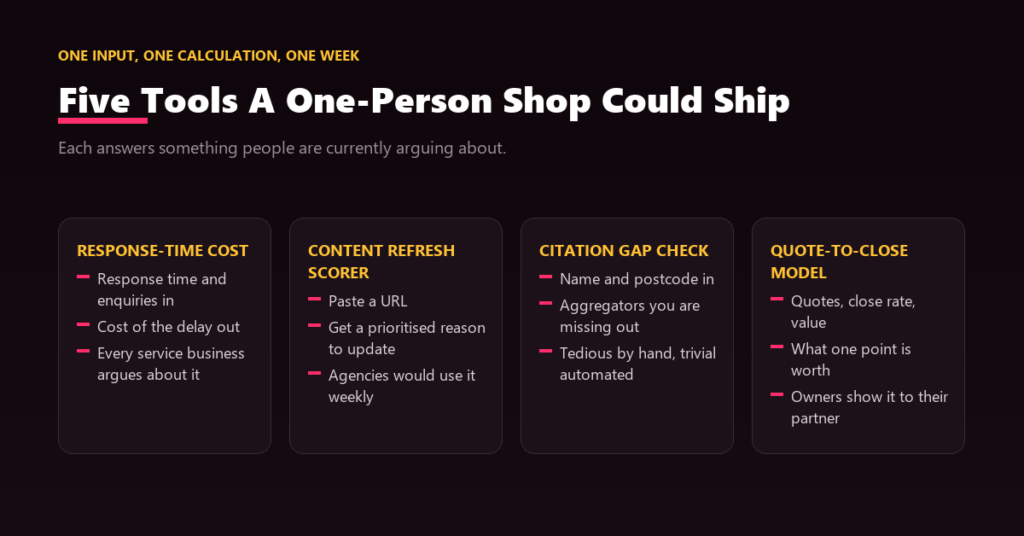
- A lead response-time calculator. Enter your average response time and monthly enquiries; return the estimated cost of the delay. Every service business argues about this and none of them have modelled it.
- A content refresh scorer. Paste a URL, get a prioritised reason to update it — age, decay, thinness. Agencies would use this weekly.
- A migration risk checklist generator. Answer eight questions about scope, get a specific list of what will break. Boring, unglamorous, and the kind of thing people send to their developer.
- A local citation gap check. Name and postcode in, the aggregators you are missing out. Genuinely useful and genuinely tedious to do by hand.
- A quote-to-close model. Enter quotes issued, close rate, average value; return what a one-point improvement is worth. Owners share this with their business partner, which is a distribution mechanism no article has.
The unifying property is that all five answer a question somebody is currently arguing about, and produce a number they will want to show to a second person.
The Data You Are Sitting On Already
The most common objection is not knowing what the tool would calculate, and the answer is usually in work you have already done. Benchmarks from your own client base, pricing you have seen across dozens of quotes, timings you have measured, failure rates you have observed — all of it is data nobody else has and most of it is currently sitting in old spreadsheets.
Two disciplines make it usable rather than embarrassing. State the sample and the period, because an undated benchmark with no denominator gets dismissed the first time someone competent looks at it. And keep client data properly aggregated — the tool should output a pattern, never anything traceable to an individual account.
Done properly this compounds with the citation argument: a tool built on a number nobody else has is not just linkable, it is quotable, because the number itself becomes the thing people repeat.
What Maintenance Actually Costs
The honest part, and the reason I do not recommend this to everyone. A tool is not a publication, it is a liability with an uptime requirement. Articles decay quietly; tools break loudly, and a broken tool is worse than no tool because every link now points at an error.
What it actually costs, from having done it: hosting and a domain, which is trivial; somewhere between one and four hours a quarter for dependency updates; and an unpredictable afternoon whenever an underlying assumption changes — a data source moves, a rate changes, a platform deprecates something. Budget the afternoon before you build, not after.
So the honest recommendation is to build one, not five, and to pick the one whose underlying logic is least likely to move. A calculator built on arithmetic you control will outlive one built on somebody else’s API by years, and the links only keep their value while the thing they point at still works.
The full conversation with Gimmer is in robots with wallets. How I build linkable assets out of interviews is in podcast-powered link building and SEO production, and the rest is on the blog.