The day before I recorded this interview I published a finding across seven platforms. A query on my site showed ten searches a month in the keyword tools. Search Console showed eleven hundred impressions for that same query that same month. I said the tools were undercounting real demand by about seven times. Then the daily export showed 52% of those impressions landing inside three days in July 2025, at position 72, with zero clicks.
So I asked Gert Mellak about it on tape, because he has twenty years in and I wanted somebody to tell me I was wrong.
He told me I was right, and then took a bigger swing than I was ready for.
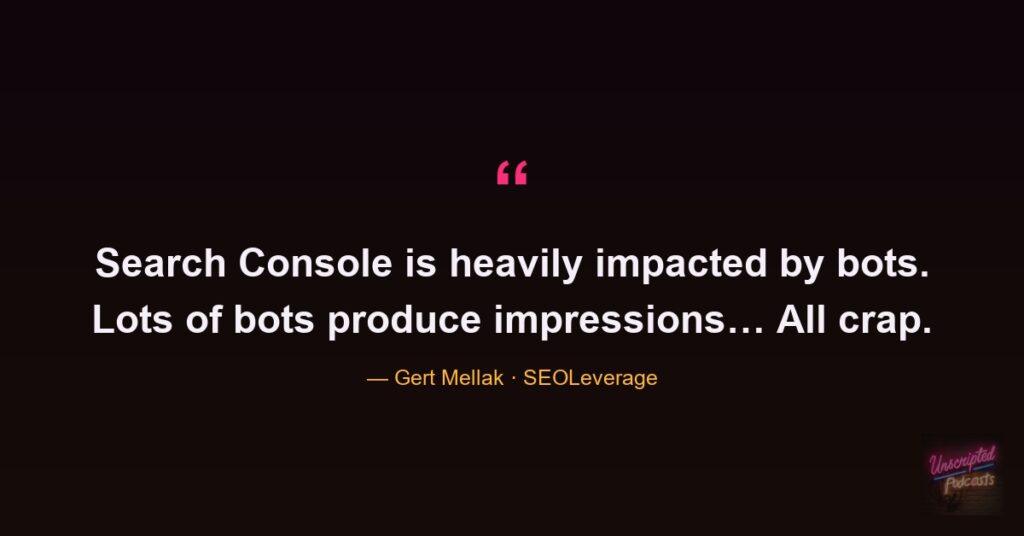
“We know now that Search Console is heavily impacted by bots. Lots of bots produce impressions. I used to use impressions all the time. A few months ago, still, I talked about impressions, and look, we are more visible, etc. All crap. Because we know bots are creating impressions and Google doesn’t care to filter them, apparently.”
Gert Mellak
That is independent confirmation of the thing I had published twenty-four hours earlier, arrived at from client work instead of from my own spreadsheet. I have written about Search Console data being inaccurate before. Having someone else land on it without seeing my post is a different kind of proof.
Then he came for the rest of it
The confirmation was the easy part. What he said next is the reason I am still chewing on this episode.
“The main challenge we have right now is to explain to C-level executives that the ROI on SEO is not measurable on its own. Unless you make a hundred and fifty assumptions that are all flawed on its own, coming with data from platforms that are all flawed on their own, and you accept this as the source of truth.”
Gert Mellak
My honest reaction on the recording was “Whew. Hold on, give me a second, because that’s a deep challenge to twenty years of SEO.”
I built the thing he is describing. I still have a keyword cluster tool that takes search volume, multiplies it against a conversion rate and a CTR table, and builds buckets out of the result. It has been in my kit since I was making SERPs, before I turned that into my agency site. And I always knew the CTR tables were shaky. I told myself I was using the numbers directionally. If all the volume numbers are flawed in the same way, you can still compare them to each other. That was my defense for years.
The problem is that the flaw is not uniform. Money keywords get scraped more, so they inflate more. The comparison is not clean either.
The num=100 thing was the tell
When Google removed the ability to pull a hundred results per page, my impressions dropped by 50% overnight. My first reaction was that half the internet was gone. Then it clicked:
“That means every search volume that we’ve seen, that’s a ton of scraping, especially for money keywords. And the more money that those keywords have, the more scraped they are, the higher the search volume.”
Jeremy Rivera
It gets worse on the click side. Cross-referencing Google Analytics with Microsoft Clarity on a project, Analytics had a hundred clicks total and fifty fell into direct. Clarity showed those fifty were bots. I had been about to tell myself that unattributed direct was my organic work leaking. It was machines.
I conceded on air
About twenty-three minutes in I told him I was going to declare victory for him in the social post afterwards. He wins for losing.
Here is what made it easy to say. My methodology had already flipped without me announcing it. I only do keyword research as a secondary process now. I would rather get somebody on an interview, have them talk, and pull the first cut of keywords out of what they actually said. I had been doing that for months while still opening the volume tool first out of habit.
He works the same way. Start with an interview, extract the vocabulary, look at the forms, see how clients talk about it versus how the brand talks about it. Check the volume tools last, and only for a directional read.
What I am changing
The impressions column comes out of my reporting. I am not going to caveat it into a footnote. If I cannot filter the bots out, I will not put the number in front of a client.
I am stealing his high-intent metric. He defines it as a soft conversion: people landing on the key pages they hit before they convert. Service page, pricing page, course page. It counts across every channel, which sidesteps the whole attribution fight, and it does not care what Google reported.
And I am keeping the frame he closed on. Nobody sells a trip to Hawaii by describing how good the plane is, but that is what SEOs do all day. We are one wheel in the machine that gets the brand to Hawaii. An important wheel. Still a wheel. A wheel does not need absolute truth from its instruments. It needs enough of a directional read to know which way to turn.
The framework behind that is his Search Everywhere Optimization Pyramid, live on Search Engine Land. It starts with a thought experiment I have not been able to shake: “Imagine you do SEO, but search engines don’t exist.”
Gert is at gertmellak.com and on LinkedIn. Go get challenged.
The full breakdown of the episode, with the rest of what he said about reporting, is on Unscripted SEO.