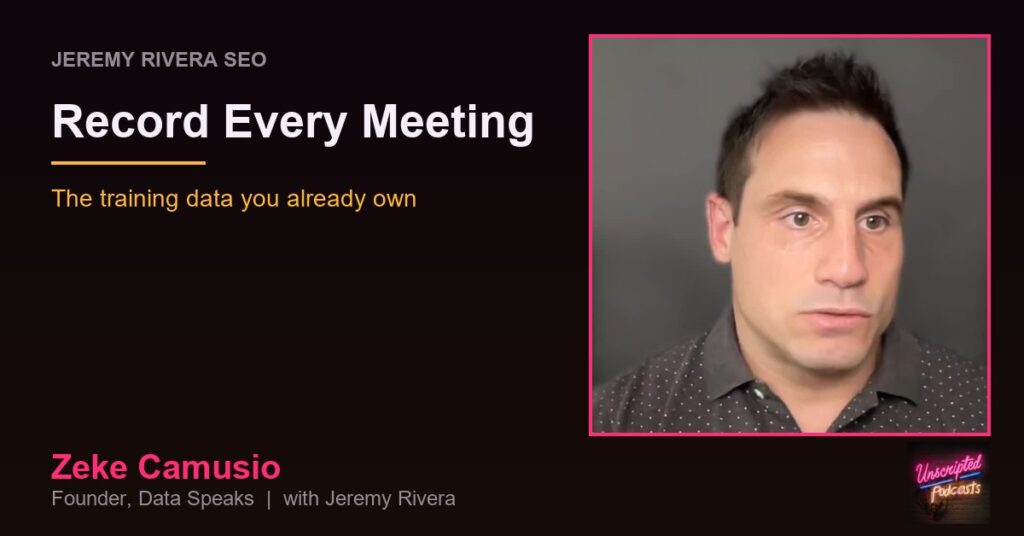
You’re already sitting on the best training data your business will ever have, and most of it is evaporating after every call. That was the line from Zeke Camusio that I kept thinking about after we stopped recording. Zeke runs Data Speaks, a marketing measurement company, and he spends his days building machine learning models for brands with serious ad budgets. His advice to those clients is almost embarrassingly simple: record every meeting. Tom Girgash makes the same case from the product side: AI answers are only useful when they are grounded in your own work. You can watch the full episode here or listen on Castos.
The data you need for AI already exists
I’d asked Zeke how a local business should think about geography in its campaigns. He admitted it wasn’t his area, then made a bigger point about AI with the right prompting.
“The data that you’re going to need one day to make the AI really good, you’ve been creating that for years. So that could be customer reviews. It could be product copy. It could be video scripts, every email your support team ever sent.”
Think about what’s in your inbox right now. Every question a customer asked before they bought. Every objection your salesperson handled. Every review that says, in the customer’s own words, why they picked you. None of it is in a spreadsheet, and all of it describes how your buyers actually talk.
Record every meeting, because every client call is data
Zeke said meetings are the one thing that doesn’t get captured unless you choose to capture it.
“I recommend to our clients, record every meeting. That’s one of the things that is not always automatically recorded unless you actually do it. But every time you talk to a client, that’s data that can later be used to create documentation and content.”
His argument is that you might jump into AI a little later than everyone else and still come out ahead, because on top of the foundation models you’ll have years of your own data to fine-tune with. The cost of keeping a recording is close to nothing. The cost of not having it shows up later.
Sales calls are SEO copy you haven’t mined yet
This hit home because I’d seen it work. I once worked with an outfit that recorded all of its sales calls, sorted them into winners and losers, and analyzed what happened on each. What were the themes? What were the pitches? What were the hooks the salesperson used? I asked if I could have it for SEO, and they said, “yeah, I guess so. We only used it for sales.”
That’s gold. The words a prospect uses on a call are the words they type into Google, or into ChatGPT. The objection that comes up on every third call is a page you should already have. The hook that closes deals is your title tag. I’ve written before about marketing through conversations instead of ads, and this is the same idea pointed at your own archive.
Here’s what you can do with recordings this week:
- Pull the five most common questions from your last 20 sales calls and check whether your site answers each one in plain words.
- Copy the exact phrases customers use to describe their problem and compare them with the words on your service pages.
- Mark the calls that closed and the ones that didn’t, then look for the objection that shows up in the losers.
Human conversation is getting more valuable, not less
I told Zeke I think conversations like ours are going to become more valuable as other data sources fill up with stuff that came out of LLM tools in the first place. Copy-pasted AI marketing material gets recycled into the next model, and you end up with an uninteresting soup of insights. Real people arguing about real work is the thing the machines can’t generate.
Zeke added that this is exactly where LLMs shine. Structured data you can chart. Unstructured data, like phone conversations, reviews and customer journeys where every one is different, used to take a human forever to read.
“LLMs are amazing at that. So you can ask, where are people dropping off on my funnel?”
His example: a store gets far more product page views than the industry benchmark but a much lower add-to-cart rate, and the model points out the products don’t have many reviews. A human could find that. It would just take weeks.
Better prompts come from better leadership
Recordings only help if you can ask good questions of them. Zeke compared prompting to running a team: “in the same way that you are a better leader of your organization, if you can communicate clearly what you want to your employees, you’re going to be a better user of AI if you can communicate to AI what you want out of it.” He doesn’t expect that skill to ever become less valuable.
His own habit is worth stealing. Instead of telling the AI to just do the thing, he says he thinks he wants to go in a direction but isn’t sure, and asks what he’s overlooking and which assumptions might be wrong. Treat it like an expert you hired, not a vending machine.
This connects to something I keep coming back to: traffic is a proxy, and the real signal is what customers say and do. Zeke’s main work is in attribution, and you can hear the rest of that, including why he says 36 cents of every ad dollar is wasted, in the full episode recap on Unscripted SEO.
So when was the last time you listened back to one of your own sales calls? And what would your website say if you rewrote it in your customers’ words?