I host a podcast, which means I am asked fairly often why I also spend time as a guest on other people’s. The honest answer is that they do different jobs, and for a while I was doing one of them badly because I assumed hosting covered both.
This is the ledger, including the parts that do not flatter the format.
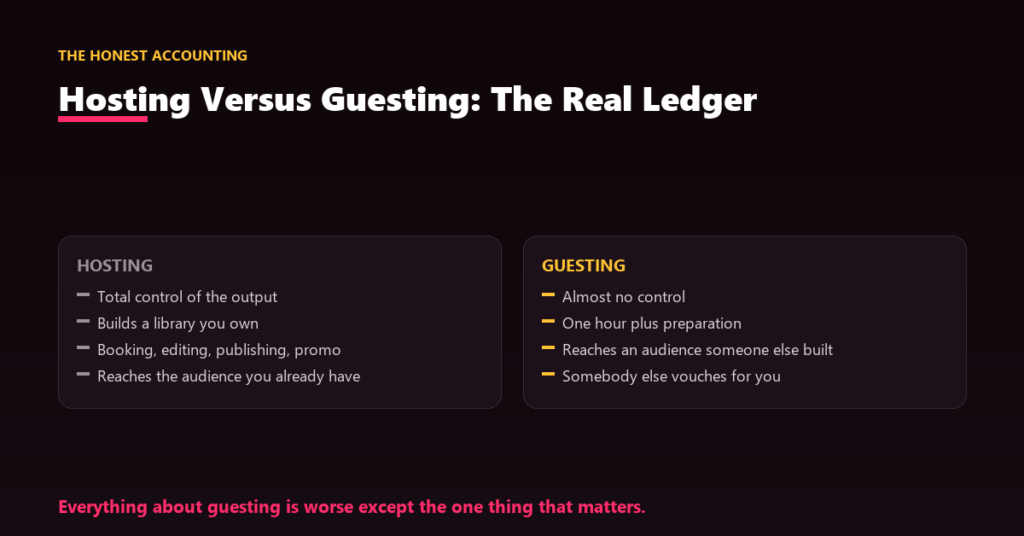
Hosting Versus Guesting: The Real Ledger
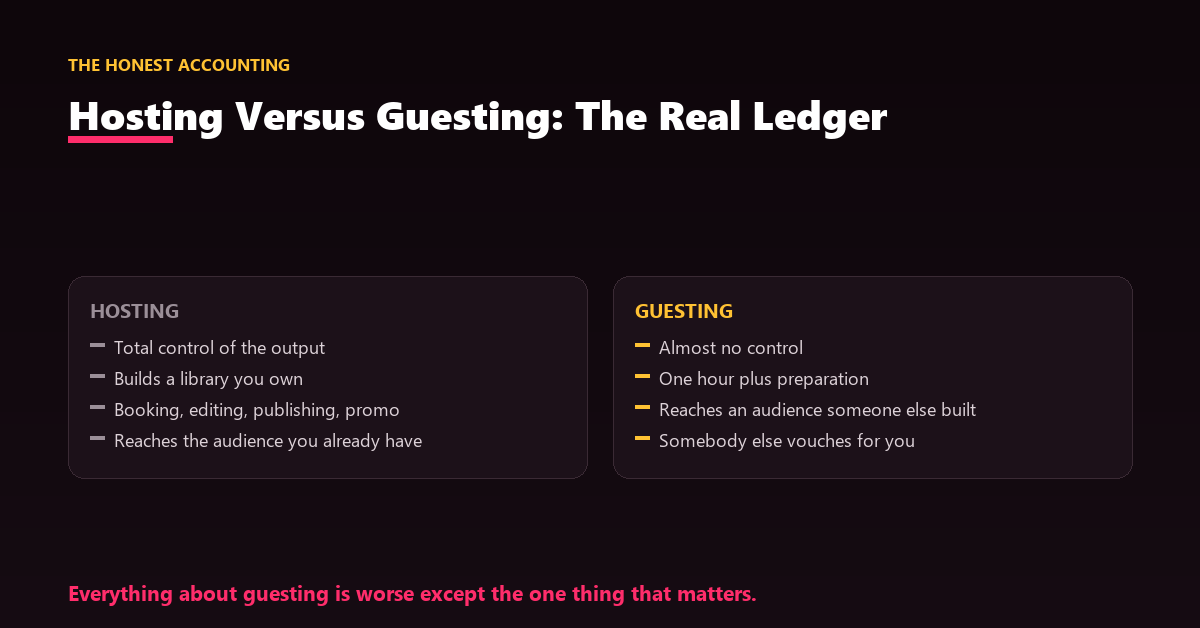
Hosting gives you control, a library, and a reason to talk to people who would never take a sales call. It costs an enormous amount — booking, recording, editing, publishing, promotion — and every episode reaches whatever audience you have already built.
Guesting costs an hour plus preparation, gives you almost no control over the output, and reaches an audience somebody else spent years assembling. That last clause is the whole argument. Everything else about guesting is worse.
Greg Digneo, who ran growth at Time Doctor and now runs Content Guppy, gave me the framing I use for why the second column matters. His point was about ownership of distribution:
the truth is you don’t own the distribution that you’re getting from Google. And so don’t rely on it. Leverage it for all it’s worth.
— Greg Digneo, Content Guppy, Unscripted SEO
His prescription is to use whatever traffic you have to build channels you do own — a newsletter, a listenership, a subscriber base. Hosting is how you build one of those. Guesting is how you borrow somebody else’s while you do.
Digneo also described where the brand awareness at Time Doctor actually came from, and it was not the blog alone. He says inbound and outbound conversations were warmer because people already knew them — they had signed up for the newsletter and forgotten, or read the blog once, “or because they had heard us on a podcast.” That is the mechanism, in his words, from the buyer’s side.
To be precise about what he did and did not claim: Digneo did not tell me that guesting outperforms reworking your own content, and I am not going to put that in his mouth. What he argued was that the off-site surfaces — Reddit, other publications, podcasts, YouTube — are where the brand conversation now happens, and that an SEO focused only on links and content is siloed. The ledger below is mine.
What A Guest Spot Produces That A Blog Post Cannot
My own accounting, from having done a lot of both:
- Somebody else vouches for you. A host putting you in front of their audience is an endorsement. Nothing you publish on your own domain can manufacture that.
- You say things you would never write. Being asked a question you have not pre-planned produces sharper material than a blank document ever does. Most of my better positions were first said out loud under mild pressure.
- The artefact is on someone else’s domain. A transcript, a set of attributed claims, your name and company in text, on a page the host actively wants to keep live and promote.
- It is durable. Jason Wade made the point that this content keeps working — he described one podcast becoming something like fifty assets. That is his estimate of the ceiling, but the direction matches what I see.
- It compounds socially. Guests introduce you to other hosts. There is no equivalent referral loop for publishing another article.
The thing a blog post does better: precision. If I need to make an exact argument with exact caveats, I write it. Speech is a worse medium for that and I have said things on shows I have had to clarify afterwards.
The Shows I Turn Down And Why
I say no more than I say yes, and the criteria are unglamorous:
- No published episodes in the last two months. A dormant show means my episode ships into silence, if it ships.
- No show notes worth the name. If the last ten episodes have two sentences and no links, mine will too.
- A pitch that does not name a topic. “We would love to have you on to discuss SEO” means they have not listened to anything I have said and neither will their audience.
- Pay to appear. That is advertising. It can be a legitimate purchase, but it should be evaluated as media spend, not as PR.
- An audience with no overlap. Reach that cannot buy anything is a pleasant hour and nothing else.
Wade’s observation about supply is why turning shows down is affordable: very few people are willing to do this consistently. He notes that most podcasts do not survive their first handful of episodes and that only a small fraction of people even say they want to. If you are reliably available and easy to work with, you are not competing for slots.
How I Follow Up So The Link Actually Lands
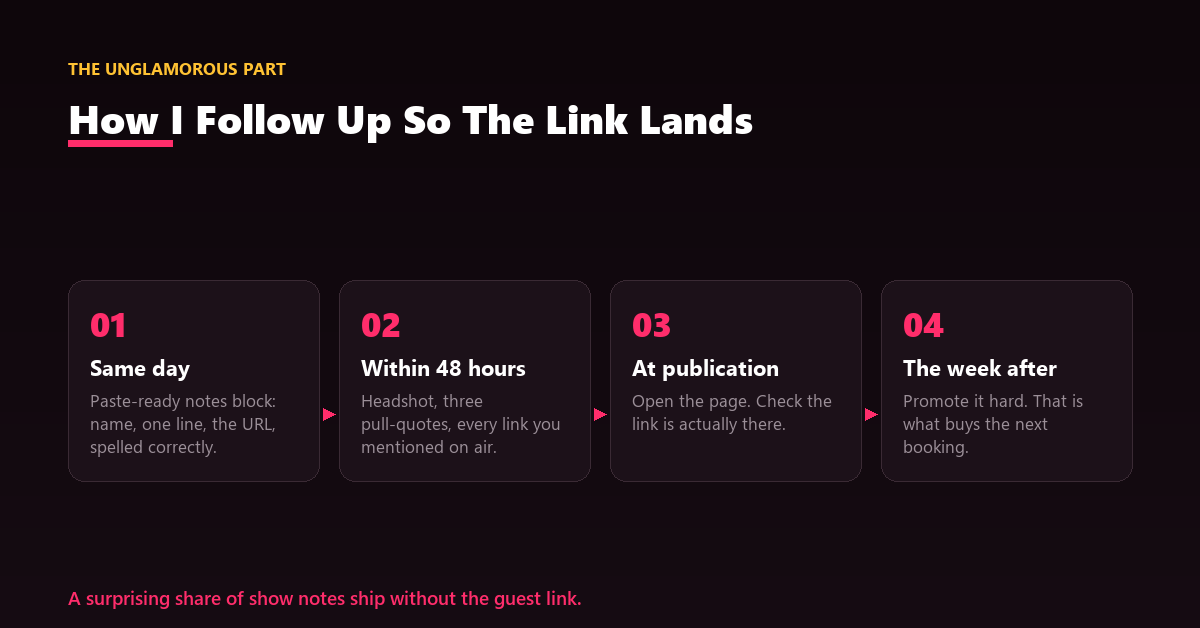
The unglamorous part, and the one that decides whether any of the above counts.
- Same day. Send the host a short block of text containing exactly what should appear in the notes: name, one line, the URL. Correctly spelled, ready to paste.
- Within 48 hours. Anything that reduces their workload — a headshot, three pull-quotes, links to whatever you referenced on air.
- At publication. Open the page and check the link is actually there. A surprising number are not, and a polite note fixes it in a day.
- The week after. Promote it properly from your side. This is what makes the host want you back and what makes them recommend you to other hosts.
More on the host side of this in podcast-powered SEO and the entity argument in from guest seat to authority. What the full production pipeline looks like is in podcast-powered link building and SEO production.