- 1 Why I ignored PR for a decade
- 2 Credibility is what other people say about you
- 3 PR keeps coming up at the wrong two moments
- 4 For a local business, be useful to the community instead of loud about features
- 5 Every reporter was a stranger once
- 6 Hiring a PR agency for a small business: what to settle first
I apologized to a PR guy on my own podcast, and I meant it. From about 2010 to 2020, SEOs like me treated PR people as the folks who sent out press releases full of nofollowed links we didn’t want. Evan Boyer, founder and CEO of Leaders PR, said it was the first apology he’d ever heard from an SEO person. “And I accept,” he added. He started in agencies around 2011, when PR was, in his words, “the redheaded stepchild” next to digital marketing.
If you own a business and you’ve wondered whether PR is worth paying for, this one’s for you. Evan has almost 15 years in PR, works mostly with B2B companies from Raleigh, North Carolina, and changed how I explain credibility to my own clients.
🎧 Listen to this episode
📺 Watch the interview
Why I ignored PR for a decade
I wasn’t being stubborn for no reason. Google had a deal with us: build good content and a good site, and it would send you enough traffic to pay for more content and more links. I once ranked a client I never met, working through an agency contact I never met either. The traffic converted into leads, the leads into sales. Who needed a publicist?
That worked “until Google broke the agreement.” Now your customer asks Claude, forwards the answer to a spouse who uses ChatGPT, saw you on TikTok last week, and then buys. I can’t tell you which of those moments closed the sale. I already admitted I was wrong about press releases. This conversation showed me I’d been wrong about PR as a whole.
Evan has never promised clients attribution. “It’s not about proving attribution for me,” he said. What he watches is whether trust building moves the things you already measure: traffic, conversions and how long it takes a buyer to say yes. His words: “we want to shorten sales cycles.”
Credibility is what other people say about you
Evan’s sharpest point was that expertise and credibility aren’t the same thing. You can have the experience and the expertise, but “you don’t necessarily have the authority and the trust.” Those come from outside: a reporter, a local outlet, a customer who repeats your story. That’s the whole job of PR, as he defines it:
“PR is asking somebody or telling somebody your story who has no reason to tell it to anybody else, no reason to validate it or vouch for you.”
I’ve written that authority is what others say about you, and AI search has made it more true. Evan pointed to research from Ben Wills (I talked to Ben about it on Unscripted SEO) showing that mentions, even without a link, line up with showing up in AI tools almost as strongly as backlinks do. So when a local paper names your business and doesn’t link to it, that still counts. “If you can stack up those mentions over a period of time,” Evan said, there’s real value in it.
PR keeps coming up at the wrong two moments
In my consulting, PR has come up in one of two situations. One client was making precast concrete walls for Florida projects and breaking ground in a new market in Houston, and wanted a press release about it. Another had a founder who did something stupid, and they needed someone fast.
Evan’s response: both are short-term, single-focus asks. The client relationships he’s seen work last years, and you only build a reputation one way:
“the only way really to do that is to make a consistent effort over the long term.”
It’s not “turn the faucet on when those things happen and then turn it back off.” Keep earning coverage, and when someone searches your name, the result already says you are who you say you are. That’s the version of PR that shortens the sales cycle.
For a local business, be useful to the community instead of loud about features
If you run a service-area business, you aren’t pitching national trend stories. Evan said the angle for a smaller business is “what’s happening inside of the community,” like an event coming up that relates to your service. Offer the local outlet something that helps its readers get more out of it.
“It’s less product promotion, feature benefit promotion,” he said, and more of a value add. Readers connect the help back to your company, sign up for your newsletter and follow you. That’s earned media as a catalyst, and it costs you knowledge, not ad spend.
Don’t overlook your own people, either. Evan’s old employer, Red Hat, had a phrase for it: “Use your nerds.” Your best technician or estimator often knows more than the owner does, and “people trust people.”
Every reporter was a stranger once
Business owners ask Evan “who do you know?” They assume a PR person’s contacts are the product. He wishes they’d ask how he builds those relationships, because:
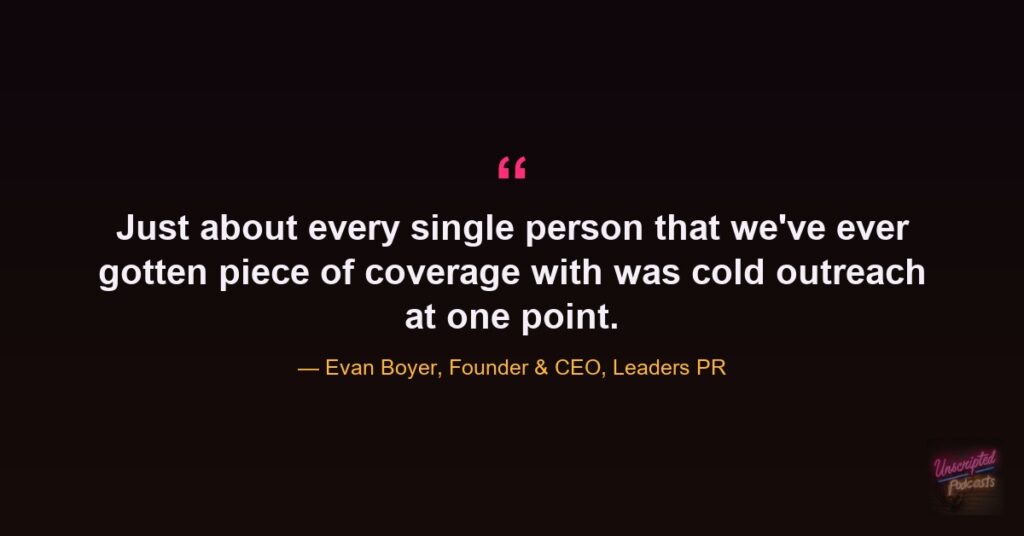
“just about every single person that we’ve ever gotten piece of coverage with was cold outreach at one point.”
An email found on Muck Rack, an introduction, a conversation at an event. It all started cold. What turns it warm is learning what a reporter covers, who they quote and when they’re busy. When Evan served a Big Four firm, nobody bothered its experts during tax season, so the content got done in Q4. He called the effort relationships take “really underrated.” I’d add that you can start that effort yourself, today, with the one local reporter who covers your industry.
Hiring a PR agency for a small business: what to settle first
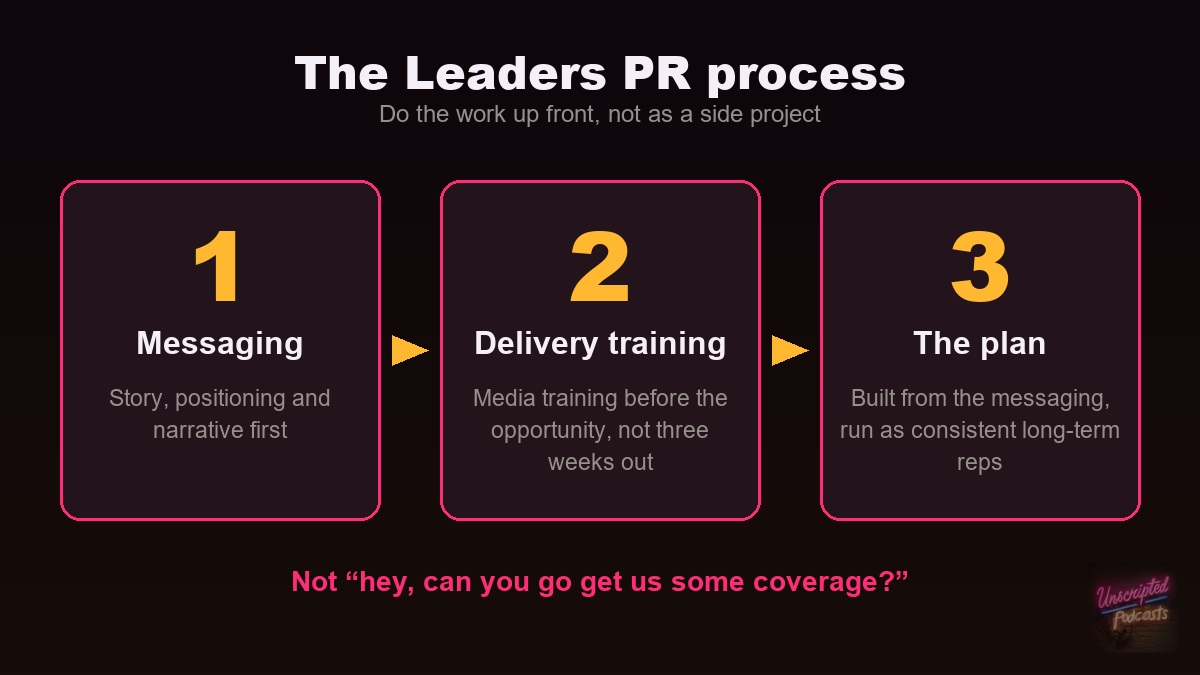
Evan founded Leaders PR in August 2025 after working at a global agency with clients like JP Morgan Chase, Ernst & Young and Anheuser-Busch. He left partly because “I saw a real lack of process and procedure in bringing a PR agency into the equation.” Media training got sold as a side project three weeks before a trade show. So his process runs in a fixed order:
Before you hire anyone, answer these yourself:
- Can you tell your story in two sentences that a stranger would want to repeat?
- Who on your team, besides you, knows enough to be quoted?
- What’s happening in your community or industry this quarter that you could help people understand?
- Are you buying one announcement, or a year of showing up?
- How will you know it worked? Watch branded searches, calls and how fast deals close, not a single link.
Evan offers a PR readiness quiz if you want a second opinion, and he’s on LinkedIn. Listen to the full episode on Castos, read the episode recap on Unscripted SEO, and if you run an agency, the SEO Arcade piece on how SEO and PR teams should work together turns this into a working agreement.