I don’t have a degree. I did a year of community college on a small scholarship, then took a customer support job at a hosting company. A friend of mine stayed in school, finished his associate’s and then his bachelor’s, and graduated into the 2008 recession. He spent a year hunting for work while every employer told him the same thing: you don’t have any experience. In those same three years I’d gone from support rep to support supervisor to running a marketing team.
So when Chuck Mobley came on Unscripted Small Business and said this, it landed: “I’m not saying that a business degree doesn’t help you, but sometimes we learn our way out of common sense.” Chuck is an air conditioning technician who got fired, started Polar Bear Air Conditioning in the Cayman Islands 38 years ago, and grew it to about forty-four employees and five thousand customers. His first line on the show was “Jeremy, don’t ever trust me as an expert in anything.” I trust him more for it.
🎧 Listen: the episode on Castos | 📺 Watch: full episode on YouTube
He learned service by watching his parents
Chuck was fired for refusing to keep using his own car for a service company’s calls. He had technical knowledge and no idea how to run a business. “It was a year in before I realized, wow, I can make money doing this.”
What carried him was what he’d watched at home. His mom sold real estate, and if she had a client’s house listed while they were out of town, “she would just go out in the middle of the night and go wrap people’s pipes up.” She’d get his dad to mow their grass. “And so when I started this business, the only thing that I knew was to give great service to my customers.”
You can’t learn that in a classroom. You can learn it by paying attention. And the funny part is that Chuck has since handed the business to his son, who has the business degree, and Chuck says he’s “actually doing a better job than I ever did.” Both things can be true. The degree helps. The common sense has to come with it.
My dad’s railroad board and the end of the time window
The idea from this episode I’d hand to any service business is Chuck’s scheduling policy. “We no longer give a time window. We can only guarantee the first call, because our work is fluid.” His reason is the best line in the interview: “When you tell somebody they’ll be there between nine and one, they don’t hear one o’clock. I promise you, it sounds weird, but they hear nine o’clock.”
That made sense to me right away because of my dad. He was a railroad engineer, and the crew system worked like a queue. There are nine engineers ahead of you, they go out as trains load up, and however long that takes, you’re the tenth one out. Nobody promised him a time. He knew his place in line, and he got a call.
Chuck’s version: the technician calls twenty to thirty minutes before arriving, and the customer is told to “continue about your day as if we don’t exist.” The part most service businesses skip is the explanation. “You have to explain the benefit to the customer. Otherwise they think we just don’t want to give a time.” Leave it out and you’re the cable guy in that South Park episode, feeding the ducks while the customer waits all day.
The books can’t keep up, in SEO or in HVAC
Part of why I don’t regret skipping the degree is that in SEO, the books literally can’t keep up with the pace of change. That was true twenty years ago when I started. It’s more true now that AI is a discovery channel and the tools ship new versions every month.
So I asked Chuck whether AI was the biggest change he’d seen in his business. He said his industry doesn’t change monthly, “but we go through yearly changes.” His technicians used to replace belts and compressors. Now “we’re actually having to go and program thermostats” and check the Wi-Fi. Efficiency rules change, and equipment that still works becomes obsolete “because you can’t get parts for it.” And indoor air quality has landed on the AC company. “Mold was on bread, right?”
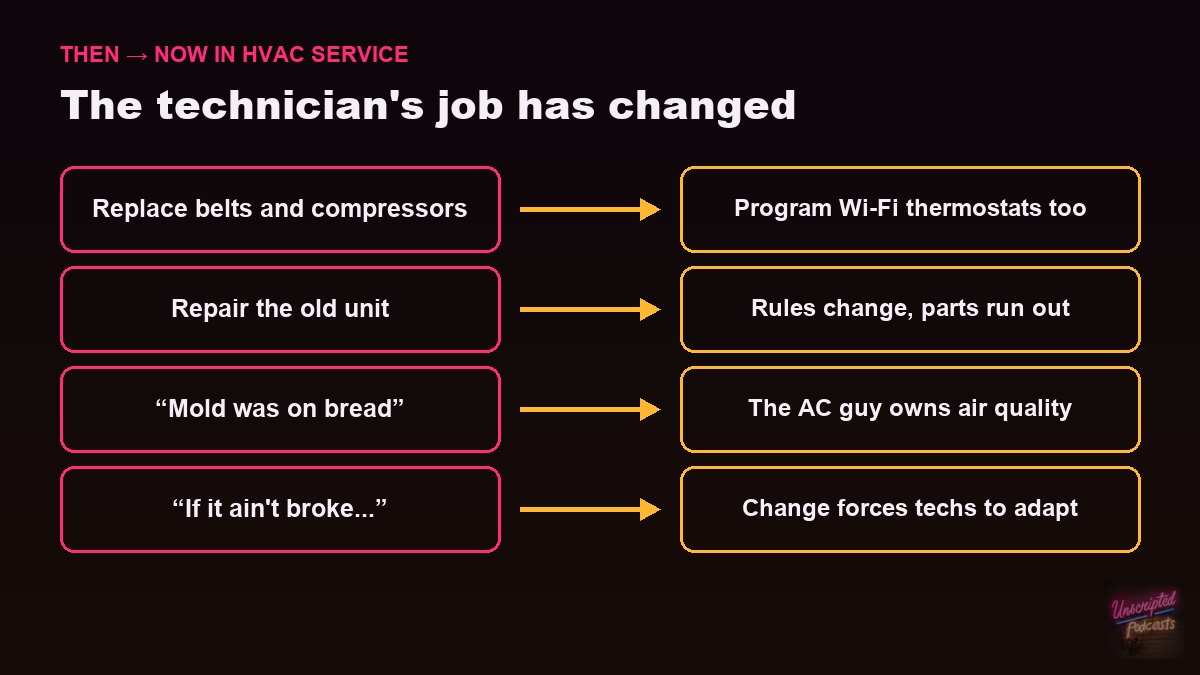
Next to all that, “AI for us is small peanuts.” Lots of HVAC contractors are technicians with an “if it ain’t broke, I ain’t gonna fix it” mindset, he said, so they’re slow to adopt it. But the industry changing “forces us to adapt.” If you’re in a trade, that’s your hands-on advantage. You’re already learning faster than any textbook could.
Put the time AI saves back into people
Chuck’s plan for AI is the one I’d hand to most of my small business clients. “Get AI to do the data input, but keep your frontline people talking to that customer.” In a small shop the customer service rep is also the bookkeeper and the data-entry person. Take the mundane hats off them, and they get more time on the phone with the customer, “finding out what their needs are.”
He told me about a customer who called to cancel because their husband was sick. His team doesn’t just reschedule. They say “we can definitely reschedule it, but more importantly, is there anything that we can do? Can we go pick up some medicine?” That’s how he gets to “the third generation of people who wouldn’t consider using anybody else but Polar Bear.”
It lines up with something my friend Michael McDougald wrote. When AI saves you half an hour, don’t spend all of it somewhere else. Pour most of it back into quality. Rich Thomas made a similar case when he told me to hand off what bores you and keep the people work.
The golden rule in a business full of middlemen
I asked Chuck for one thing small business owners could walk away with. He told them to sit down first, “because this is profound.” Then: “The golden rule still works, in our personal relationships and in our business relationships. So treat people the way you want to be treated.” He says it’s been Polar Bear’s main core value for almost forty years, and you can see it written into their core values page.
It’s an old-school value, but I think it gets more valuable as technology puts more layers between people. It’s a big part of why I’m doing so much podcasting. I can ask Claude any of the questions I asked Chuck, and I’ll get a diluted average of the internet back. A half-hour conversation with somebody who’s done the work for 38 years gets me a story, and we learn from stories. I wrote more about that in what 100+ interviews taught me about search.
Chuck also wrote a book, Leap Before You Look: But God…, which he calls “an irreverent faith book.” Given that he once took a four-hour course and jumped out of a plane, the title is accurate. So here’s my advice, borrowed from a guy with no business degree and 38 years of customers: treat people how you’d want to be treated, and tell them how your business works before they have to ask.
The full episode recap is Chuck Mobley on why Polar Bear stopped giving time windows on Unscripted Small Business, and the marketing angle is on SEO Arcade: tell customers and AI how your service works. You can find Chuck at chuckmobley.com and Polar Bear at polarbear.ky.