- 1 Branded vs non-branded keywords: what each one actually tells you
- 2 Brand vs non-brand: how branded searches make flat SEO look like growth
- 3 Why the old brand vs non-brand split overstated your brand
- 4 The non-branded search trap: an empty answer that looks like a clean one
- 5 Questions to ask your SEO about branded vs non-branded keywords
- 6 Branded vs non-branded keywords belong on two lines of every report
Your SEO report says organic clicks are up. Before you thank anybody (or fire anybody), find out how many of those clicks came from people who typed your company’s name into Google. Those people already knew you. They’d have found you with or without an SEO. Splitting branded vs non-branded keywords is the first cut I make on any site I look at, and since November 16, 2026, Google hands you that split for every click instead of only the ones it shows you. I ran it across 94 Search Console properties, and the old way of making the split overstated brand share on 12 of the 16 sites with enough data to check.
Branded vs non-branded keywords: what each one actually tells you
A branded keyword is any search that includes your name: the company, a misspelling of it, or a product only you sell. “Acme Roofing reviews” is branded. “Roof leak repair near me” is non-branded, because the person typing it hasn’t picked anybody yet.
Here’s why the difference matters to you as the person paying the bill:
- Branded searches measure demand you already created. Your trucks, your referrals, your ads, the podcast you went on, the AI answer that named you. Good SEO keeps those searches from leaking to a competitor or a review site, but it rarely creates them.
- Non-branded searches measure reach. These are people who had a problem, didn’t know you existed, and found you anyway. That’s the part of search an SEO can most fairly take credit for growing.
I used to treat brand like it didn’t count at all. I wrote about the meeting where I said I’d filter branded search out of every report, and why I took it back. Branded search is a signal that people want you, and it matters more now that AI answers name brands without linking to them. Jason Berkowitz put the mechanism plainly when we talked on Unscripted SEO:
“…one of them includes a brand but doesn’t include a link to that brand. What is that person going to do next? Are they going to ask for a link or are they going to take that brand and go to Google and search for that brand?”
Jason Berkowitz on Unscripted SEO
So track brand. Just don’t let it hide inside the number you use to grade your SEO. Ernesto Ortiz goes further and makes non-brand traffic to the pages that sell his headline KPI for ecommerce, and I think he’s right.
Brand vs non-brand: how branded searches make flat SEO look like growth
Picture a software company where 87% of its Google clicks are people typing the product’s name. That’s not made up; it’s one of the SaaS sites in my data. Now say a launch pushes brand searches up 30%. Total organic clicks rise about 26%, and the report gets to say “organic is up 26%” even if non-branded search didn’t move at all.
It runs the other way too. A business with very few brand searches can have an SEO doing solid non-branded work while the total looks flat, because a slow quarter for referrals dragged branded clicks down. You can’t tell those two stories apart from one line on a chart.
None of this makes brand lift fake. Rob Bonham, who works as a fractional SEO director for agencies, made the case on his Unscripted SEO episode that SEO work can raise brand visibility too:
“…make sure you’re paying attention to how things are performing at a URL by URL level, but also you might be getting better visibility for your branded searches. So maybe your homepage traffic is gonna go up, you’re getting shown more frequently.”
Rob Bonham on Unscripted SEO
He’s right, and the only way to have that conversation honestly is with brand and non-brand on separate lines, so you can see which one moved and argue about why.
Why the old brand vs non-brand split overstated your brand
Until this month, the standard way to split brand from non-brand was a filter. Your SEO wrote a pattern that matched your name, ran it against the queries in Search Console, and added up the matches. The catch is which queries you get to see. Search Console withholds the query behind most clicks (I measured how much in the dark-clicks study on SEO Arcade), and the withheld ones aren’t a random sample.
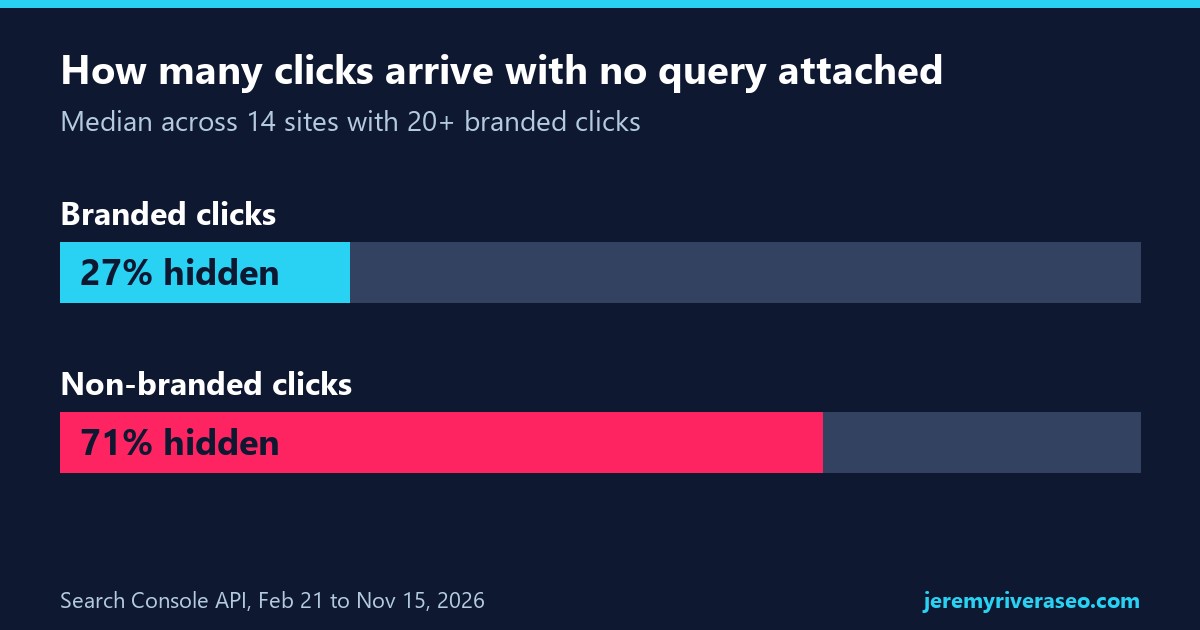
On the median site in my data, 27% of branded clicks had no query attached, against 71% of non-branded clicks (14 sites with at least 20 branded clicks, February 21 to November 15, 2026). Brand searches get typed by lots of people, so they clear Google’s privacy threshold. The long, odd, one-off non-branded searches don’t. A filter on the visible rows sees most of your brand and a sliver of everything else, so brand looks bigger than it is.
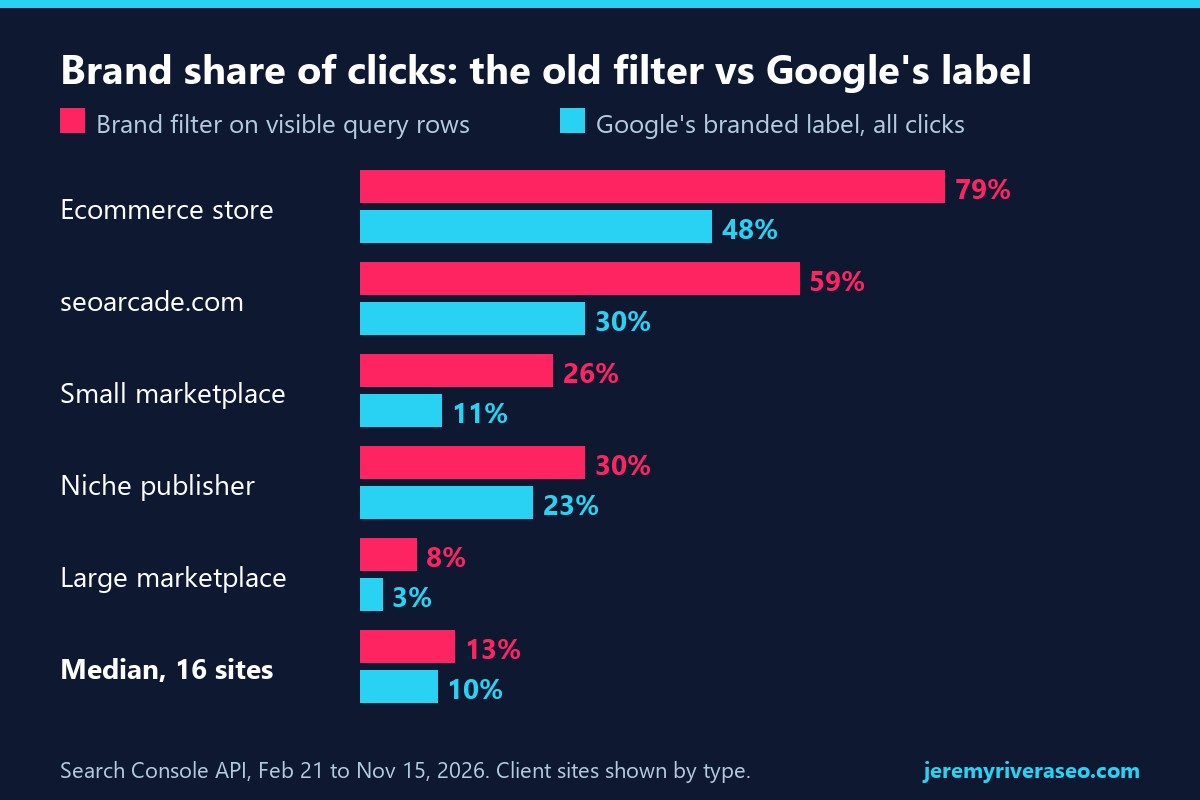
How much bigger? Here’s what the filter said against Google’s label for the same months:
- seoarcade.com: 59% brand by the filter. Google’s label across all 764 clicks: 30% (232 branded, 532 non-branded).
- An ecommerce store: 79% by the filter, 48% by Google’s label.
- The median across 16 eligible sites with 30+ clicks: 12.8% by the filter, 10.5% by the label.
I asked Matthew Mellinger, co-founder of SEO Gets, about this on LinkedIn: what share of the anonymized queries were actually branded? For their data, non-branded terms were “like 80%-85% of anonymization.” On the sites I checked it’s even more lopsided. The median site’s hidden clicks were only 5.1% branded.
Here’s what changed. On November 16, 2026, Google added a branded classification to the Search Analytics API. Every click gets labeled branded or non-branded, including the ones with no query attached, and the two buckets add up to your total exactly. They did on every eligible property I pulled. The labels come from the branded filter Google added to the Performance report in November 2025, which Google calls “an internal, AI-assisted system” that catches your brand in other languages, misspellings and products unique to your site. The data starts February 21, 2026. (AI-assisted means you should still eyeball the labeled queries you can see. It’s still a far better guess than a pattern somebody wrote in 2019.) The API reference has the field details, and the SEO Arcade breakdown of the branded queries API walks through the full method and data.
If you’re wondering what to do with all the clicks that still have no query, I laid out a routine for measuring SEO when Search Console hides your queries.
The non-branded search trap: an empty answer that looks like a clean one
Here’s the part that’ll bite you. Not every property gets the label. Google only fills it in for properties it considers eligible, and when yours isn’t, the API returns no rows. You don’t get an error. You get nothing.
This site is one of them. jeremyriveraseo.com had 168 clicks from February 21 to November 15, 2026, and the branded request comes back empty. Across the 94 Search Console properties I checked, 19 returned branded data at all.
Why should you care? A report or dashboard that adds up an empty response shows zero branded clicks. Zero branded reads like “all of your search traffic is non-branded,” which is the best possible news about your SEO, and completely made up. If someone shows you a brand split, ask whether the property was eligible before you believe the 0%.
A real near-zero exists too, which makes the fake one harder to spot. unscriptedseo.com is eligible, and Google labeled 1 of its 421 clicks branded. That one’s true: almost nobody searches the show by name. Same number on the screen, opposite meaning.
Questions to ask your SEO about branded vs non-branded keywords
You don’t need to pull the API yourself. You need to ask the person who does. Take these to your next report review:
- How much of our organic growth this quarter was branded, and how much was non-branded?
- Where does the brand split come from: Google’s branded label, or a filter on the visible queries? (If it’s the filter, expect brand to be overstated.)
- Is our Search Console property eligible for the branded label? If the split shows zero branded clicks, how do you know that’s real?
- Which pages earn the non-branded clicks, and do any of them sell something?
- When branded searches went up, what else was happening (a campaign, press, an AI answer naming us), and what part do you think SEO played?
- What share of our clicks have no query attached, and how are you reporting on those?
A good SEO will have answers ready, or will go get them without getting defensive. If the answer to the first question is “we don’t split it,” that’s your answer too.
Branded vs non-branded keywords belong on two lines of every report
Brand searches tell you whether people know your name. Non-branded searches tell you whether Google sends you the people who don’t. Both matter, they move for different reasons, and you should grade them separately. If you want a second set of eyes on your own split, that’s the kind of work I do as a fractional SEO consultant, and there’s more on reading your own data in the Search Fundamentals hub. Start with the first question on that list. You might not love the answer, but you’ll finally know what you’re paying for.