Most small business owners who end up on a call with me have already hired an SEO once. They paid the monthly package, got a report every month full of charts they couldn’t decode, and a year later they can’t say what changed. Here’s how you avoid that the second time: ask the questions Google itself recommends, make the SEO explain success in calls and sales, give them read-only access to your data during an audit, and walk away from anyone who guarantees a #1 ranking. That’s the short version of the hiring section in my guide to small business SEO. This is the long one.
Google already wrote your interview questions
Google publishes a page called Do you need an SEO?, and it’s the best vendor checklist I know of. It also opens with a line most agencies would rather you skipped: if you run a small local business, “you can probably do much of the work yourself.” If you still want help, here are Google’s questions that matter most for a small business, with what I’d listen for in each answer.
- “Can you show me examples of your previous work and share some success stories?” Ask for a page that ranks, then search for it yourself.
- “Do you follow the Google Search Essentials?” You want a yes, plus a tactic they turned down. If they’ve never said no to anything, they’ll say yes to the thing that gets you hurt.
- “What kind of results do you expect to see, and in what timeframe?” You want a range and a reason. Google’s own SEO Starter Guide says some changes “might take effect in a few hours, others could take several months.” Anyone promising page one by next month is guessing out loud.
- “How do you measure your success?” This one tells you the most. If you hear rankings and traffic, keep asking until you hear calls, form fills, booked jobs or sales. I wrote about why in traffic is a proxy, so measure by revenue.
- “What’s your experience in my industry?” and “What’s your experience in my country/city?” My take: a roofer in a small town doesn’t need someone whose whole portfolio is SaaS companies.
- “How long have you been in business?” Since you’re asking, I’ve been doing SEO consulting for nineteen years, and you can read how I work with clients. Years aren’t proof, but they mean someone has lived through a few Google updates.
- “How can I expect to communicate with you?” Ask whether the person on the sales call is the person doing the work.
- “Will you share with me all the changes you make to my site?” A yes should come with an example of what that change log looks like.
Notice what they ask you, too. Google says a good SEO “should ask questions about what makes your business unique, who your competitors are, how search results can help, and how your customers find you.”
The red flags are written down, in Google’s own words
Well, the truth is that Google is blunt about this: “No one can guarantee a #1 ranking on Google.” Here’s what to walk away from:
- A ranking guarantee. Google’s advice for this one is three words long: “find someone else.”
- A “special relationship” with Google, or a “priority submit.” Google says it “never accepts money to include or rank sites in our search results.”
- Secrecy. Google says to “be careful if a company is secretive or won’t clearly explain what they intend to do.” It also says “you are responsible for the actions of any companies you hire,” so their shortcut becomes your penalty.
- Cold emails saying you’re not listed in the major search engines. Google gets them too, and compares them to “burn fat at night” diet pills.
- Submitting your site to thousands of search engines, or making you link back to them. Google says “you should never have to link to an SEO.”
- Bought clicks and bot traffic sold as an SEO boost.
That last one isn’t on Google’s page, but it should be. Matthew Slaymaker runs paid ads for clients, so he sees where junk traffic comes from:
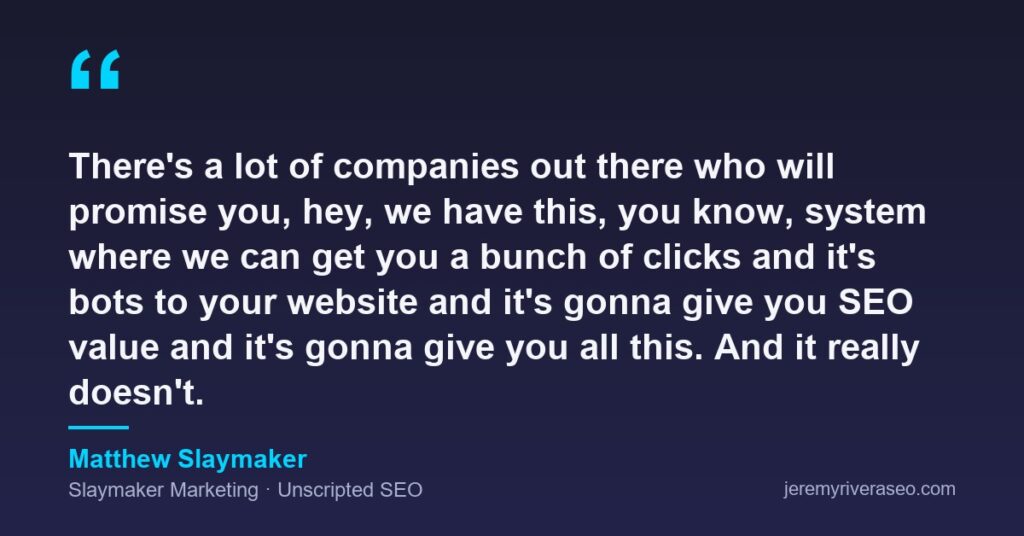
“There’s a lot of companies out there who will promise you, hey, we have this, you know, system where we can get you a bunch of clicks and it’s bots to your website and it’s gonna give you SEO value and it’s gonna give you all this. And it really doesn’t.”
— Matthew Slaymaker, Slaymaker Marketing, Unscripted SEO
Give an auditor read-only access, and keep the keys yourself
If an SEO offers an audit, Google says to “only grant read access to Search Console” and not to give write access at that stage. In practice, you add them as a Restricted user, which Search Console’s permissions help page describes as “simple view rights on most data.” An auditor doesn’t need more than that to tell you what’s wrong.
I’d go one step further. You should own your Search Console property, your Google Analytics property, your Google Business Profile and your domain account, and add the SEO as a user on each one. If an agency sets those up under its own login, ask what happens to your data the day you stop paying them. And if they have access to your server, Google says they “should be willing to explain all the changes they are making to your site.”
The pricing model tells you what you’re actually buying
Each model hides a different risk. Here’s what I’d ask about each.
| Pricing model | What you’re paying for | Ask this before you sign |
|---|---|---|
| Hourly consulting | Time and judgement on a specific problem | What will I have in hand when the hours are used up? |
| Flat project | One defined deliverable, like an audit or a site migration | What’s in scope, and what costs extra? |
| Monthly retainer | Ongoing work | Which tasks happened this month, and what did each one change? |
| Per link | A link placed on someone else’s website | Which site, does a real audience read it, and can I see it before I pay? |
| Content package | Articles, episodes or pages produced for you | Who owns the content, and where does it get published? |
My own prices are public on my SEO pricing page: $200 an hour for consulting, $150 per link, and $700 per podcast episode package. If an agency won’t tell you what anything costs until the third call, that’s a smaller version of the secrecy flag above. And if you’re buying links from anyone, read why local links are just relationships with URLs first, so you know what a real one looks like. For the full breakdown of what each model buys, see what small business SEO costs.
Your monthly report should answer three questions in plain words
A report you can’t decode was written for the agency. (The other half is on you: if you never ask what a chart means, read are you a bad SEO client?) Whoever you hire, every report should answer these:
- What changed on my site this month, page by page?
- What moved in Search Console: impressions, the queries I show up for, and clicks?
- Did calls, forms or sales from search go up, and how do you know?
If the third answer is “we can’t track that,” you’ve found the first thing to fix. Ask for it in the proposal, before you sign.
Holding a proposal right now, or a stack of reports you never understood? Book a free 30-minute call and bring them. I’ll tell you what I’d ask that agency, even if you end up hiring them instead of me. For the rest of the picture, from DIY basics to how long results take, see my guide to SEO for small businesses.
So before you sign anything: who owns the accounts? What will be different on your site in 90 days? And when it works, will you feel it in the phone ringing, or only see it in a chart?