For years the default SEO retainer looked the same: four blog posts and two links a month. On a recent episode of Unscripted SEO I said I think the days of that actually working are long gone, and asked Lum Kamishi if he agreed. “Yeah, I agree completely,” he said, and then told me how he scopes work instead.
Lum is an SEO consultant at LumKamishi LLC and the founder of Assertio.ai. He spent about eight years in-house at marketplaces before taking clients in 2025, so he came to client work without an agency’s habits. I’ve sold my share of packaged retainers. If you sell SEO services, or buy them, here’s what his answer means for you. You can watch the full conversation here.
“I don’t care about budgets, I care about results”
Lum had just promised a home renovation client at least thirty new blog articles. Not four a month. Thirty, because that’s what the content map said the site needed.
“And the way that I work, when I work independently, I don’t usually go on promising budget-scope things. I don’t care about budgets, I care about results.”
“If there’s thirty-one, then I would do thirty-one, right?” The scope comes from the work, and the price follows the scope. That’s the opposite of how the package gets sold, where the price is set first and the deliverables are whatever fits under it. If you’re the one setting that price, Ann Carden makes the case that most experts undercharge by three to ten times.
He isn’t absolute about it. In low-competition local niches and some regional markets, he thinks the package may still work. “If it works, it works.” Where competition is fierce, he has his doubts. If you’re comparing pricing models, I break down the common ones in how much SEO costs for a small business.
The two links got expensive
Half of the package is two links a month. That half has gotten harder to deliver honestly. When I said almost nobody responds to an outreach email anymore, Lum finished the thought: “Yeah, now they just send you the bill, right?” He hasn’t built links himself since before COVID, but the link builders he has managed all say the same thing: they have to pay for links now.
And the links matter more, not less. Lum’s first SEO job was a Penguin recovery, and his read on AI search is that LLMs are “way more primitive than Google when it comes to ranking.” Google spent years defending against link builders. ChatGPT and Perplexity haven’t caught up, so links count for more there:
“It’s not that links now still matter, but in fact they matter more than five years ago, right?”
The catch is relevance. Lum calls it niche relevance: links from sites whose content sits close to yours in vector space. On the episode I shared Ben Wills’ OppAlerts research, which as I summarized it found 20,000 positive matches and zero negative ones for backlink profiles from pages in the same vector embedding category. That’s why I tell clients relevance is the only link metric that survived. Two links a month from whoever will reply doesn’t buy you that.
Lum’s frame for AI visibility is the same idea at a bigger scale: “GEO is basically what the web is saying about you.” Mentions from niche-relevant publications, linked or not. I wrote about this in authority is what other people say about you.
The four blogs got cheap
The other half of the package has the opposite problem. Writing got cheap, and the result shows. Lum measured it: a writer producing 2,000-word articles by hand averaged two articles per three days. With Claude he got it to two per day.
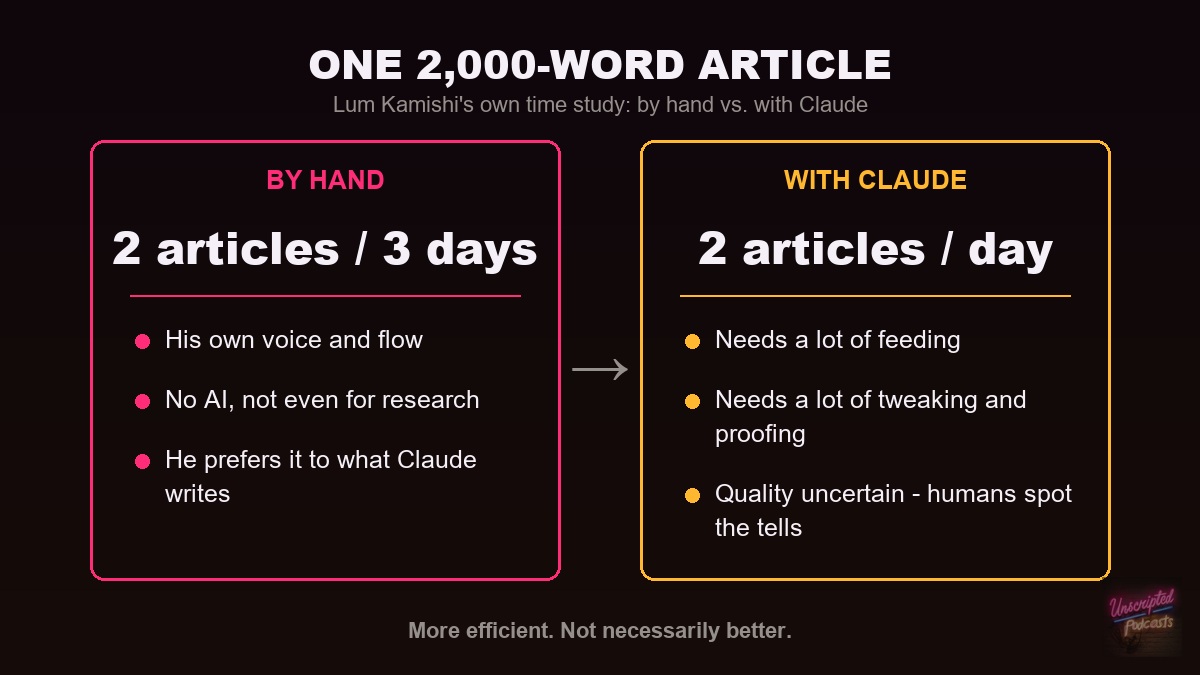
“So we’re more efficient, but I’m not sure about quality at all. That’s the biggest issue.”
I told him about drafting my anchor text study. The data said exact-match anchors did nothing while token-match anchors showed a real effect, and Claude’s first draft still wouldn’t come out and say “you’re doing backlinks anchor text wrong.” It’s too wishy-washy. “They basically need a lot of food,” Lum said. That’s why about 80% or more of the content I make starts from at least one interview transcript. Matt Brooks of SEOteric calls that kind of material human chow. You can’t keyword-research your way to it, and it’s the part of the work I’d protect first. I’ve written about that split in the brief is the human part.
What gets scoped instead
Lum’s alternative isn’t a bigger package. It’s a map. For the home renovation client, he scored each blog post’s topical proximity, “the semantic distance between a blog post and a service page,” and found posts ranking for money queries the service pages should have owned. He killed sixty percent of the blog, then promised thirty or more posts built in mini clusters of two or three per service page. The full method is in the SEO Arcade breakdown of topical proximity.
Here’s my judgement on what that means for you, not something Lum prescribed. If you’re the one paying for SEO, ask your provider what the site needs before you ask what the month includes. If you’re the one selling it, the deliverable you can defend is a map: which pages should exist, which should go, and which niche-relevant publications should be talking about the client. The count of posts and links falls out of that.
Lum is building the content half of this into Assertio, a multi-agent, answer-first pipeline still in beta that he runs as a white-label service. You can find him at lumkamishi.com, and the whole episode, including his take on why Google should stop picking fights with SEOs, is in the Unscripted SEO recap.
Stop selling the quota. Sell the map.