When I started in SEO around 2007, attribution was easy. If somebody bought something online, they did it on a desktop with a credit card, at work during the day or at home in the evening. Today my wife picks a new bag by scrolling TikTok influencers, not by Googling it. So when Irwin Hau, who runs the Melbourne agency Chromatix and the software company ConversionCow, told me on Unscripted Small Business that he’d fix a website before putting most of the effort into traffic, I wanted to know how he decides. He says he has analyzed 60,000 websites over 17 years, so he’s had some practice.
🎧 Listen: the episode on Castos | 📺 Watch: full episode on YouTube
The salesperson copy that drives me crazy
I’ve worked with a lot of salespeople, and they always want the same copy on the site: we do customer service, we’re the best in our industry. It drives me crazy, because if you listen to a real sales call, nobody talks like that. Those calls run on rapport.
Irwin put it more sharply than I did. “It’s not about filling voids with words. If that was the case, then AI would win, because it can fill a lot of words.” His fix is to use names and numbers, which he calls factual trust, alongside borrowed trust from who you’ve worked with and the implied trust a clean design gives you.
He also opened the interview with advice somebody once gave him, and it fits him: “be the master of one thing and be world class at it.” For him that one thing is trust on a website. That focus is why his answers were specific.
An anesthetist before the surgeon
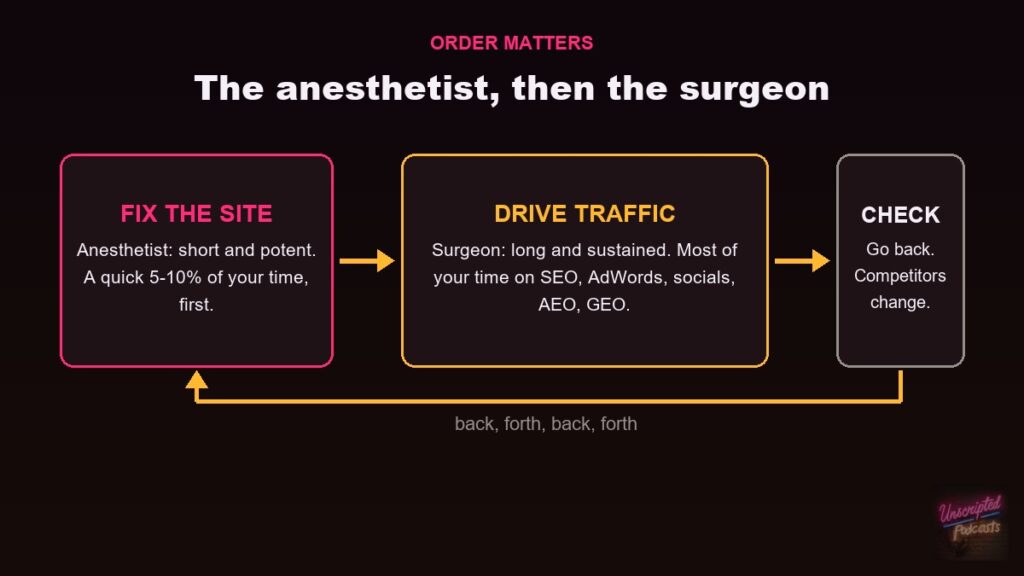
I asked Irwin how a business should balance trust on its own site against visibility work off it. Is it fifty-fifty? He answered with heart surgery. You need the anesthetist first, and “the anesthetist is very short but very potent.” The surgeon’s part runs long. “Short and powerful, and long and sustained, yet also powerful.”
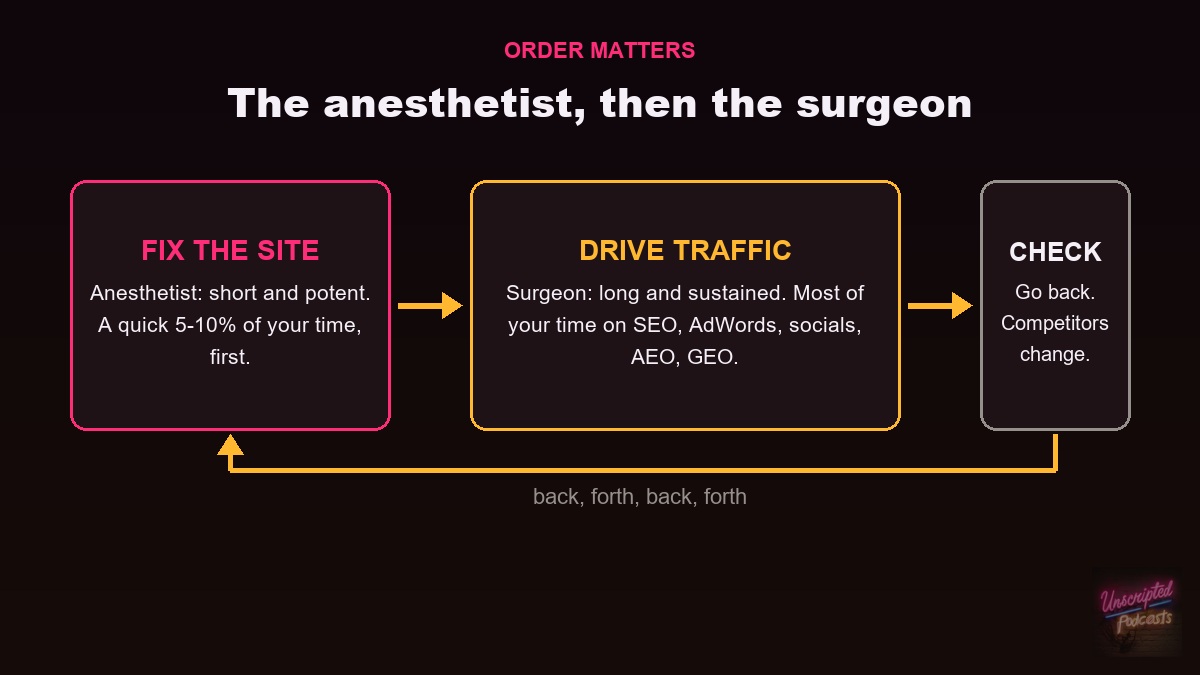
The point is the order. The site work is the smaller share of your time, and it still goes first. Then most of the effort goes into getting people to the site, since that work never stops. “But you still want to go back once in a while just to check it, to make sure it’s still optimized, because things change.”
That’s the order I’d recommend to a client too. Sending more people to a site that loses them doesn’t help anyone, so the site gets the first pass and getting found gets every week after that.
Search everywhere, and a city full of restaurants
I wrote a book called Search Everywhere Optimization because I don’t think we need a new acronym every year. There’s a search engine in Facebook and one in TikTok. It’s still optimization, and it’s still search.
Irwin’s version of that idea was about choice. Decisions aren’t linear any more, he said. There are too many options and too many devices. In a country town there are one or two shops, so everybody goes to the same cafe. In the city, he can eat wherever he wants. “We’re not as trusting as we used to be. If anything, we’re a bit more skeptical, and with AI we’re even more skeptical.”
When people have that many choices, reviews and proof carry more weight. I made a similar case for local businesses after talking with Lem Garcia: reviews first, your own voice second.
The blemish prompt
The detail from this episode that stuck with me is how people are now trying to make AI look less like AI. Irwin knows people who ask AI to generate an image and then add a few blemishes, a receding hairline and some gray. “They’re actually prompting to make it more human.”
That tells you where the bar is. Polished and generic doesn’t earn trust any more, and readers are getting better at spotting it. I wrote about the other side of that after talking with Jon Gillham: what to do when you’re 98% sure a writer used AI. Irwin still tells agency owners to use AI to augment what they do, and he’s right that staying away from it will leave you behind. You just have to edit like a reader is looking for the seams.
Small business website trust: what I’d check first
Here’s what I’d take from Irwin into a client audit this week:
- Would a first-time visitor know what you sell and who’s behind it?
- Does every claim have a name, a number or a customer behind it?
- Which trust signal does your industry run on, and is it visible?
- Are there typos, distorted images or obvious AI patterns on the page?
- Can someone reach you in one click?
Fix those first, quickly. Then put your time into traffic, and keep your attribution honest. Irwin trusts his analytics and his customers’ answers together. If you report to a boss or a board, I wrote about how to report SEO results to a CEO when attribution is that messy.
You can hear the whole conversation on Unscripted Small Business, and SEO Arcade has the agency version: website trust signals for AI search. Irwin is on LinkedIn and says he loves connecting with people.