- 1 AI tools repeat the words the web already uses about you
- 2 Five signals that file you as the cheap option
- 3 What I changed on my own site, and what I can’t prove yet
- 4 What a premium positioning change looks like from three angles
- 5 Getting ChatGPT to recommend your business at the price you actually charge
Everybody’s chasing the same goal right now: get mentioned in ChatGPT. Well, the truth is that getting mentioned is the easy part. If you’re a consultant or an agency, the harder question is how it describes you. An AI assistant builds its description out of the words the web already uses about you, on your own pages, in your reviews and in what other people write. If those words say “affordable”, “starting at” and “we do it all”, you get filed as the cheap option. You change that by changing the words, in the places the assistant actually reads.
I’ve been doing SEO consulting for close to twenty years, and I’ve watched this exact mistake play out in Google long before ChatGPT. You price yourself as a specialist, then write your site like a discount shop. The assistants just made the mismatch easier to see.
AI tools repeat the words the web already uses about you
When someone asks ChatGPT or Google’s AI Mode for “a senior SEO consultant for a 50-person SaaS company”, the assistant runs searches in the background, reads what comes back, and writes a summary. Google’s own documentation on AI features describes this as a “query fan-out”: several related searches, then an answer built from what they return.
So the assistant isn’t judging your talent. It’s summarizing your paper trail. If your title tag says “Affordable SEO Services”, your packages page leads with a $499 monthly plan, and your reviews mostly say “fast and cheap”, that’s the honest summary of what it found. You can’t be annoyed when it repeats it.
This is the same consensus problem I wrote about in what 100+ interviews taught me about search when an AI answers first: the AI recommends whoever the rest of the web vouches for, in the words the rest of the web uses.
Five signals that file you as the cheap option
Here’s what I look for first when a consultant or agency tells me AI tools keep describing them as the budget pick. You can check all five in an afternoon.
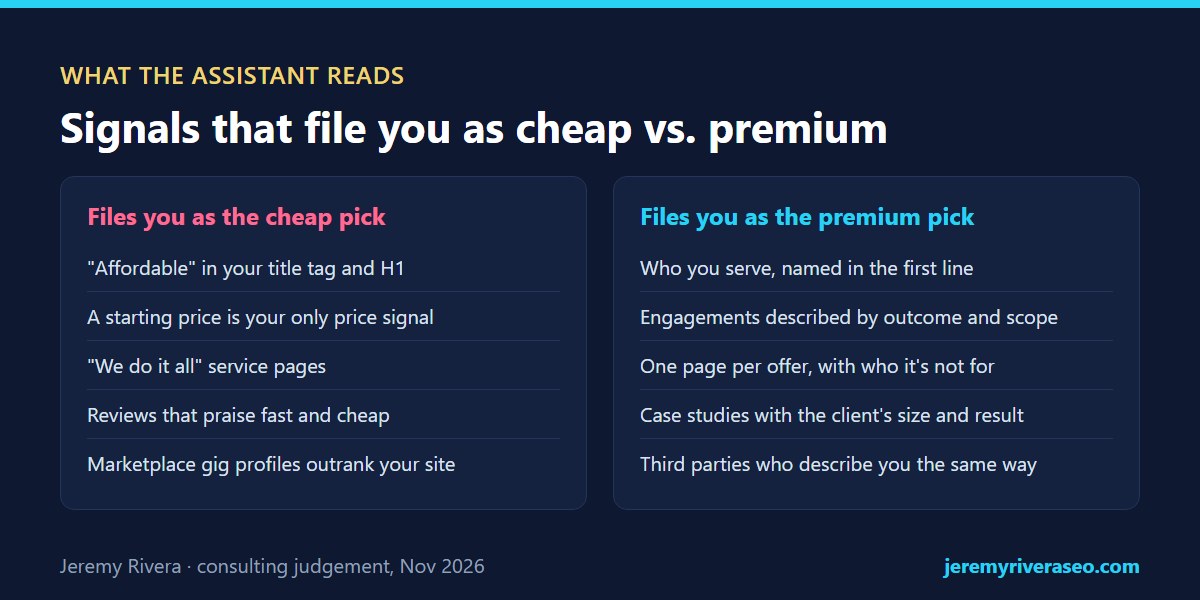
- “Affordable” or “cheap” in your title tag and H1. These are the first words a crawler reads and the most likely to get repeated. If you wouldn’t say it in a sales call with your best client, take it out.
- A starting price is your only price signal. A “from $299” line with nothing about scope or outcome tells the assistant one thing: you’re the low bid.
- One “we do it all” services page. A page that lists twelve services can’t answer “who’s the best at X for Y?”. Specialists get named for specialist questions.
- Reviews that praise speed and price. “Quick turnaround, great value” is a nice review. It’s also a description of a commodity vendor.
- Marketplace profiles that outrank your own site. If your Fiverr or Upwork gig shows up above your site for your own name, guess which page gets read first.
None of these are hard to fix. They just never got fixed because they weren’t costing you anything visible in Google. They’re visible now.
What I changed on my own site, and what I can’t prove yet
I’m not immune to this. In October I rewrote the H1 on my own homepage to “Fractional Senior SEO Consultant: Technical SEO, Content Marketing & Link Building”, dropped the city that used to sit in it, and pointed links from four of my sites at a dedicated fractional SEO page. The goal was simple: when anything reads my site, the first words it finds should describe the level of work I actually do.
I can’t tell you yet whether ChatGPT describes me differently because of it. That’s a snapshot, not an experiment, and assistant answers change from run to run. What I can tell you is that you control the inputs, and most consultants haven’t touched theirs.
Here’s the short list I’d work through on a consulting or agency site:
- Name who you serve in the first line of your homepage and every service page: company size, industry, the problem.
- Describe each engagement by scope and outcome, then show a price range or a minimum, not only a “from” number.
- Give each offer its own page, including who it’s not for. Saying no is a premium signal.
- Write case studies that include the client’s size and the result, with the client’s permission to name them.
- Get described by other people the same way: podcast appearances, guest articles and directory profiles that use your positioning, not a stale bio from 2019.
That last one matters more than most people expect. Ethan Felizzari-Castillo’s approach to getting a knowledge panel without a publicist runs on the same idea: other people writing about you, with every article tying the same name to the same work.
Pricing is the other half of it. Ann Carden made the case on the podcast that most experts could charge several times what they do, and that a premium offer should come before a new market. Her full argument is in Ann Carden’s case for premium pricing. And if you keep losing deals and writing down “price” as the reason, read Angelo Ponzi on why price is the easy answer.
What a premium positioning change looks like from three angles
I asked three people who work on this from different sides, product marketing, local search and web design, one question each. Their answers are below, in their own words.
Mike Ginley on getting your source of truth airtight
Mike is a freelance SEO and product marketing consultant in Chicago.
Mike Martin on finding the websites AI actually reads
Mike Martin is the founder of GBPly, a Google Business Profile and AI visibility tool for local businesses. A few sentences wasn’t going to cover it, so he recorded a walkthrough instead: how to check whether ChatGPT, Google AI Mode, Claude and Perplexity name your business, which websites those answers pull from, and how to get your business onto them.
Dean Leigh on what a premium website looks like
Dean is a web designer who builds CMS templates, design systems and component libraries.
Getting ChatGPT to recommend your business at the price you actually charge
So run the test yourself. Open ChatGPT and ask it to describe your business in two sentences, then ask it who the best option is for your ideal client in your niche. Does it name you? If it does, which words does it use: “affordable”, “experienced”, “specialist”? Where do you think it got those words, and do you still use them anywhere? And if a prospect read that description before your first call, would they expect your actual price, or be shocked by it?
If the honest answer is “shocked”, start with your title tag and your first line. That’s the cheapest fix you’ll make all year. And if you’d rather have someone go through the whole paper trail with you, that’s what my foundational SEO consulting engagement is for.