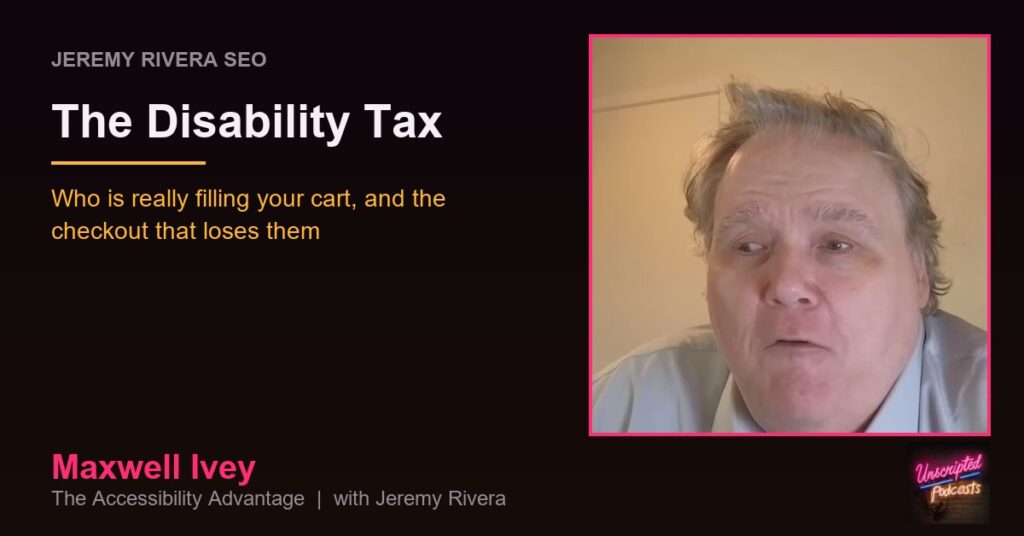
You probably don’t know who’s actually buying from your website. I don’t either, for most of my clients. That was the part of my conversation with Maxwell Ivey that stuck with me longest. Maxwell is almost totally blind, he’s known as The Blind Blogger, and he spent years running a kids’ game on a carnival midway, where one of his jobs was ordering supplies from websites that never imagined a blind buyer. You can watch the full episode here or listen on Castos.
You don’t know who is filling the cart
I asked what a car dealership down the street should do about accessibility. Maxwell said a lot of businesses still fight the idea that they have customers who need it. The B2B version of the argument is the same: why should we care, we sell to businesses. His answer works for both.
“You don’t know who’s actually making the purchasing decision, especially in a large purchase where it’s usually more than one person making that decision.”
Somebody does the research. Somebody fills the cart. Somebody else signs off. On a team, in a family or at a mid-sized company, any of those people might have a disability. Maxwell was the person placing the orders for his carnival business, and most of those supply sites made it hard.
Then he told me about a salesman he met in a doctor’s waiting room. A blind customer and his wife had nearly closed on a new Dodge truck. The husband sat in it and realized the heat and the radio all ran through a touchscreen. The salesman remembered the Chevy had physical controls, and the couple switched brands, which is hard to get truck buyers to do. That’s a whole truck sale decided by accessibility.
The disability tax is a loyalty program you aren’t running
Maxwell compared it to the pink tax. People with disabilities often overpay, because so few companies make the effort to serve them.
“I mean, when it comes to consumer loyalty, we will actually overpay. We consider it a value added aspect of a product.”
The companies that do make the effort get support, and advocacy. If you build an accessible campaign for a product people with disabilities need, Maxwell said, “more often than not, we’re going to be those influencers, influencers that you probably won’t even have to pay.” For a small business, that’s word of mouth you didn’t have to buy.
He also made a point about advertising I’d never thought about. TV and streaming shows can carry audio descriptions, a narration of the action for blind viewers. Closed captioning gets a sponsor credit at the end of a show. Maxwell said he’s never heard “audio descriptions are provided by” anyone, and that most of that work is funded by nonprofits. That’s a loyal audience nobody is advertising to.
Your checkout is where you lose them
I told Maxwell about a client who sold dog collars. He ranked well and had plenty of interested visitors, but almost nobody bought. I walked through his checkout, and it took seven minutes and 14 steps, including a request for the buyer’s home address. On Amazon the same kind of collar takes one or two clicks.
Maxwell’s take was that people build in what they think they should have, because everybody else’s forms have it. With a screen reader, every extra field is more work, and the mouse often fails right at the end: “the last button of a checkout system.” He even prefers Walmart over Amazon now, because its navigation and checkout make more sense with a screen reader. He said people have told him they believe a big part of cart abandonment comes from a checkout that isn’t enjoyable to use.
So here’s a test you can run this afternoon. Put your mouse away and try to buy something from your own site with only the keyboard. Count the fields. Count the steps. Then ask which of them you’d defend to a customer.
Small businesses can beat big brands here
You’d assume big companies have this handled. Maxwell said some of the worst offenders have budgets and whole teams. For a long time, he said, Calendly published an accessibility statement saying how good it was while blind users kept telling the company otherwise.
“This is a place where the smaller companies can get a competitive advantage by investing a little bit of time and effort in accessibility.”
The payoff stacks: better user experience for everyone, a loyal audience the big brands ignore, and cleaner pages for search engines too. Most of the fixes are the same basics I’d give any small business: clear headings, real words on the page and a homepage focused on what you do. If you’ve read write for four readers, add a fifth: the one listening to your page instead of looking at it. And if you’re starting from zero, the DIY SEO basics cover most of the same ground.
The full episode recap, with Maxwell’s advice on headings, alt text and keyboard navigation, is on Unscripted SEO. So who’s filling your cart? And how many steps did you make them take?