I have argued with more business owners about page length than I can count, and they are almost always wrong for the same reason: they are writing for themselves. They scan, so they assume everyone scans, and they want the page short enough to fit how they personally read. That instinct quietly torches your rankings, your conversions, and now your shot at showing up in an AI answer.
The four readers landing on your page
Tom Malesic has run EZMarketing since 1997, and when he came on the Unscripted SEO podcast he laid out a framework I have been stealing ever since. Every page has to satisfy more than one kind of reader at the same time, and they want opposite things.
The first is the scanner. Tom calls this guy “Tom the scanner” after himself. He reads the H2s, decides in four seconds whether the page is relevant, and bails if it isn’t. The second is the deep reader. In Tom’s telling that’s his wife, who reads every word and wants every detail before she trusts you. The third is Google, which still rewards depth, coverage, and pages that genuinely answer the question behind the query. And the fourth, the new arrival, is ChatGPT and its cousins.
You’ve got to hit three types of readers: Tom the scanner who reads the H2s, my wife the reader who reads everything, and Google who wants to know everything. Write long pages — they hate it, but Google loves it and now ChatGPT too.
— Tom Malesic
The mistake is treating these as a tradeoff. They are not. A long page with strong heading structure serves all four at once. The scanner reads the headings and skips the body. The deep reader reads the body. Google and the LLMs read everything. The only person you lose by writing long is the owner who insists the page should look the way he reads, and he was never your customer.
Headings are questions, not slogans
Here’s the structural move that does the heavy lifting. Tom’s advice is to stop writing H2s and H3s as clever sales headlines and start writing them as the actual questions a section answers. As he put it, every section of a page is technically answering a question, you just have to figure out what that question is. “Our Process,” becomes “How long does a kitchen remodel take?” “Why Choose Us,” becomes “What makes your warranty different?”
That single change feeds all four readers. The scanner gets a table of contents that mirrors his own questions. Google gets clean semantic signals. And the LLM, which is matching a user’s phrased question against the structure of your content, finds a heading that looks exactly like the prompt someone just typed. Tom pushes this further by putting FAQ blocks inside the relevant service page instead of dumping them on a lonely standalone FAQ page where nothing connects.
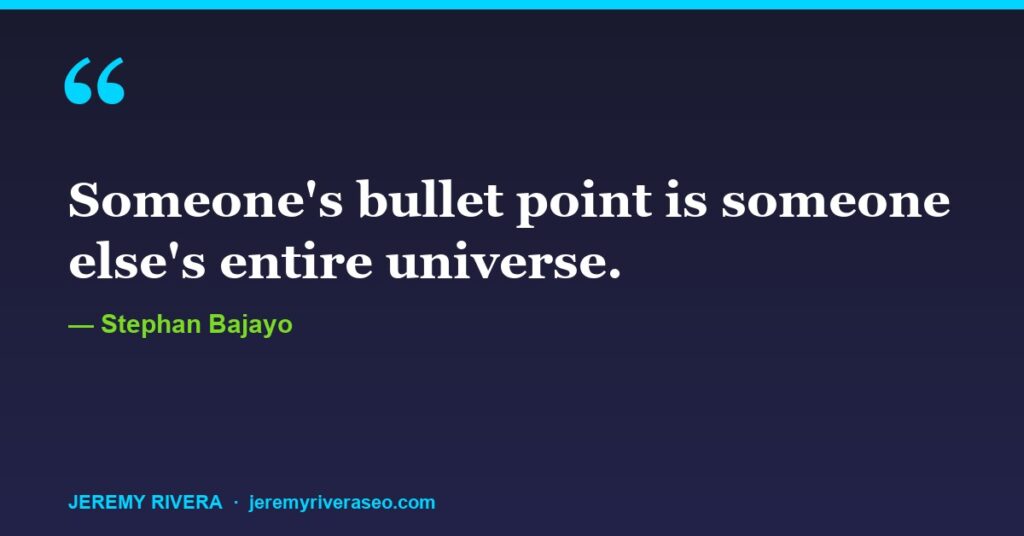
Someone’s bullet point is someone else’s universe
Depth without a reason is just word count, so the question becomes where to go deep. Stephan Bajayo, co-founder of Vibe Logic and one of the people who helped build the enterprise SEO industry, gave me the sharpest answer I have heard on this.
He told a story about a healthcare client whose coverage overview had a single bullet point: “divorce is a life change event.” One bullet. He turned that into an entire content brief, because for the person actually getting divorced that bullet is a wall of terror. Can I keep my spouse on my plan? For how long? What if we’re only separated? Does my employer have to know? Every one of those is a real question at a moment of real stress, and answering them builds trust no listicle ever will.
There is no rank in an LLM. You’ve been trained to believe that ranks. The real question is: what are you giving them to interpret?
— Stephan Bajayo
That reframing matters for the fourth reader specifically. People keep asking me how to rank in ChatGPT, and Stephan’s point is that the premise is broken. LLMs don’t rank, they interpret and synthesize. The lever you actually control is what you hand them to work with. Thin content gives them nothing to pull. The page that goes fully into someone’s bullet-point universe is the page that gets quoted back in an answer.
Write where the decision is forming
Stephan also makes the case to be where decisions are formed, not made. People form opinions on Reddit and inside long articles long before they ever hit a product page. That widens what counts as depth: it isn’t only your service pages, it’s the genuinely useful long-form content sitting where people are still making up their minds.
None of this is a reaction to AI breaking the rules. It is the same discipline I covered in my piece on search fundamentals, and the same lesson Grant Simmons hammered when we talked about what thirty years of SEO actually teaches you: be the most useful answer, structured so a machine can read it. If you want tools to pressure-test that structure, that’s most of what I build over at SEO Arcade. And if you’re a small business owner trying to apply this without a marketing team, the conversations on Unscripted Small Business and the local crew at the Digital Christian Collaborative here in Cookeville are where I see owners actually working through it.
What I do now
This is the same approach behind every audit and build I take on as an SEO consultant. When I draft a page, I write it long, I phrase every heading as a question a real person asks, and I find the one bullet point on the page that is somebody’s whole universe and I open it all the way up. The scanner still gets his four-second read. The deep reader gets her detail. Google gets its depth. And ChatGPT finally has something worth interpreting. Four readers, one page, no compromise.