🎧 Listen to the episode:
I’ll be honest: talking with Joshua Altman of Beltway Media changed my own opinion about the role of SEO. For most of my career I thought of myself as a lone gunman — head down, ranking pages, doing my own thing in my own lane. Joshua is a fractional Chief Communications Officer, and about ten minutes into our conversation I realized my lane was too narrow. I don’t need a lane. I need a bigger ecosystem.
Comms is the layer above SEO
Joshua’s whole worldview is omnidirectional: internal and external messaging, every channel, all of it pointed at one thing — trust. “Every purchase we make is a trust-based purchase,” he told me, “so we focus on that trust component as the primary driver.” Sitting across from that, my old identity as “just the SEO” felt small.
Here’s the thing I keep coming back to on this show: in the AI era, ranking isn’t engineered findability anymore — it’s consensus. The LLMs surface what the broader ecosystem says about you, which means SEO and PR have quietly become the same job. You can’t keyword-stuff your way into an AI recommendation any more than you can buy trust. That’s exactly the muscle a communications leader has been building all along, and it’s why I now believe authority is what other people say about you, not what you say about yourself.
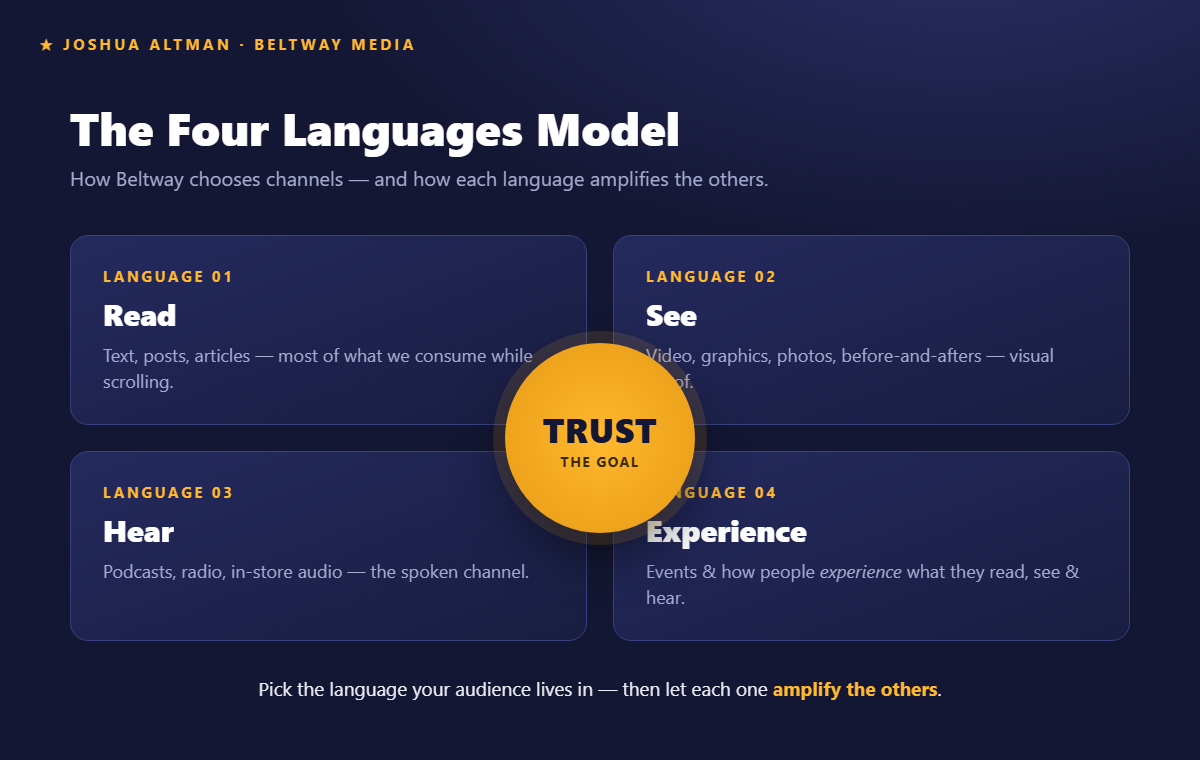
His framework for choosing channels is the Four Languages model — what people read, see, hear, and experience — and how each one amplifies the others. I grinned when he laid it out, because it’s a cousin of something I preach constantly: you’re never writing for one audience. You’re writing for the scanner, the reader, the machine, and the skeptic all at once. Pick the language your audience actually lives in, then let the others reinforce it.
The part that hit home: attribution is a fantasy
We got deep into measurement, and Joshua said the quiet part out loud: the buyer journey now takes 30-plus touchpoints across devices you will never connect. “That conversation you had with your spouse about it — that was an important part of that buyer journey. But we can’t measure that.” Chasing one-to-one cause and effect, he warned, “frequently leads to the opposite of the results people want, because you’re losing what builds up the buyer to make the decision.”
I’ve been beating this drum for a while — it’s the whole reason I argue you should measure SEO by revenue, not traffic. Traffic is a proxy. Trust is the thing. And when Joshua talked about Reddit backfiring the second a community smells inauthenticity, I thought about how much of the new citation map runs through Reddit and podcasts now — earned, not bought.
Bots are best at talking to bots
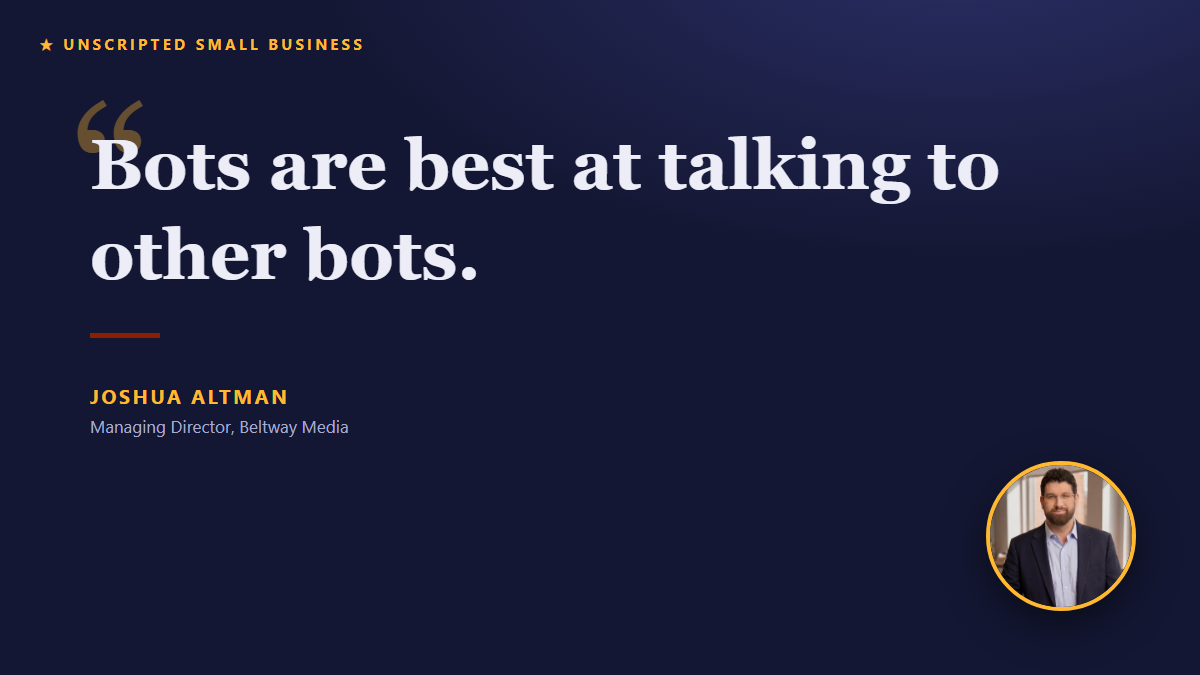
My favorite line of the whole conversation: “Bots are best at talking to other bots.” Joshua’s point is that you have two audiences — human and machine — and you should let a machine handle the machine-readable structure (keywords, metadata, schema) while people handle the brand and the bigger picture.
This is almost word-for-word my Human-to-Bot-to-Human sandwich: you’re not writing for a robot, and you’re not writing just for a person — you’re writing for a bot that will serve your content to a human. And in the agentic era it’s stretched into a Human–Bot–Bot chain, which is exactly what I got into when Christopher Gimmer and I talked about robots with wallets doing the buying. Joshua’s version is the practical field manual for it.
AI freed me to think bigger
I told Joshua how I’d used Claude Code the day before to mine years of my own podcast interviews and build a 60-tactic SEO library — who endorsed what, how to execute it — work that would’ve taken weeks a couple years ago. My other guest Adrian Nikolov called AI “the steroids SEO and digital marketers really needed,” and after my conversation with Adrian I’m convinced he’s right: the tools clear the janitorial work so we can finally play the bigger role. This is also why every interview I do is a link-building engine — the conversation is the asset, and AI just helps me multiply it across channels.
It gets granular fast: I’d just interviewed Ben from OpenSEO, and now I can turn those notes into a resource doc, a blog post, or a quote graphic — then push it live through an MCP that cross-posts once I approve it. The friction kind of just goes away.
The rule I’m keeping
Joshua’s closing line is the one I’m taping to the wall: “Everything you produce should be useful. An ad that’s just a billboard doesn’t help anyone.” That’s the Digital Shadow in one sentence — your online presence is the shadow of a real company doing real, useful things. The shadow follows the substance. Publish the DIY tip. Answer the real question. Give people a reason to discover and trust you, and the rankings take care of themselves.
Meet Joshua: Beltway.media · free tools & quizzes · LinkedIn. Heard on the Unscripted podcast.