I have sat through enough sales calls this year to spot the pattern: an agency adds two letters to its deck, calls it AEO, and keeps doing the exact same keyword work it has always done. That instinct is going to leave a lot of businesses invisible, and two of my recent Unscripted guests said so plainly.
The same channel fallacy
Brittany Trafis founded an AI-native agency after spending a decade running strategy inside a major shop, and she built it by asking what a marketing agency should look like if it started from AI rather than bolting AI onto old workflows. Her core warning is the one I keep repeating to clients who think a sitemap and some FAQ schema buys them a seat in ChatGPT.
AI search is not SEO 2.0. If you keep treating it like just keywords and rankings, you’ll get keywords and rankings — in Google. If you’re trying to show up in ChatGPT and Claude and Perplexity, you’re not going to see it.
— Brittany Trafis
Her analogy landed for me: you wouldn’t run Facebook ads using Google ad logic when Facebook launched. Same channel mistake, new decade. Keywords, links, and clean structure are still the base layer. They are not the strategy. I unpacked more of that distinction in my notes on how AI search and GEO actually work, but the short version is that retrieval and recommendation behave nothing like a ranked list of ten blue links.
Get found, get chosen, get paid
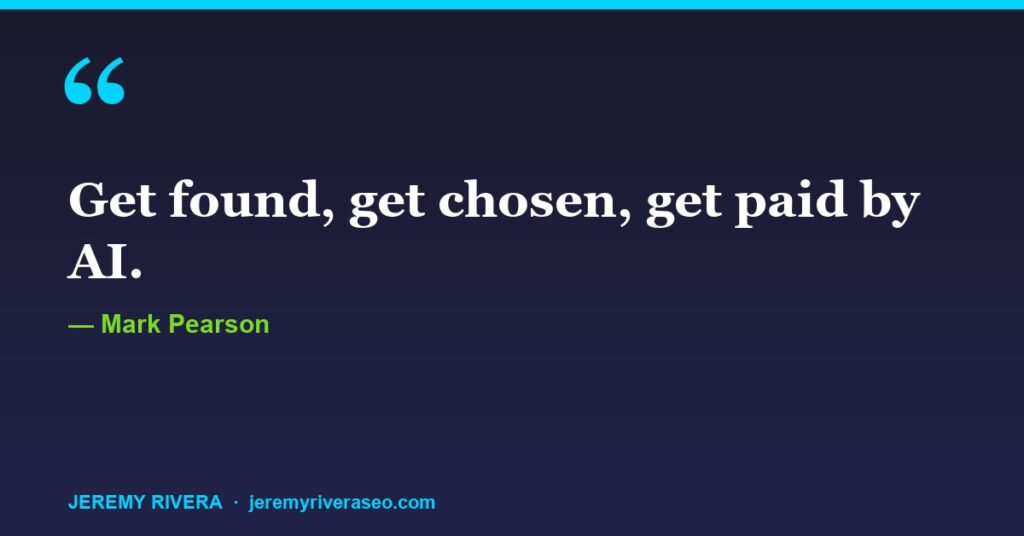
Mark Pearson, who I talked with for Unscripted Small Business, has narrowed his whole consultancy down to two things small businesses are about to need badly: getting found by AI and getting paid by AI. His framing is the cleanest funnel I’ve heard for this shift.
SEO has graduated into the agentic world. AEO is an evolution of SEO. And as you do really good SEO, you are doing AEO.
— Mark Pearson
That sounds like it contradicts Brittany, but it doesn’t. Mark’s point is that the foundation carries forward while a brand-new sales channel opens on top of it. With the Stripe and OpenAI partnership and Google’s competing protocol, AI agents now hold a wallet and can complete a purchase agent-to-agent. It is live first at the enterprise layer (Home Depot, Lowe’s, Etsy, Wayfair) and rolling downhill toward the contractor and the chiropractor. His prediction for where the real volume lands is unglamorous and probably right: routine B2B reorders that agents handle on a schedule.
Productize the service so an agent can read it
The practical work Mark describes is turning fuzzy services into agent-readable catalogs. A chiropractor sells a ten-pack on Shopify. A paving contractor assigns SKUs and schema to driveways, sidewalks, and pavers, with the descriptors that matter like plow-rated weight. The agent strips out the human fluff and reads the structured data. That forces the engineering and marketing roles together even in a one-person shop, and it is exactly the muscle Patrick Stox and I dug into when we talked about building for the GEO era.
Recency is the new authority signal
Both guests circled the same trust mechanic from different directions. Brittany’s team watches AI agents crawl freshly published content within hours while Google still takes six to eight weeks to recognize a change, and roughly half of what LLMs serve is less than thirteen weeks old. Mark put the consequence bluntly.
Because Gemini, GPT, and Perplexity each run their own retrieval logic, you want accurate signals spread across many surfaces (your site, Reddit, YouTube, reviews) so the models cross-reference and trust you. A counter QR code that drives fresh reviews, consistent blogging, recent citations that actually name and link the brand. That citation discipline is the same reason I keep pushing the Bing side of the house. The engine that now feeds ChatGPT rewards exactly this behavior, which I laid out in the Bing playbook I actually use.
Why the small business is the favorite here
This is the part I want every owner reading this to sit with. AI search reset a competition that was rigged for years by budget, domain authority, and link equity. Brittany has watched brands spending a quarter of a competitor’s ad budget show up with higher AI presence, because they move faster and structure their content better. She is also blunt about how to vet whoever you hire.
If your agency tells you they have AEO covered, lean in and ask three questions deeper. You will usually find they are just doing SEO with a new label. The businesses that win this window are the ones that treat agentic visibility as its own channel, get specific about their services, and stay recent. I see this energy in person at the Digital Christian Collaborative here in Cookeville, where small operators are moving on this faster than any enterprise marketing committee ever will.
What I’d do Monday morning
Stop measuring AEO by your Google rankings. Productize your top three services into clean, structured, agent-readable units. Publish something real every week so the recency signal stays warm, and get cited across more than one surface. Then verify it the only honest way available right now, which is watching for actual AI referral traffic landing on your site. If you want the conversations behind all of this, they live on Unscripted SEO. The starting line is open, and it will not stay level for long.