My eight-year-old son sometimes says “I’m stupid” right after he makes a mistake. I thought I had a good answer for that. I’d tell him I don’t think he’s stupid, he just made a mistake, and that’s not who he is. Then I said it out loud to Anil Gupta on Unscripted Small Business, and he asked if he could coach me.
Anil is a relationship coach who goes by The Love Doctor. In thirty minutes he gave me better words for a few things I say at home, and a sharper way to think about how I talk to clients. Here’s what I took from him, and what you can borrow.
You can watch the full episode or listen on Castos.
“I think you’re not stupid” isn’t the same as knowing it
Anil caught the soft spot in my answer right away. I’d said I think he isn’t stupid. His version:
“I know you are not stupid. You just did a stupid thing. And I do stupid things all the time, but that doesn’t make me stupid.”
Then you point at proof, he says. Remind the kid of times they were smart, because it changes focus. “And you gotta be certain.” A hedge gives the label room to stay.
The same trap shows up in client reports. When you write we think the update may have affected rankings, the client hears doubt about you, not about Google. Be certain where you’ve earned it, and say plainly where you haven’t.
My job is pattern-matching, and so is everyone’s
I told Anil that in SEO it’s literally my job to look at a black box of inputs and outputs and work out what’s happening in between. He’d say we all do that, all day, with no data. “As human beings, we’re meaning making machines.”
His example: “My wife doesn’t call me back. I make it mean she doesn’t love me.” What actually happened? “All that happened was she ran out of battery on a phone.”
If you freelance, you’ve probably done this with a client. They go quiet for a week, and you decide they’re unhappy and shopping for a new agency. Often they’re just on vacation. Anil’s rule is the one I need taped to my monitor: “Look at things as they are, not what they mean.” If you freelance, you know the spiral. Dr. John A. King and I talked about the quieter stress responses that drive it in freeze, appease and the yes man.
Anil’s bigger claim is “languaging is everything.” The words you repeat about yourself and other people start doing your thinking for you. “Keep away from labels.” That’s his coaching view, and it’s a useful one to test on your own vocabulary for a week.
The right shoulder rule is the one I’m keeping
Anil asked me whether I’d rip off my right shoulder and give it to him if he asked. Obviously not. “It’s a rule that you have, it’s a good rule, keep it. What if you had the same rule for your happiness? Under no circumstances will I give my happiness away.”
If you run a consulting business, you give yours away constantly. A core update lands. A client sends a sharp email at 9pm. Someone on social says SEO is dead again. Anil’s list was more ordinary – “you miss the bus, you missed the train, you didn’t get that promotion” – but the move is the same: “we give it up because we’re so good at it, because we practice it.”
His alternative is a picture I can’t shake: “I’m gonna be this nonstick frying pan spray. Nothing’s gonna stick.” And when a reply is needed, “instead of reacting, respond.” If a client relationship is fraying, Andre Savoie’s take on what the happiest marketing clients do differently is a good check on which side of the table the problem’s on.
You don’t need the other person to forgive them
I’ve heard bitterness described as drinking poison to harm somebody else, and I said so on the show. Anil’s version is a house. You’d never let a guest stay who started trashing your dream house. “You see, the most expensive real estate in the world is between your ears.”
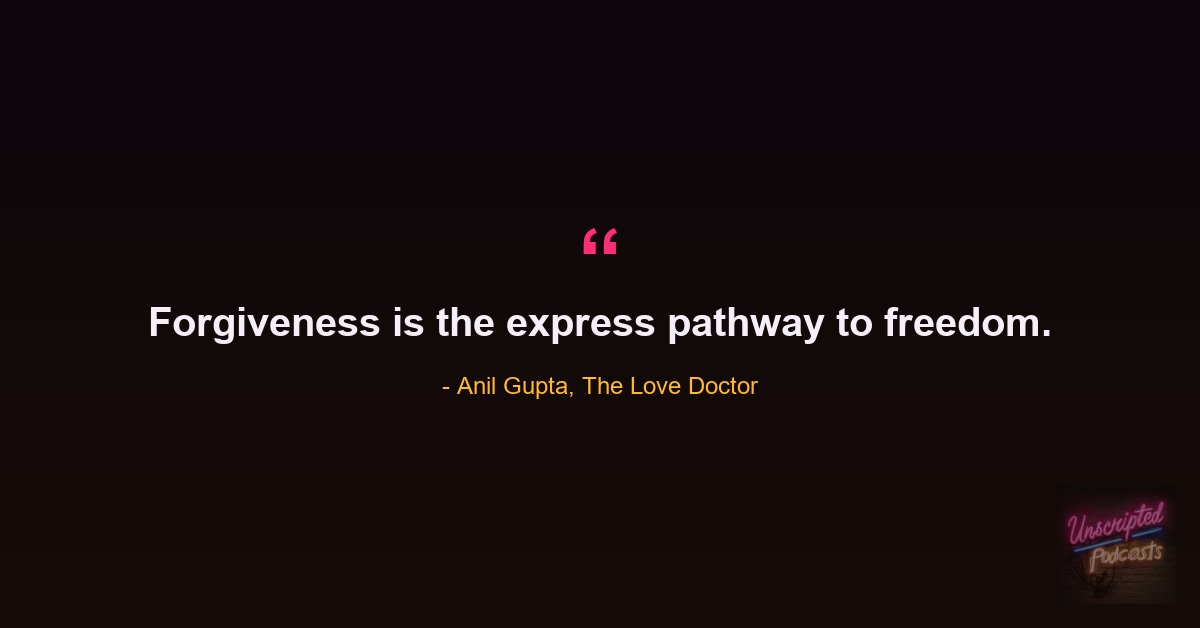
What surprised me was this part: “the beautiful thing is you never need to have that conversation with the other person.” Forgiving, in his view, isn’t letting them off. “It doesn’t mean that you’re letting them get away with it, it’s just that you’re not giving them your power.”
Run a business long enough and you collect a few grudges: a former partner, a client who never paid. They probably don’t know or care that you’re still carrying it. If you’ve got your own list, his line is the permission slip: “Today’s freedom day. Today’s forgiveness day.”
The question Anil told me to ask my wife
We’ve been married twenty years, and neither of us is the person we were at the start. I asked Anil how couples adjust. He said it’s very easy to get comfortable, and gave me one question:
“Honey, what can I do to make you feel even more loved?”
Then keep asking “What else can I do?” Then ask what makes her feel respected, and let her ask you both. He also said something that stung a little: “And remember the stuff you used to do, Jeremy, that you haven’t done for a while. That would rekindle so much.”
He thinks a lot of marriages strain because the kids become the number one priority. “But if you continue to make your partner your number one priority, they will always feel loved and respected.” With two kids at home, that one hit close.
What I’m taking from Anil
- Say I know, not I think. With your kids, and with your clients, when you’ve earned it.
- Stop making meaning out of silence. Look at things as they are, not what they mean.
- Keep the right shoulder rule. Handle the bad email. Don’t hand it the rest of your day.
- Forgive without the meeting. You don’t need the other person in the room.
- Ask the question at home. What can I do to make you feel even more loved?
Anil’s one sentence for everybody was “Be so amazing that you cannot be ignored.” His closing challenge was smaller and harder to dodge: “So today, just perform five acts of random kindness. Notice how you feel.” So go do five today. For the full episode recap, read Anil Gupta on forgiveness, language and love on Unscripted Small Business, and for the marketing angle, why your customers are meaning-making machines on SEO Arcade. You can find Anil at meetanil.com, including his book Immediate Happiness.
This post shares Anil Gupta’s views and coaching approach from the episode. It is not medical or mental health advice.
This episode is supported by our sponsors: uSERP, a GEO agency that helps brands get found in AI search, Oleno, which gives a whole team the same shared context so everyone uses AI the same way, and ClearLead Digital, a marketing agency for property management companies.
Sponsor disclosure: uSERP, Oleno and ClearLead Digital are paid sponsors of the Unscripted podcast network. Links to them are marked as sponsored.