Two of my recent guests on the small business show gave me the same advice from completely different industries, and I have started repeating it to every client who will sit still long enough to hear it: stop trying to please everybody. It is the single most expensive mistake I watch business owners make, and it almost always wears the costume of being reasonable.
You cannot serve everyone, so quit pretending you can
Paul Pape has spent more than twenty years as a freelance artist and fabricator, and he now runs a consulting framework called Gamify Business that turns a stuck owner’s real obstacles into a tabletop campaign. When I asked him for his bluntest hot take, he did not flinch.
Stop trying to please everybody. Stop it. Knock it off. As soon as you try to appeal to everyone, you gray yourself out. Stay true to the passion that you have and the customers you are imploring to are going to be like super fans.
— Paul Pape
Gray yourself out. I have not been able to shake that phrase. When you widen your message to catch everyone, you sand off the specific edges that made anyone choose you in the first place. Paul says he can walk into any business and diagnose this in about ten seconds by looking at what they advertise. The grayed-out ones are advertising to nobody in particular, which means they are advertising to no one. If you have read about the interview where Paul turned the tables on me mid-conversation, you already know he does not deal in soft generalities.
Ride the dragon of passion
The natural instinct when sales feel slow is to branch out. Add a service. Chase another category. Say yes to a customer who was never yours to begin with. Paul has a framework for why that backfires, and it is the most memorable thing he said all episode.
Fame and fortune, he told me, are two dragons that are very fast. The only way to catch them by chasing directly is to strip away everything you are in order to move as fast as they do, and by the time you catch them you are no longer the person who wanted them. So you do not chase those two. You ride the dragon you can actually mount.
Ride the dragon of passion. Find the thing that you were really passionate about in the first place and just hang on to that. Because everything branches off of that. Fame and fortune are two dragons that are very fast — the only way to catch them is to strip away everything that you are. Ride passion instead, and the dragons of fame and fortune follow behind you.
— Paul Pape
This is not a motivational poster for him. It is a business diagnosis. The owners who try to please everyone are the same owners who have stopped riding their passion dragon and started sprinting after fame and money on foot. They gray out, and then they wonder why the work stopped feeling like theirs.
The rule of 100
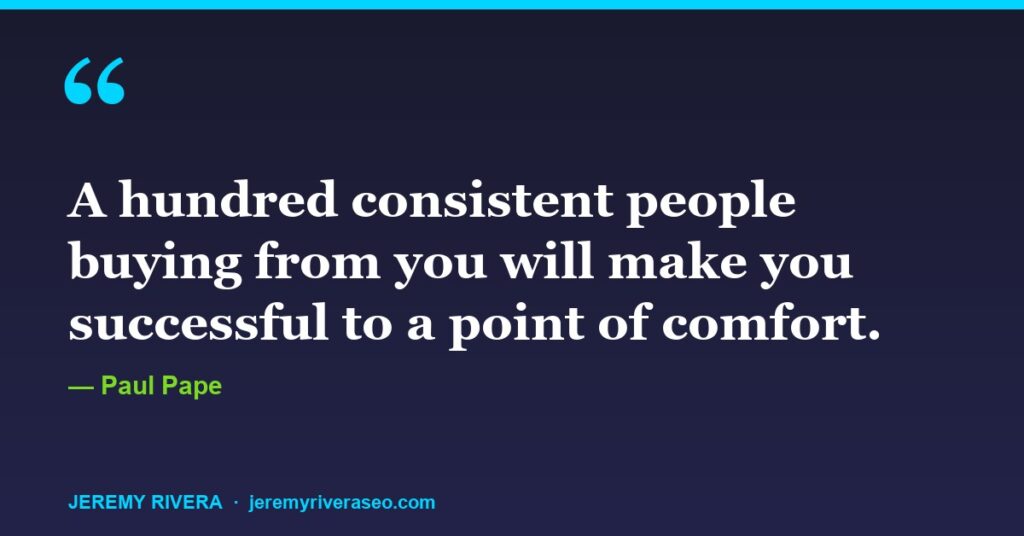
Here is the part that should take the pressure off. Paul does not believe you need to scale to be successful, and he has a number for it: a hundred. A hundred consistent customers is enough to build a comfortable, durable business. A mom-and-pop shop serving fifty to a hundred people a day can run for eighty years, and a sudden flood of a million customers would destroy it, not save it.
I lived the other version of this. I watched Raven Tools run as a profitable lifestyle business where the founder once paid out of pocket for an employee’s wife’s surgery, then get acquired and slowly hollowed out until nothing was left but the software. Scale is not free. It quietly trades the thing that made the business good for a bigger number. If you serve a local market, my notes on how small local businesses actually win lean on this same idea. A hundred of the right people beats a million strangers, and a lot of that trust gets built away from the keyboard, which is the whole argument behind why the best SEO you can do often happens offline.
The customer is not always right
Marc Pitts has run DiscountVapePen.com for more than a decade, in an industry where paid advertising was shut off on every major platform and a YouTube channel with millions of views got terminated overnight. He has no patience for the slogan most owners treat as scripture.
The customer is always right was one of the biggest lies of our lifetime. People will tell you that your shirt is blue — it’s yellow. It’s amazing.
— Marc Pitts
Friendly fraud, manufactured entitlement, the customer who insists on a reality that is not true. Marc is not being cynical. He is pointing out that bending your entire operation to please every complaint is the same disease as trying to please every prospect. It grays you out from the back end. He addresses it with structure instead, like a free-shipping threshold that protects his margins rather than caving to Amazon-trained expectations.
Just get started, then learn everything
Marc left a university marketing program that was still teaching billboards and TV while he was trying to learn the internet. He taught himself HTML and SEO because hiring it out was not an option, and that constraint became the engine of the whole business.
His SEO breakthrough came after years of writing conversationally and then rebuilding everything around structure, headers, and proper formatting. The growth that followed was exponential. It is the same human-to-bot-to-human reality I cover over at the Unscripted SEO podcast and put to work with the tools at SEO Arcade: you write for the machine that hands your words to a person, so structure is not optional.
But the advice he wanted to leave with younger owners was simpler. Do not wait until you understand everything. You never will from reading.
That is the through line between both guests. Niche down hard enough to have real fans, ride the passion that started the thing, settle for a hundred loyal customers instead of a faceless million, refuse to let the customer-is-always-right myth run your shop, and start before you feel ready. I get to have these conversations every week on Unscripted Small Business, and I see the same lesson land in person with the founders at the Digital Christian Collaborative here in Cookeville. Pick your hundred. Stay true to the thing you actually care about. The dragons follow behind you, not the other way around.