At one job I had, there was a solid week where, from eight o’clock until lunch, eight people in our office, eight people in Boston and eight people in California were all on one meeting. We took lunch together on the call. Then we ran another three hours. I told Alfred Poor about it on Unscripted Small Business: “literally no work that wasn’t in the meeting was getting done by 24 people all at once.”
Alfred spent over 20 years writing for PC Magazine, works as a professional speaker and startup mentor, and founded The 75 Percent Solution to help leaders come across better in online meetings. His diagnosis of my lost week took one sentence: “Don’t do things by default, do them on purpose.” We recorded this in March 2025, and if you run a team or a client roster over video, you’ll probably recognize your own calendar in it.
This meeting could have been a memo, and that’s a respect problem
I asked Alfred how you lead remotely without replacing everyone’s actual work with being on a meeting. He started with an old saying: give a kid a hammer and the whole world looks like a nail. “Just because we have this technology doesn’t mean you have to use it.”
The first call he helps clients make is synchronous or asynchronous. Does everyone need to be there at the same time, or would email or Slack do the job? “If you don’t need to have it right away, then maybe there are other ways.” Then the old joke: this meeting could have been a memo.
What stuck with me is the reason he gives. It isn’t efficiency. It’s “a place of respecting the time and energy of the other people.” When Alfred steps on stage as a speaker, the audience has agreed to give him their time, and he owes them something better than what they’d have done otherwise. Owners and managers, he said, tend to ask what’s most efficient for themselves instead. His test is to put yourself in the other person’s shoes: “how’s this gonna impact them? And is this the best use of their time?”
Apply that to the 24-person week and it fails before lunch on Monday. Alfred allowed that sometimes a big meeting really is the right path. “But don’t do it just because that’s what we do on Tuesdays.”
Forcing cameras on tells your team you don’t trust them
Alfred has a pet peeve about managers who want everyone’s camera on so they can check whether people are paying attention. “What does that tell the other people about your level of trust in them?” If you want to keep your best people, he said, opening with “this is third grade and I don’t trust you” is probably not where you want to start.
His alternative is to ask “what’s the goal of the meeting?” and then look at how the information flows. That’s where he pushed back on me a little.
Information flow beat my three meeting categories
I offered my own three kinds of meeting: a broadcast, like a CEO’s quarterly update; a dialogue where two people trade information back and forth; and an open brainstorm where anybody can raise a hand. I asked if there were others.
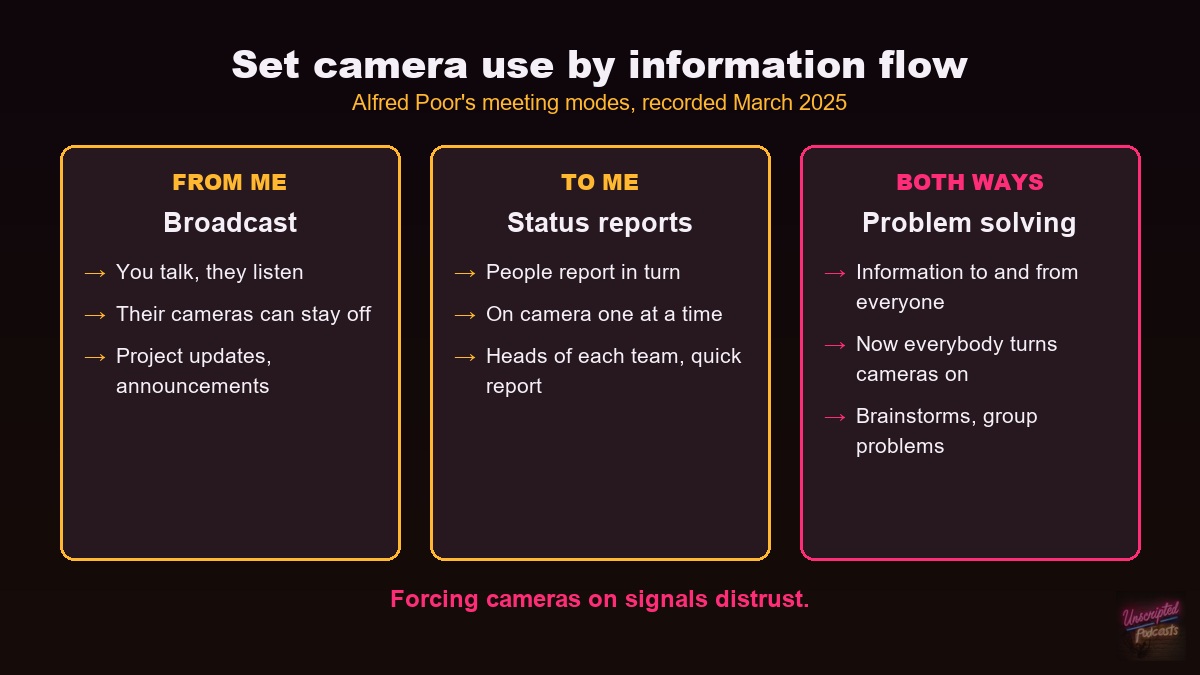
Alfred reframed it. He breaks meetings down by “how the information is flowing”:
- From you to the meeting. You talk, they listen, and they don’t need cameras on.
- From the meeting to you. Status reports, with people on camera one at a time.
- Both directions. Problem solving, where you want everyone’s input and everyone on camera.
His version is better than mine because it tells you what to do with the cameras. Mine only named the meetings. He also pointed out that one agenda can hold all three: “here’s where things stand on this project,” then a quick report from each team head, then “now everybody please turn your cameras on, because this is a problem we need to solve.” The goal is “meetings that people want to attend.”
Digital aristocracy and the meetings we inherit
When I asked what meeting advice has survived since the boardroom of the 1960s, Alfred said “being intentional and not just walking in and winging it.” He described the best boss he ever had, who was at his desk before Alfred arrived early and still there when he stayed late. “I never felt that he was asking me to do more than he was willing to do.”
I’ve seen the opposite in corporate jobs. It becomes “a game of you just do this because this is how we do it,” without any further thought, and more and more disrespect for the worker. I called it “almost a digital aristocracy.” Alfred called it fraternity hazing: I went through this, so you have to. There are probably fewer than five people in the world, he said, who could tell him “I need you on a meeting” and get him there without question.
His fix is a reminder that this is a skill. “You’re not born knowing how to run meetings.” Sitting in meetings for a whole career doesn’t teach you to run one, and “nobody’s born knowing how to lead” either. Barry Moline made a similar case to me about leadership in be the host, not the hero, and Zeke Camusio’s habit of recording calls, in record every meeting, is one way to make the meetings you keep pay for themselves.
A default is a choice: auditing your meetings with the three I’s
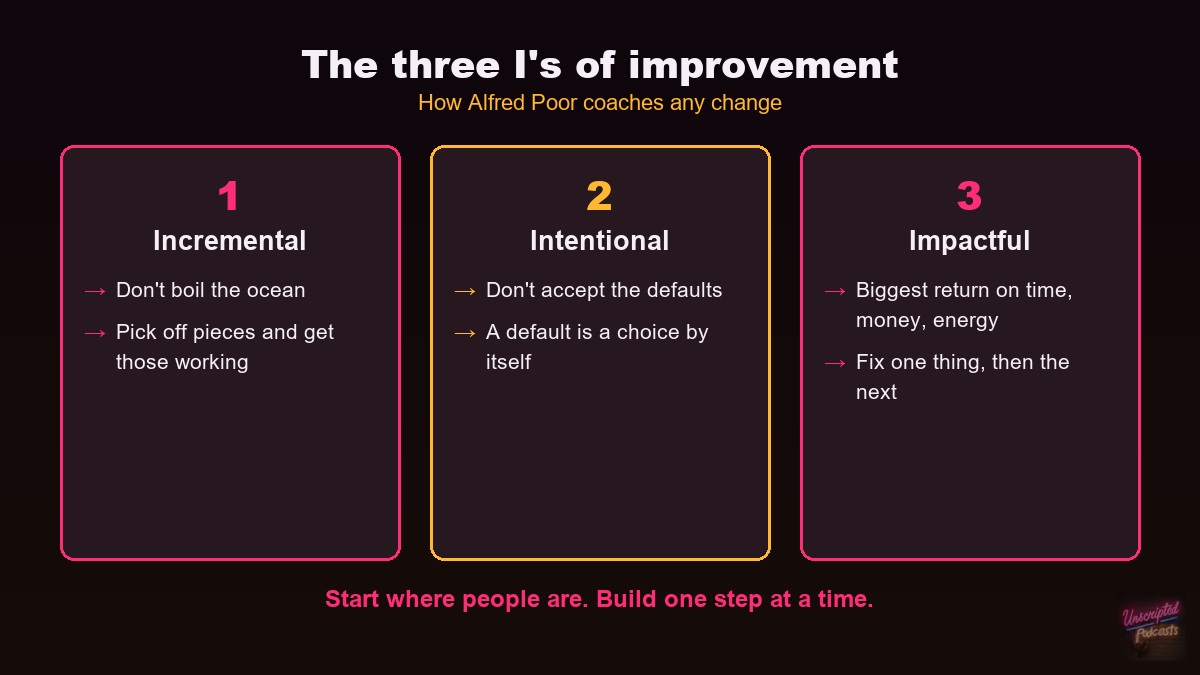
Alfred closed with what he calls his three I’s of improvement. Changes should be “incremental, that are intentional, and that are impactful.” He uses it for how people come across on video, but he said it applies to any change you want to make.
“A default is a choice by itself. You’re choosing not to change it.”
That line is the one I’d hang over every recurring calendar invite. Here’s how I’d run his three I’s on a meeting-heavy week. The steps are my judgement, built on his framing:
- Incremental: pick one recurring meeting, not the whole calendar. “Don’t boil the ocean.”
- Intentional: name its flow. Broadcast, report or problem solving. If it’s a broadcast, try it as a memo or a recording for a month.
- Impactful: start with the most expensive one. The meeting with the most people on it for the longest time gives back the most hours.
- Set the camera rule to match, and say it in the invite so nobody has to guess.
- Then pick the next one. “Pick one thing, fix the one thing that’s going to have the biggest impact, and then choose the next thing and the next thing.”
The full episode recap is Alfred Poor on video meetings: be seen, be heard, lose the background on Unscripted Small Business, and the marketing angle is on SEO Arcade: your video call is a brand touchpoint. You can find Alfred at the75percent.com and alfredpoor.com, and on LinkedIn. If you connect there, he asked that you mention the Unscripted Podcast.
This episode is supported by our sponsor OppAlerts, a database of daily link and mention opportunities.
Sponsor disclosure: OppAlerts is a paid sponsor of the Unscripted podcast network. Links to it are marked as sponsored. Alfred Poor has no connection to it.